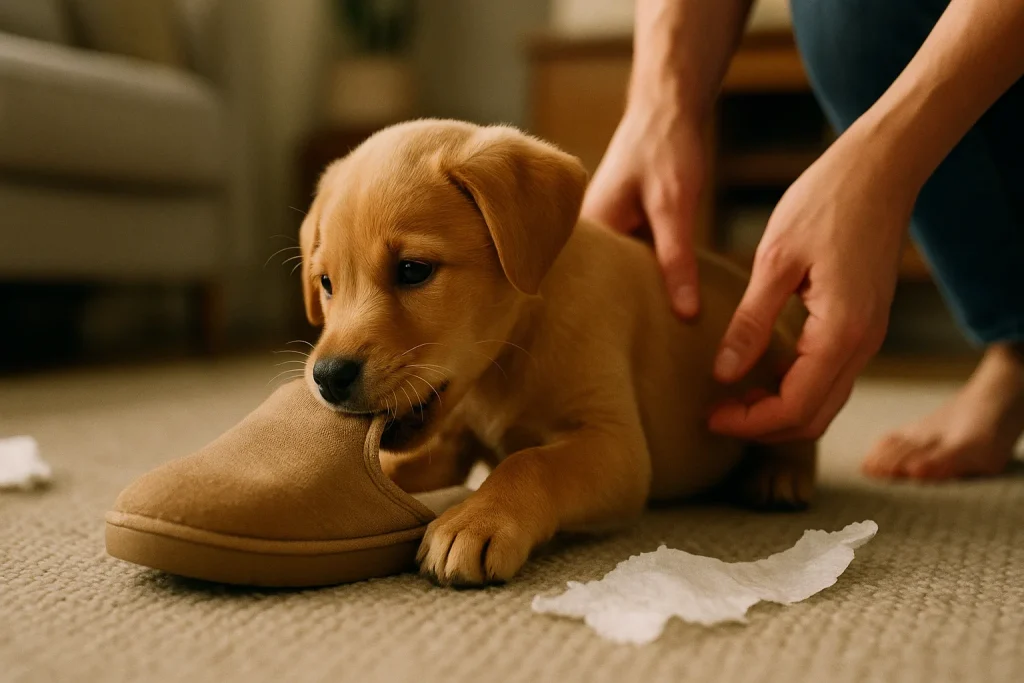
It’s the moment that can stop a first-time owner cold: your puppy has something valuable, you move a hand closer, and a growl rolls out. The first decision is simple but important: do not treat the growl like defiance. Treat it like a signal that the situation has become too hard right now. Staying positive does not mean brushing it off. It means pausing, lowering pressure, and choosing the next move that keeps everyone safe.
If you only remember one thing, remember this: a growl is information. The job is not to punish it out of your puppy or force a win in the moment. The job is to figure out what set it off, make the setup easier, and teach a response that works better.
Read the Trigger Before You React
Start with the part of the scene that changed right before the growl. Was it your hand reaching for a toy, a bowl, a chew, or the puppy’s body? Was the puppy already tired, cornered, or busy with something especially valuable? That detail matters more than the growl itself, because it tells you what kind of situation your puppy finds hardest.
A useful way to sort it is this: is this a one-off reaction in a very specific moment, or does it happen in the same kind of setup again and again? Repeated growling around food, toys, resting spots, grooming, or handling usually means the environment or the interaction is too difficult for your puppy yet. A random growl in a noisy, unfamiliar moment may simply mean the puppy was overwhelmed.
The next move depends on that reading. If the puppy cannot disengage, cannot recover, or keeps stiffening when you repeat the same setup, stop trying to “push through.” That is your signal to make the situation easier.
Make the Situation Easier First
The fastest way to stay positive is to lower the difficulty before you ask for anything else. That may mean stepping back, removing extra people, ending rough play, changing rooms, or stopping a hand reach over a valued item.
For a puppy who growls when you take away a toy or chew, do not keep repeating the same removal. Instead, prevent the confrontation while you reset the setup. Feed in a quieter space, trade before the item becomes a problem, or use management so the puppy is not rehearsing the same upset over and over.
For a puppy who growls when touched, grooming, or moved, the easier starting point is gentler contact in a calmer moment, not the same touch at the same intensity. You are looking for a version of the situation where the puppy can stay loose, accept the interaction, and recover quickly.
This is not avoiding the problem forever. It is choosing a starting point the puppy can actually learn from.
Use the Growl as a Boundary, Not a Fight
A growl usually means the puppy is saying, “That is too much.” Your response should answer that message, not challenge it.
So if you ask, “Is it okay to ignore growling?” the practical answer is no. Ignore the drama, yes. Ignore the warning sign, no. If you continue reaching, taking, or holding on after the puppy growls, you often make the next response stronger, not weaker.
Should you punish your puppy for growling? No. Punishment can suppress the warning without solving the cause, which leaves you with less information the next time and a puppy that may skip straight to a more intense response. A calm owner response works better: pause, create space, and reset.
That does not mean you give the puppy whatever he wants. It means you stop the conflict long enough to teach a better pattern.
Teach an Easier Alternative to the Growl
Once the puppy can stay calm in a simpler setup, show him what you want instead of the growl-triggered standoff.
For a toy or food issue, a swap can be the first workable skill. The idea is simple: your approach predicts something better, and the original item is not lost forever. The puppy learns that moving away, releasing an item, or turning toward you can lead to a good outcome.
Keep this part short and clean. If the puppy is stiff, staring, or clamping harder, the step is too difficult. Go back to an easier version of the setup and make the reward arrive sooner. If the puppy succeeds, keep the repetition brief so the session ends while the experience still feels easy.
This is also where many owners lose confidence. They wait too long to reward, or they ask for too much too soon. If that happens, simplify. A calmer owner usually gets a calmer puppy.
Decide What the Growl Means in the Moment
Not every growl asks for the same next move, so your decision should be based on what you can see.
If the puppy growls once, loosens when you stop, and can still take treats or move away normally, you are probably seeing a boundary that needs a smaller step, not a bigger confrontation. Pause, reduce the difficulty, and try again later in a simpler version.
If the puppy growls, freezes, guards more tightly, refuses food, or seems unable to recover, the situation has moved out of the learning zone. Stop the session. Management is the better response there than continued training.
If the growling happens only when the puppy is playing and the body looks loose, the sound may still be part of excitement rather than threat—but you should still watch the whole picture. Loose movement, normal recovery, and easy disengagement matter more than the sound alone. If the body is stiff or the puppy cannot back off, treat it as serious.
That distinction matters because the next action changes. A loose, short growl may call for a calmer setup. A tense, repeated growl calls for distance and a reset.
Stay Calm When the Growl Scares You
Many first-time owners struggle here more than anywhere else. The growl feels personal, sharp, and sudden. Your job is not to feel fearless. Your job is to keep your hands and voice steady enough to avoid making the moment worse.
A simple pattern helps: stop moving, breathe out, and decide whether to step back or remove the trigger. Do not hover. Do not lecture. Do not keep reaching because you want to prove the puppy should tolerate it.
If you feel yourself getting shaky, shorten the interaction. That is not weakness; it is good handling. A worried owner often lengthens the problem by trying to “fix it right now.” A calmer owner reduces pressure first and solves the pattern later.
If you need a practical reset for the whole day, manage the environment more aggressively for a while. Fewer chances to fail usually help both sides settle down.
Know When the Pattern Is Getting Worse
What if the growling gets worse or more frequent? That is a sign to slow down and look for what changed.
Ask whether the puppy is more tired, more sore, more frustrated, or facing a harder setup than before. A puppy that was fine yesterday and is suddenly guarding more today may need simpler handling, a break from the trigger, or a health check if pain seems possible.
If the growling starts spreading to new situations, becomes more intense, or is joined by snapping, biting, hiding, or a strong inability to recover, stop trying to solve it by repetition alone. That is the point where the problem may be bigger than ordinary first-time owner troubleshooting.
In that case, use safety management and get qualified help. A trainer or behavior professional can observe the timing and body language in person, and a veterinarian can help if pain, injury, or another medical issue might be involved.
The rule is not “wait until it gets bad.” The rule is “change course when the same plan keeps creating the same distress.”
Keep the Response Simple, Then Build Slowly
Once the puppy can handle a easier version of the situation, build one small step at a time. Change only one thing: distance, value of the item, handling intensity, room activity, or duration.
If the puppy stays loose and recovers quickly, that is your sign to stay at that level a little longer before asking for more. If the puppy stiffens or the growl returns, back up. Progress is not measured by how fast you get there. It is measured by whether the puppy can stay safe, calm, and learnable.
That is the core of staying positive. You are not forcing optimism over a bad moment. You are reading the moment accurately, making it easier, and choosing the next move from what the puppy actually shows you.