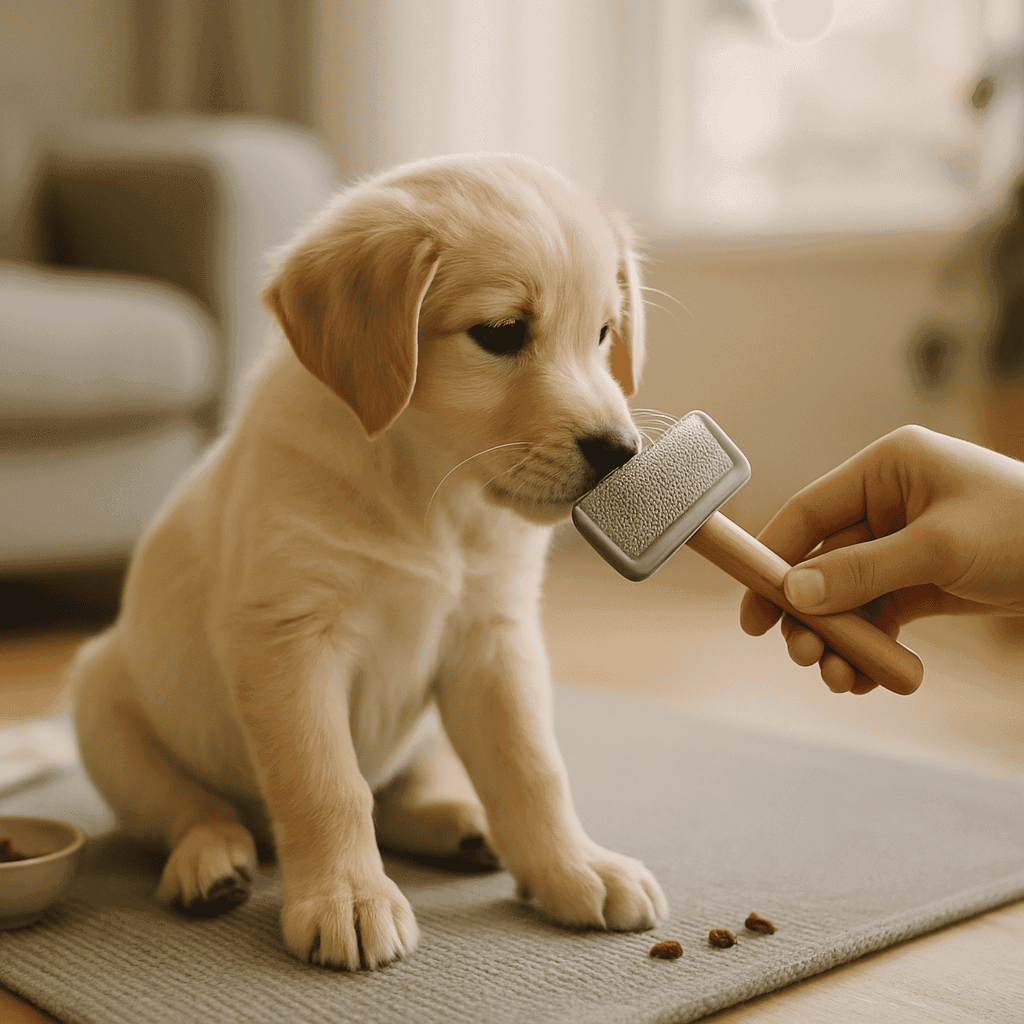
You bring out the brush, and your Goldendoodle puppy instantly acts like you’ve announced a tiny disaster. He may squirm, back away, hide, mouth the brush, or try to wriggle out of your hands. That reaction can feel frustrating, but it is also useful information: something about the brushing setup is too intense, too unfamiliar, or too uncomfortable for him right now.
The goal is not to overpower him into compliance. The goal is to make brushing predictable, low-pressure, and worth tolerating. For a Goldendoodle, that matters because the coat can mat quickly, and brushing is part of normal care. The good news is that most puppies can learn to accept it gradually when you break the routine into smaller pieces and pay attention to what your puppy is telling you.
This article gives you a practical plan. First, you’ll prepare the environment and rule out avoidable problems. Then you’ll start at the easiest possible stage, use a simple timeline to decide whether to continue or back up, and adjust one thing at a time when your puppy’s response changes. If your puppy’s reaction suggests pain or a serious red flag, you’ll know when to stop and get qualified help.
Prepare for the Routine
Before you try another brushing session, pause and check the setup. A lot of brushing struggles are made worse by timing, noise, bad tools, or missing preparation. If you skip straight to the brush when your puppy is already excited, tired, trapped, or uncomfortable, the problem can snowball.
Start with the basics:
- Pick a calm time of day when your puppy is not zooming, hungry, or overtired.
- Choose a quiet spot with fewer distractions.
- Make sure you have treats ready before the brush appears.
- Use a stable surface so your puppy does not feel like he might slip.
- Decide in advance what you will do if your puppy becomes upset.
Safety note: If your puppy yelps, snaps, freezes, or repeatedly pulls away from a certain area, stop and check for a mat, sore spot, or other physical reason before you try again. Brushing over pain will make the fear stronger. If you suspect injury, skin irritation, or another health issue, call your veterinarian instead of trying to push through it.
A good brushing session is not just “have brush, then brush dog.” It is more like: calm puppy, prepared person, gentle tool, and a short plan that can end early without becoming a battle.
Here is a simple readiness check you can use before each session:
| Readiness check | Ready | Not ready |
|---|---|---|
| Puppy mood | Calm enough to eat treats | Overexcited, panicked, or exhausted |
| Environment | Quiet and steady | Busy, slippery, or noisy |
| Tool | Gentle brush that does not tug | Harsh brush or unknown tool |
| Treats | Already broken into tiny pieces | No reinforcement ready |
| Your plan | Short and simple | Trying to finish the whole coat today |
If more than one item is “not ready,” delay the session or simplify it. Even a 30-second practice where the brush is just present can be more productive than forcing a full grooming attempt.
What to Expect at the Start
The first stage is often about changing the feeling of brushing, not actually brushing much at all. If your Goldendoodle puppy hates being brushed, the early goal is to help him stay calm while the brush is nearby.
A realistic first session might look like this:
- Sit on the floor with your puppy.
- Put the brush where he can see it.
- Reward calm behavior.
- Let him sniff the brush if he wants to.
- End the session before he becomes overwhelmed.
That may sound too small to matter, but it matters because you are teaching his nervous system that the brush does not automatically predict discomfort.
At the start, watch for the difference between normal adjustment and a sign the plan is failing. Some puppies may glance at the brush, sniff it, or pause for a second before taking a treat. That is okay. What is less okay is repeated backing away, trying to escape, intense barking, stiff body language, or refusing treats that he would normally take.
If he shows stress, do not interpret it as stubbornness. It usually means the step is too big. Shorten the session, reduce the challenge, and try again later.
A common mistake is trying to get an actual full brushing session on day one. That often backfires. For a worried puppy, a tiny win is better than a long struggle.
Follow the Recommended Sequence
The safest way to build tolerance is to use a sequence that goes from easiest to hardest. Do not jump from “brush visible” to “full body brushing” in one session. That is how many owners accidentally create more fear.
Use this order:
1. Brush present, no contact
Hold or place the brush nearby while your puppy gets treats. The brush is just part of the environment. If he can stay relaxed, that is enough for this step.
2. Brush touches a neutral area without moving
Touch the brush briefly to a less sensitive area, such as the back or shoulder area, then reward immediately. The goal is only contact, not brushing yet.
3. One light stroke on the easiest area
If contact goes well, try a single slow stroke in the direction of coat growth. Then stop and reward. Do not keep going just because it worked once.
4. Add a second or third stroke in the same easy area
If your puppy stays loose and calm, you can add a little more duration. Keep the area and motion simple.
5. Move to one new area at a time
Once the easy areas are going well, start a separate mini-ladder for harder spots like the legs, belly, ears, beard, or tail base.
The main rule is simple: required order first, optional details later. You are not trying to groom every inch in one go. You are teaching cooperation.
A real-life example may help. Suppose your puppy handles one stroke on his back, then turns his head and mouths the brush on the second stroke. That is not a failure. It is a signal that you reached the edge of his comfort. The next session should be easier, not harder.
If you only remember one thing from this section, remember this: end before your puppy melts down. A short success is more valuable than a long fight.
Use the Routine Timeline
When you are unsure whether to continue, adjust, pause, or prepare, use a simple timeline rather than guessing. This is where the routine becomes a decision tool.
Routine Timeline for a Goldendoodle puppy who hates brushing
| Current stage | Puppy response | Next action |
|---|---|---|
| Brush visible, no contact | Calm, curious, accepts treats | Move to brief touch or nearby contact |
| Brush visible, no contact | Backing away, hiding, refusing treats | Stay at this stage and make it easier |
| Brush touches body briefly | Stays relaxed | Try one light stroke next time |
| Brush touches body briefly | Flinches or pulls away | Return to brush-visible stage |
| One light stroke | Accepts it and stays loose | Add one more stroke in the same area |
| One light stroke | Mouths brush, freezes, or tries to leave | Pause and shorten the next session |
| Easy area is going well | Calm for several days | Introduce one harder body part |
| Hard body part triggers stress | Repeated difficulty at the same transition | Back up to the last stable step |
Use this table to decide your next move, not to force a fixed schedule. One puppy may move quickly; another may need several short sessions at the same stage.
If you missed a prerequisite, such as having a calm environment or checking for a mat, do not advance just because you already planned to. The safer choice is to use the simpler next step.
Adjust the Plan From the Puppy’s Response
Your puppy’s reaction is the best feedback you have. If a step fails, change one variable and observe the result. Do not change everything at once.
Here are the most useful adjustments:
If he only hates brushing on certain body parts
That is extremely common. Many Goldendoodle puppies are fine with the back but resist the legs, ears, beard, belly, or feet. Treat that as information. Keep brushing the easy areas so the routine stays positive, and rebuild the hard area separately.
For example, if the front legs are the problem, you might spend a few sessions just having the brush near the leg while he gets treats, before touching the leg, and only later trying one stroke.
If he used to tolerate brushing and suddenly hates it
Look for a trigger. A hidden mat, a painful tug, a startling noise, or a new sore spot may have changed the experience. If the change was sudden, assume something felt different until proven otherwise.
If he bites or growls
Treat that as a stop signal, not a challenge. Do not punish the warning. Step back, give him space, and make the next session easier. If growling or biting keeps happening, especially at the earliest stages, seek qualified help from a force-free trainer or a veterinary professional.
If he is older and already has a bad brushing history
Start smaller than you think you need to. Use the last tolerated step as your baseline. For some puppies, that means beginning with the brush in view but not touching him at all. Rebuilding trust takes longer when there is a history of fear, but it is still possible.
If he seems calm one day and upset the next
Do not assume the whole plan is broken. One good session does not mean the puppy is ready for every harder step. Consistency matters more than speed.
A useful rule: change only one thing at a time. If you alter the brush, the room, the time of day, and the treats all at once, you will not know what actually helped.
Review the First Cycle and Plan the Next Step
After several short sessions, stop and review what happened. Ask yourself:
- Which step is my puppy truly comfortable with?
- Which body part still creates tension?
- Did I check for pain, mats, or another physical problem?
- Am I trying to move faster than my puppy can handle?
If your routine is becoming stable, keep it short and predictable. Many puppies do best with brief brushing often rather than one long grooming marathon.
If the plan is not improving after careful adjustments, do not just repeat the same setup. That usually keeps the problem alive. Instead, consider whether you need support from a groomer, a trainer, or a veterinarian.
Safety note: If your puppy shows pain-related signs such as yelping, limping, a tender area, obsessive licking, lethargy, or a sudden appetite change, stop the brushing plan and contact your veterinarian. If you are unsure whether what you are seeing is a red flag, use the Puppy Panic Button as a quick next step for checking serious symptoms and deciding whether to call a vet.
The long-term goal is a puppy who can accept brushing as part of normal life. That does not happen by forcing. It happens by building trust in tiny, repeatable steps.
Frequently Asked Questions
Does the type of brush matter for a Goldendoodle?
Yes. Some brushes tug more than others, especially on a curly or wavy coat. If one tool seems to make your puppy worse, the problem may be the brush itself, not just the training. A gentler brush and a wide-toothed comb are often easier to introduce than a tool that pulls.
What if my puppy is older and already has a bad history with brushing?
Start even smaller. Use the last tolerated step as your new baseline and expect slower progress. A puppy with a bad history needs repeated calm experiences before he trusts the brush again.
What if he only hates brushing on certain body parts?
That is useful data. Keep the easy areas in the routine and work on the hard spots separately. Do not force the whole body if only one part is causing the problem.
Why did my Goldendoodle suddenly hate being brushed?
A sudden change often means something changed in the experience. A mat, sore skin, a painful tug, or a scary event during brushing can create a new fear. Check for physical reasons first, then back up to an easier step.
How do I get him to stay still during brushing?
Keep sessions short, calm, and rewarding. Many puppies stay still more easily when they are on a stable surface and know exactly what comes next. Stillness usually improves as the puppy learns the process is safe.
Should I force him to be brushed or give up?
Neither. Forcing usually makes the problem worse, but giving up can let mats and fear build. The better answer is to lower the difficulty, use short positive sessions, and get help if the pattern does not improve.
Brushing a Goldendoodle puppy can feel hard at first, but it usually becomes easier once you stop treating it like a test of obedience. Your puppy’s reactions are not a personal insult. They are information. Start smaller, move slower, and let the next step be earned.