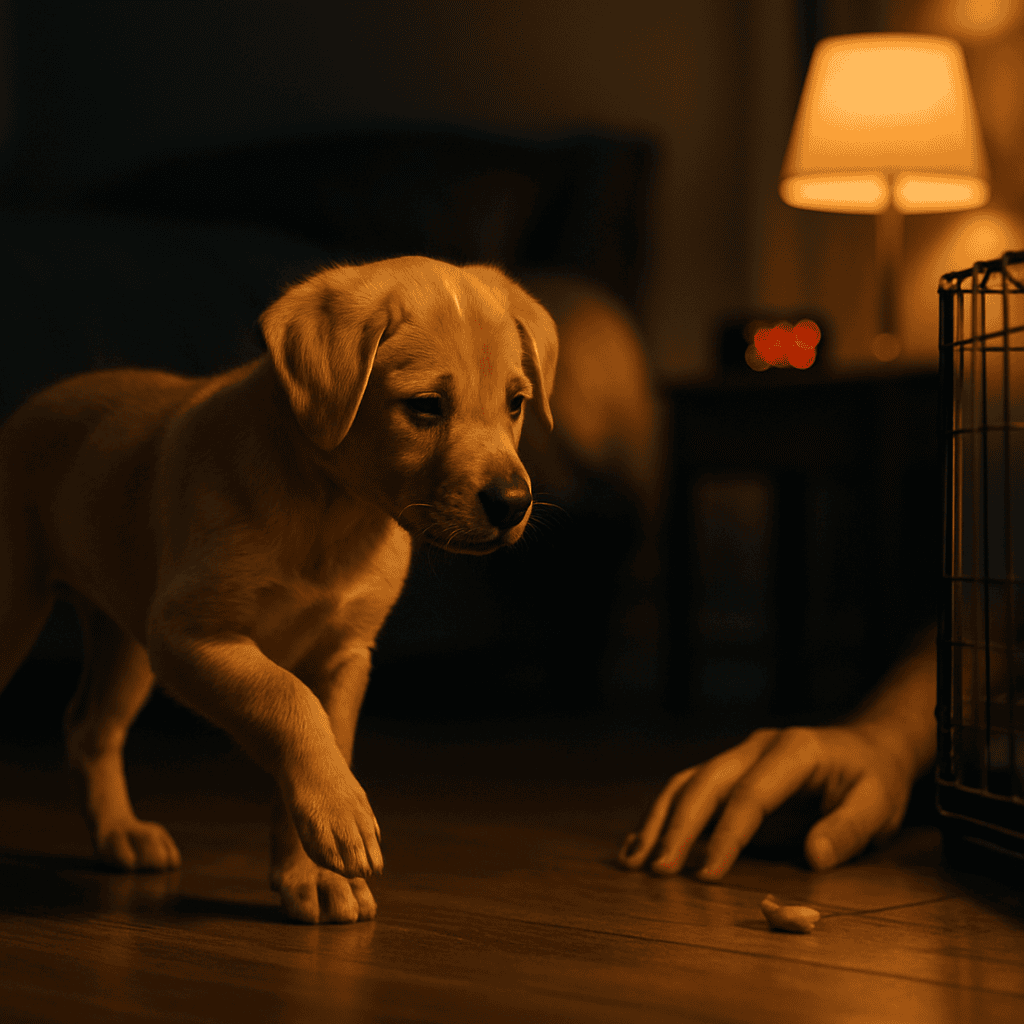
You did the dinner potty break, set up the crate, and now your puppy is backing away like the whole thing has bad intentions. That does not mean crate training has failed. It usually means the crate feels too new, too closed-in, or too closely tied to pressure. The fix is not to force the issue tonight. It is to lower the stakes, read the behavior more carefully, and rebuild the crate as a place the puppy chooses.
Fast Answer: Why Your Puppy Won’t Go Into the Crate at Night (and What to Do Right Now)
Puppies are not born wanting to sleep alone in a box. At night, they are looking for warmth, safety, and familiar company. A crate starts out as an unfamiliar barrier, not a den. If your puppy refuses to go in, the most common reasons are simple: the crate feels scary, the timing is wrong, or a past experience taught the puppy that entering leads to being shut in before they were ready.
The first thing to stop is physically placing, pushing, or steering your puppy into the crate. Even when done gently, that move can turn the crate into a place where the puppy feels handled into a corner. That makes the next bedtime harder.
Tonight, take the pressure off. Leave the door open and make the crate worth investigating. Toss a tiny high-value treat a little near the crate, then closer, then just inside once your puppy is already comfortable approaching. You are not asking for sleep yet. You are just changing the association from “that box ends my freedom” to “good things happen near that box.”
If your puppy sniffs the crate, backs away, and lies down outside it, that is not defiance. It is caution. If your puppy once entered willingly but cried after the door shut, that is often a sign the closing step moved too fast. Either way, the answer is the same: slow the process down and let the puppy succeed in smaller pieces.
What to Do First: Set Up the Evening So the Crate Feels Easier
A calm crate session starts well before the door opens. If the puppy is still bouncing off the walls, the crate will feel like a penalty. The goal is to arrive at bedtime with a body that is ready to rest.
Start with the basics of the evening sequence.
Give the last full meal early enough to allow a potty break afterward. You do not need to micromanage the clock, but you do want enough space between dinner and sleep that the puppy is not still digesting when bedtime arrives. Water should also taper off before bed in a way that fits your puppy’s age, size, and temperature of the room. Very young puppies and hot weather may call for a looser approach. Let observable need guide you: if the puppy is panting, restless, or drinking hard, adjust thoughtfully rather than following a rigid cutoff.
Take a calm potty break right before crate practice. This is not the time for an exciting walk. It is a business trip. The more ordinary and repeatable it is, the easier it becomes for the puppy to understand what happens next.
Shift from active to quiet. A short play session earlier in the evening is fine, but the final stretch before bed should be low-key. Think sniffing games, gentle tug if your puppy can stop easily, a frozen stuffed Kong, or another long-lasting safe chew outside the crate. Chewing and licking help the nervous system come down. Wild play does the opposite.
Set the crate up so it looks and sounds less abrupt. A light cover over the top and sides can reduce visual stimulation, but leave the front open and make sure there is airflow. Use flat, washable bedding that will not bunch up. Remove collars, harnesses, and any tags before the puppy enters. Keep the room dim and add soft white noise if the house sounds are likely to wake your puppy.
One detail matters more than people think: make the crate available before the puppy is asked to use it. If the door is swinging, rattling, or closing unexpectedly, the puppy may decide the whole setup is unsafe. Tie the door open or remove it if needed while you work on the first few sessions.
If your puppy is still amped up during wind-down, do not rush the crate to compensate. Give the puppy more time to settle first. A calm brain learns faster than a tired, overexcited one.
A Gentle Nighttime Crate Introduction Plan
This is the part that turns the idea into a repeatable habit. Move in tiny steps and let the puppy tell you when to stay, when to pause, and when to back up.
- Start outside the crate with treats nearby. Toss a small, high-value treat on the floor near the crate. When your puppy eats it calmly, toss the next one a little closer. The purpose is simple: the area around the crate should predict good things before the puppy is ever asked to enter.
- Let the puppy step in on their own. Once your puppy is choosing to approach, toss a treat just inside the crate. Do not lean over the opening or try to coax with lots of talking. You want the puppy’s feet to do the work. If all four feet go in, mark it with a soft “yes” and reward immediately.
- Pair a simple cue with the action. When the puppy is already entering willingly, you can say a short cue like “crate” or “bed” as the puppy steps in. The word should describe what the puppy is already doing, not pressure the puppy into doing it.
- Feed treats while the door stays open. Once the puppy is inside, stay beside the crate and feed a few treats through the bars or from the open doorway. This tells the puppy that being inside does not make good things stop. You are building comfort with the crate itself, not just a game of chasing food.
- Close the door for a second, then reopen it. When your puppy is calm and still taking treats, close the door briefly, give a treat, and open it right away. At first, that may mean only a couple of seconds. If the puppy stays relaxed, you can slowly stretch to a few more seconds, then longer. Progress is based on behavior, not on the number on a timer.
- Increase closed-door time only while your puppy stays calm. If whining begins, do not turn the session into a standoff. Open the door calmly, let the puppy settle, and shorten the next repetition. The rule is not to reward crying with immediate release in a panic, but also not to stay locked in a struggle. Calm repetition teaches more than a drawn-out battle ever will.
- Add a chew once short closed-door time is easy. After your puppy can stay inside with the door closed for about a minute without distress, add a safe long-lasting chew or stuffed toy. That gives the puppy a job and helps the crate predict rest. Use only items you know are safe for your puppy and size.
- If the puppy falls asleep with the door open, use that win. If your puppy dozes off in the crate with the door open, that counts. Once the puppy is fully asleep and relaxed, you can try closing the door quietly. If the puppy wakes up and panics, go back to open-door sleep for that night and try the closed-door step later.
A useful pattern to remember: the crate is not the first place your puppy should have a hard time. The crate should be where easy wins happen until it feels ordinary.
What a Real Evening Can Look Like
A timeline helps because owners often know what to do but not when to do it. Use the example below as a flexible pattern, not a strict schedule. Very young puppies may need shorter wake windows and earlier wind-down.
| Time Before Bed | What to Do | What You Should See |
|---|---|---|
| About 2 hours | End rough play and give the last real burst of activity | Puppy is active but not frantic |
| About 1.5 hours | Offer a calm potty break and begin quiet indoor time | Puppy starts to slow down |
| About 1 hour | Give a chew, snuffle mat, or calm activity outside the crate | Puppy lingers, sniffs, or settles |
| About 30 minutes | Do a final potty trip and start crate practice | Puppy is more interested in food than movement |
| Bedtime | Close the door only if the puppy is calm and willing | Puppy remains relaxed or sleepy |
If the puppy is still wild at the one-hour mark, the answer is usually not “try harder.” It is “adjust earlier.” Too much exercise can leave a puppy overstimulated, not sleepy. In that case, use more sniffing, more licking, and less chasing.
The best cue that your timing is right is not the clock. It is the puppy’s body language: slower movement, fewer bursts of zooming, softer eyes, and a willingness to lie down.
Normal Puppy Reactions vs. Signs You Need to Slow Down
Not every noise means something is wrong. Puppies often complain a little while they learn a new routine. The key is to separate ordinary protest from real distress.
Usually normal:
- sniffing the crate and backing away before trying again
- stepping in and out several times
- light pawing at the door
- brief whining that settles quickly
- choosing to lie down near the crate rather than inside it at first
A sign to stop and back up:
- trembling or hiding instead of investigating
- refusing high-value treats even outside the crate
- frantic screaming that does not come and go
- biting the bars in panic
- urinating or defecating from fear
- stiff body posture with a tucked tail and no interest in the room
A useful rule of thumb: if the crying is brief, rhythmic, and interrupted, the puppy may simply be objecting to the change. If the crying is sharp, continuous, and paired with frantic movement, the puppy is overwhelmed. In that case, open the door, reset, and make the next session easier.
You are looking for signs of settled learning, not perfect silence. A puppy that can sit inside, chew, or relax with the door closed for 30 seconds without spiraling is already making progress.
The Mistakes That Make Crate Refusal Worse
A few common habits quietly train the puppy to dislike the crate. Most of them happen when owners are tired and want the night over with.
Putting the puppy into the crate yourself. Even if it feels efficient, it tells the puppy that entering is not a choice. Let the puppy walk in willingly so the crate becomes self-directed.
Using the crate as punishment. If the crate is where the puppy goes after being “bad,” bedtime will not feel restful. Keep the crate linked to meals, treats, and sleep instead.
Rushing to a closed door too soon. If the puppy can only handle a few seconds, that is where training starts. Going straight to ten minutes usually creates a louder, harder version of the same problem.
Changing the setup every night. New room, new bedding, new routine, new expectations—too much change makes it harder for the puppy to form a sleep pattern. Keep the early routine simple and repeatable.
Skipping daytime practice. Nighttime is the hardest time to teach a new behavior because everyone is tired. A few short daytime sessions with the crate door open make the nighttime version much easier.
If you have already made one of these mistakes, do not treat that as damage control failure. It just means the puppy needs a cleaner pattern now. Start again with lighter steps and better timing.
Troubleshooting by What You’re Seeing
If the general plan is not working, match your next move to the puppy’s actual behavior.
If your puppy will not go near the crate at all: Take the door off if you can. Make the crate a food station during the day. Feed meals near it, then inside it, without asking for the door to close. The crate needs to stop feeling like a trap before you ask for bedtime.
If your puppy sniffs the crate, then backs away repeatedly: Increase the value of the reward and remove possible triggers. Some puppies are bothered by a rattling door, a slippery surface, or the crate being too exposed in the room. A quieter corner, a non-slip mat underneath, or a lighter cover can help.
If your puppy goes in happily but leaves fast: Stop trying to close the door. Build longer stays with all four feet inside while the door remains open. Reward the puppy for staying in place before asking for anything more.
If your puppy is fine until you stand up or step away: The crate may not be the main issue. Distance is. Practice tiny movement changes: shift your weight, stand, sit, take one step, return. Keep the puppy below the point of panic and expand the distance slowly.
If nothing improves after a few nights: Pause nighttime crate training for now. Let the puppy sleep in a safe contained area close to you and continue with daytime crate work only. Some puppies need that gentler ramp before they can handle the full bedtime version.
That fallback matters. It is better to preserve trust than to win one night and lose the next week.
Next Step: Build a Routine You Can Actually Repeat
The hardest part of bedtime crate training is not knowing what to do. It is doing the same sequence well enough to become familiar. A routine builder helps with that because it turns the evening into something predictable instead of improvised.
Build your puppy routine if you want a simple schedule that fits your puppy’s age, wake windows, potty breaks, meals, naps, and crate practice. It is especially useful if your evening keeps falling apart in the same place, or if you want a routine you can print and use night after night.
For tonight, do not aim for a perfect crate session. Aim for one calm rep. Open the door. Toss the treat. Let the puppy choose. That one choice starts changing the whole bedtime story.