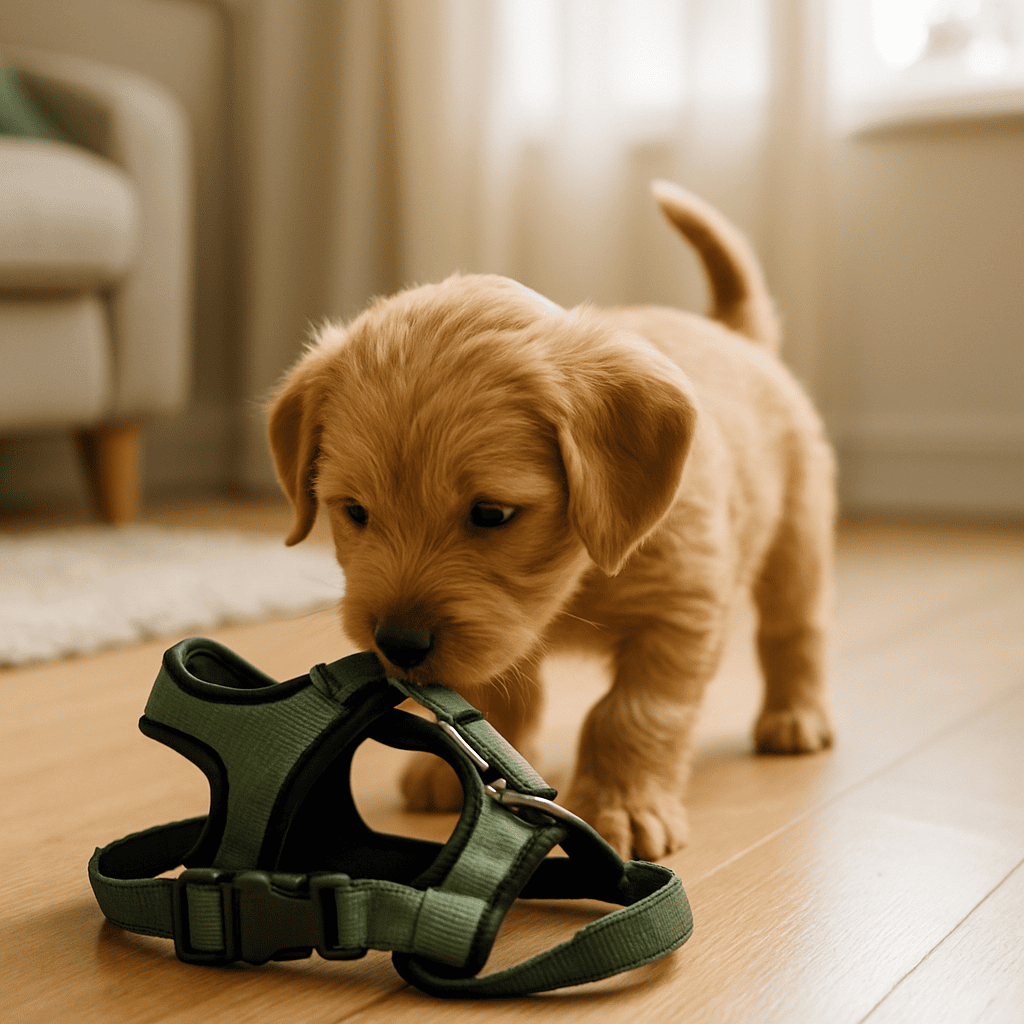
Puppy Hates Harness and Leash: How to Help Without Forcing It
Your puppy backs away when the harness appears. Or you finally get it on, clip the leash, and she locks her legs, bites the leash, or pancake-flops onto the kitchen floor. It can feel personal, especially when you are trying to do the right thing and just get outside for a walk.
But in most cases, this is not defiance. A harness is new, snug, and highly physical. The leash adds pressure, movement, and loss of control. For a young puppy, that can feel confusing or even scary.
The good news: you do not have to force your puppy to “get over it.” The goal is to help her feel safe enough to accept the harness and leash in tiny steps.
Why Your Puppy Hates the Harness and Leash
Most puppies are not trying to be stubborn. They are reacting to something that feels strange or uncomfortable.
- Head or neck sensitivity: Some puppies dislike things going over the head or near the ears.
- Strap pressure: A strap too close to the armpits or shoulders can feel pinchy.
- Poor fit: A harness that is too tight, too loose, or rides up into the neck can be uncomfortable.
- A scary first experience: If the puppy was yanked, rushed, or caught on something, she may now expect trouble.
- Leash pressure: Many puppies freeze the first time they feel tension on the leash.
- Too much happening at once: New home, new smells, new sounds, new rules, and new gear can be a lot for a baby dog.
Gear Check: Comfort First, Training Second
Before you train, make sure the equipment is not the problem.
A beginner-friendly harness should be lightweight, adjustable, and easy to remove. It should not rub the elbows, twist sideways, or shift so much that the puppy can step out of it. If the design is bulky, stiff, or hard to size correctly, it may be making the problem worse.
Here is a simple comparison:
| Harness type | How it goes on | Good for puppies who... | Watch out for |
|---|---|---|---|
| Overhead H-harness | Slips over the head and clips at the back | Are comfortable with head handling | Can trigger backing away if the puppy dislikes head movement |
| Step-in harness | Paws step through and clips at the back | Dislike head pressure | Some puppies still dislike having paws handled |
| Y-front harness | Often goes over the head or uses a loosened opening; may have front and back clips | Need better shoulder freedom | Must be fitted carefully so it does not ride into the armpits |
The leash matters too. Use a light flat leash, about 4 to 6 feet long. Skip retractable leashes during training. The sudden lock, constant tension, and heavy handle can make a worried puppy feel trapped.
Treats should be tiny and exciting. Try cooked chicken, cheese, freeze-dried liver, or another soft treat your puppy loves. If she won’t take food, the session is too hard or she is too stressed to learn well.
The 5-Day “Sniff, Touch, Wear, Clip, Walk” Plan
This plan is meant to change what the harness and leash predict. Right now, they may predict being handled, held still, or taken somewhere unfamiliar. We want them to predict food, calm, and choice.
Keep the sessions short: 1 to 3 minutes, two to four times a day. End early while your puppy is still successful.
Day 1: The harness predicts food
Place the harness on the floor and do not move it toward the puppy.
Each time your puppy looks at it, sniffs it, or takes a step toward it, say “yes” and drop a treat nearby. If she stays far away, feed treats around the harness at the distance she can handle.
Do not wait for bravery. Reward curiosity. That is the first step.
Success looks like: the puppy willingly moves toward the harness instead of leaving the room.
If she backs away, make the task easier and end after a few treats.
Day 2: Touch without wearing
Hold the harness in one hand and feed treats with the other. Bring the harness near the puppy’s shoulder or side, not over the head yet.
Briefly touch the harness to the shoulder, chest, or side for one second. Say “yes,” feed, and move it away. Repeat only while your puppy stays soft and relaxed.
Success looks like: the puppy sees the harness come near and expects food instead of retreating.
If she flinches, pulls back, or stops eating, you moved too quickly. Go back to simply holding the harness nearby.
Day 3: Wear it for a few seconds
Loosen the harness as much as possible while keeping it safe.
Give a steady stream of treats while you slip the harness on. Keep it on for only 3 to 5 seconds, then remove it before the puppy starts to panic or scratch.
Success looks like: the puppy accepts the harness briefly and does not freeze or thrash.
If she struggles before it is fully on, stop and return to Day 2 for a while longer.
Day 4: Add the leash indoors
Put on the harness the same way as Day 3. Clip on the leash, but do not hold tension. Let the leash drag lightly behind the puppy indoors while you feed treats.
Let her take a step or two. Then unclip before frustration builds.
Success looks like: the puppy ignores the leash or walks a few steps without panic.
If the leash suddenly becomes a toy, keep your own movement calm and boring.
Day 5: Walk a few steps, then a little farther
With the harness and leash on, walk a few steps in the house or hallway. Keep the leash loose and reward every couple of steps.
If that goes well, step outside to a quiet, boring area for 1 to 2 minutes. You do not need a real walk yet. You are building comfort, not mileage.
Here is a copyable tracker you can use:
| Day | One small goal | Session length | Move forward when... |
|---|---|---|---|
| 1 | Puppy looks at or sniffs harness | 1–2 min | Puppy approaches without leaving |
| 2 | Harness touches shoulder or chest | 1–2 min | Puppy stays relaxed and eats |
| 3 | Harness on for 3–5 seconds | 1–2 min | Puppy wears it without panic |
| 4 | Leash clipped and dragging | 1–2 min | Puppy ignores leash for 10 seconds |
| 5 | Walk a few steps indoors | 2–3 min | Puppy follows with loose leash and food |
What To Do When Your Puppy Freezes or Backs Away
This is the moment many owners worry about most. The key is to decide whether your puppy is mildly unsure or truly overwhelmed.
A mild response might look like backing up one step, sitting down, or turning away. In that case, make the task easier. Move the harness farther away, let her sniff it, and reward any calm interest. Do not chase her around the room.
A strong fear response looks different. Thrashing, screaming, frantic scratching, rolling, trying to bolt, trembling hard, or urinating out of fear means the session is too much. Stop the attempt. If you can do so without yanking, remove the gear and give the puppy space. Try again later at a much easier step.
If Your Puppy Bites the Leash or Harness
Leash biting is common and usually means the puppy is excited, frustrated, or overstimulated. It is not usually “bad behavior” in the adult sense.
What helps:
- Do not tug back. Tugging can turn the leash into a game.
- Stop moving for a moment. Many puppies release the leash when it stops being exciting.
- Reward the pause. Even half a second of no biting is a chance to say “yes” and give food.
- Interrupt with an easier cue. If your puppy knows “sit” or “touch,” ask for it.
- Use a licking job during gear-up. A LickiMat or other dog-safe lick item can help the puppy stay calmer while you put on the harness.
- Check for tiredness. Puppies often bite more when they need a nap, not more exercise.
If your puppy grabs the leash only when you try to leave the house, the problem may be arousal, not fear. Slow the whole process down and keep the first practice session inside.
Common Mistakes That Make Harness Fear Worse
When a puppy resists, it is tempting to move faster so the scary part ends sooner. Unfortunately, speed often teaches the puppy that the harness is something to fear.
Avoid these mistakes:
- Chasing the puppy with the harness — this makes the harness feel like a threat.
- Forcing the head through a tight opening — this can create lasting head shyness.
- Leaving the harness on too long too soon — the puppy may panic because she cannot get relief.
- Yanking the leash or using corrections — this can make the puppy fear your hands and the leash.
- Practicing when the puppy is overtired, hungry, or overstimulated — short calm sessions work better.
- Rushing straight to a neighborhood walk — the outdoor world adds noise, smells, and movement before the harness is even comfortable.
- Talking softly while still applying pressure — kind words do not cancel out fear; stopping does.
A better rule: every session should feel easier than the one before it.
A Simple In-Article Practice Log You Can Copy
Use this little log in your notes app or print it for the fridge:
| Date | Harness step | Puppy reaction | Treat used | Next step |
|---|---|---|---|---|
| Looked at harness | Relaxed / unsure / scared | |||
| Sniffed harness | Relaxed / unsure / scared | |||
| Touched shoulder/chest | Relaxed / unsure / scared | |||
| Wore harness for 3–5 seconds | Relaxed / unsure / scared | |||
| Leash clipped indoors | Relaxed / unsure / scared | |||
| Walked 2–5 steps | Relaxed / unsure / scared |
This keeps the training from feeling fuzzy. If your puppy has a bad session, the log helps you spot whether you moved too fast, trained too long, or used a treat she did not care enough about.
When To Get Help
Some puppies warm up in a few days. Others need a few weeks. That range is normal as long as progress is moving forward.
Get help if:
- Your puppy does not improve after 1 to 2 weeks of short, gentle sessions.
- The harness panic gets worse instead of better.
- Your puppy suddenly refuses gear she used to wear comfortably.
- There is limping, yelping, stiffness, swelling, or pain when the harness goes on.
- Your puppy redirects hard bites onto your hands or clothing during gear-up.
- You feel stuck and every attempt ends in panic.
A veterinarian can check for pain, fit issues, or physical discomfort. A force-free trainer or veterinary behavior professional can help with fear without using punishment or flooding.
FAQ
Why does my puppy run away when I pick up the harness?
Because the harness has started to predict something stressful. Change the meaning of the sight and sound of the harness. Pick it up, say “yes,” drop a treat, and put it down again without trying to put it on every time.
Can I use a collar instead of a harness?
A flat collar can be okay for short, loose leash walking if your puppy does not pull. But a harness is often safer for puppies that are still learning not to pull. If the harness is the problem, a collar may be a temporary bridge while you work on comfort.
My puppy lies down and refuses to move with the leash. Should I pull?
No. Pulling usually makes the puppy plant harder. Instead, crouch nearby, show a treat, and reward any tiny movement forward. You can also walk backward a few steps and let the puppy follow you.
How long does it take for a puppy to accept a harness?
Many puppies improve within 3 to 10 days when the training is gentle and frequent. Sensitive puppies or puppies with a scary first experience may need 2 to 4 weeks.
Is my puppy aggressive because she bites the harness?
Usually not. Biting the harness is more often frustration, overstimulation, or discomfort. But if the puppy growls, snaps hard, or seems to guard the gear, pause training and get help from a force-free professional.
What if my puppy is afraid of both the harness and the leash?
That is common. Train the harness first until it feels normal, then introduce the leash separately indoors. Do not try to solve both at the same time.
Next Step
Keep this plan beside the harness and aim for tiny wins, not perfect walks. Calm repetition matters more than speed.
If your puppy’s reaction includes pain signs, heavy panting, trembling, limping, collapse, or you are simply not sure whether this is a training problem or a medical one, do not guess. Use the Puppy Panic Button to sort red flags from normal puppy drama. Use the Puppy Panic Button