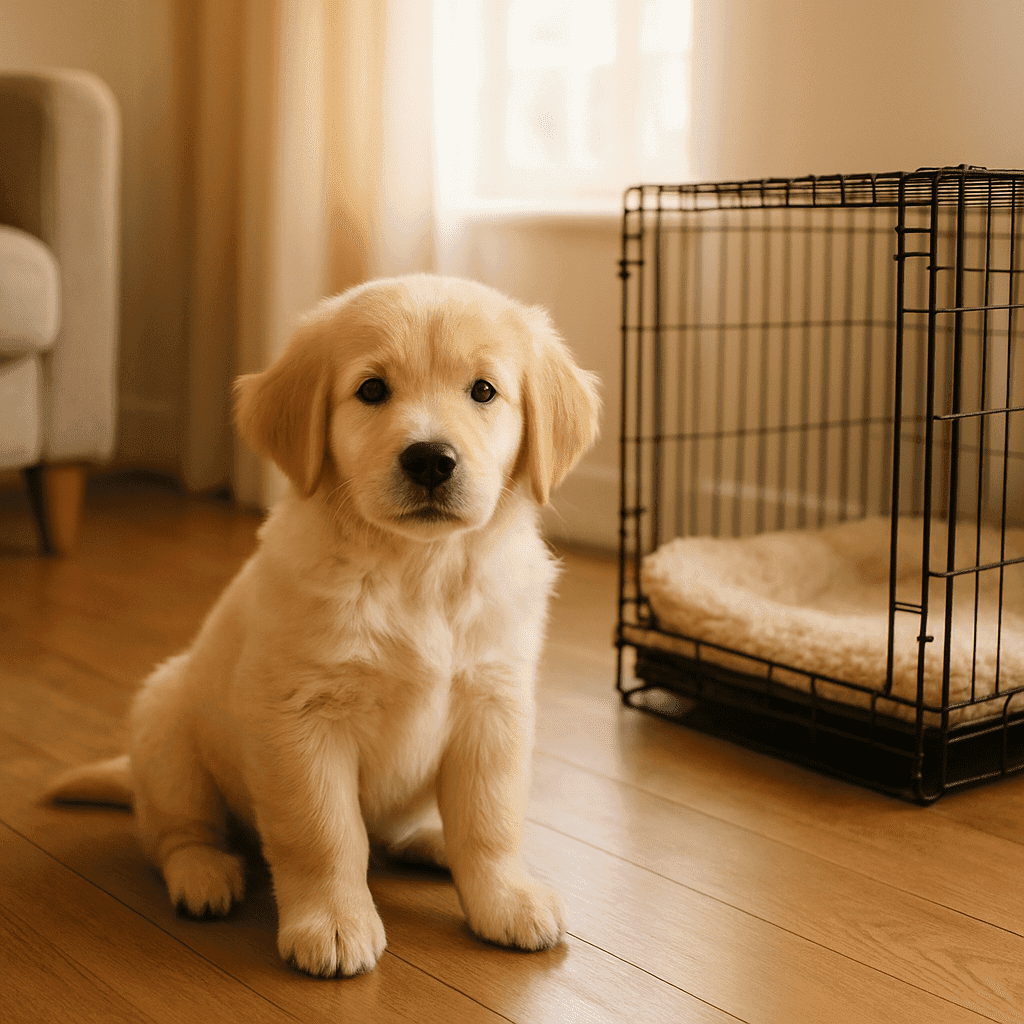
Crate Training Schedule: What To Do First, What To Avoid, And When To Worry
What To Do First: Setting Up the Crate (And Your Mindset)
Before you think about the clock, take one deep breath and set up the right environment. Most beginner frustration comes from skipping this step. You don’t need perfection; you just need safe, boring, and predictable.
Step 1: Choose the right crate and make it smaller
A puppy will not soil where they sleep — unless the crate is too big. Get a wire crate with a divider panel. For an 8- to 10-week-old golden retriever or similar mid-size pup, a 24-inch crate with the divider moved to create about 18 inches of floor space is plenty. The rule: your puppy stands, turns around, and lies down comfortably. No room to pee in one corner and sleep in another.
Step 2: Strip the dangers
Inside the crate, remove every collar, harness, and dangling tag. A collar catches on bars and becomes a strangulation risk. No loose blankets a puppy can shred and swallow. Instead, a single-piece vet-bed style mat or a towel that’s too thick to tear works. Add a sturdy chew toy — a small, frozen, stuffed Kong is the gold standard. A water bowl that attaches to the crate door is fine when you’re actively observing; otherwise, remove it to prevent splashing and soggy accidents.
Step 3: Place it where life hums, not screams
Put the crate in a family room or kitchen corner during the day — close enough that your puppy doesn’t feel abandoned, but not in the treadmill of kids running past. At night, bring the crate into your bedroom. Proximity reduces nighttime panic and lets you hear those early potty signals. It won’t spoil your puppy; you’ll gradually move the crate out once the self-soothing skills stick.
Step 4: First introduction — door stays open
Don’t shove your puppy inside to “get them used to it.” Scatter a few high-value treats near the door, then just inside. Feed their first meal with the bowl placed at the entrance, then a little deeper each time. The goal is a puppy that walks in willingly, not one that gets pushed. If they won’t go near it, back up: treats outside the crate for a day. No timeline is too slow. You’re building a safe room, not a trap.
Mindset shift
Crate training isn’t cage training. You’re mimicking a den. A good schedule paired with this setup makes the crate the place your puppy eventually chooses to rest. You will make mistakes, and that’s normal. Today, do just this: place the crate in a quiet, family-adjacent spot, take off the collar, toss in three treats, and leave the door open. That’s your assignment.
Fast Answer: Your Puppy’s Crate Training Schedule at a Glance
The at-a-glance schedule already sits in the opening for quick relief. But here’s the deeper truth: the first 72 hours are about pattern, not duration. Your puppy doesn’t need to love the crate on Day 1. They need to experience the same rhythm enough times that their little body anticipates it.
Daytime cycle (repeat every 1–1.5 hours for an 8-week-old):
- Potty → 5 minutes of calm praise or a tiny training snack → Brief play/social time (10–15 minutes) → Potty again → Crate with a tasty chew → Nap 30–45 minutes → Potty the second they wake → Repeat.
That loop might happen 8 to 10 times a day. It’s exhausting for you. It’s also temporary. Coordinate your potty breaks with this crate schedule – here’s how the full potty plan works.
Age-based max crate time (daytime)
- 8–10 weeks: 30–45 minutes per session
- 10–12 weeks: up to 1 hour
- 12–16 weeks: 1–2 hours
- 4–5 months: gradually stretch to 2–3 hours
Overnight: at 8 weeks, a 3–4 hour stretch is possible with one or two potty breaks. At 10–12 weeks, 4–5 hours. At 12–16 weeks, 5–6 hours, but not every night will be perfect. Do not compare your puppy to the neighbor’s dog.
If you’re already panicked because tonight feels impossible, take a breath and read the First Night with Puppy Survival Guide before you continue. Then use the stoplight system below when tears — yours or the puppy’s — show up.
Your Crate Training Schedule: The First 3 Days Step-by-Step
You don’t need a color-coded spreadsheet. You need a clock-based plan that you can follow while sleep-deprived. Below is Day 1 for a typical 8-week-old puppy. Adjust wake-up time to match yours, but keep the sequence.
| Time | Activity | Notes |
|---|---|---|
| 6:00 am | Wake & potty | Carry puppy straight to potty spot. No detours. |
| 6:15 am | Breakfast in crate (door open) | Bowl at back of crate, you sit nearby. |
| 6:30 am | Play & training | 10–15 min of gentle interaction. |
| 6:50 am | Potty | Always after play/meals. |
| 7:00 am | Crate with frozen stuffed Kong | Calm entry, cover crate lightly. |
| 7:45 am | Wake & potty | Immediately out. |
| 7:55 am | Short supervised free time | 10–15 min. |
| 8:15 am | Potty, then crate nap | Same drill. |
| Repeat cycle | Potty→play→potty→crate | Every 1–1.5 hours. |
| 12:00 pm | Lunch in crate | Door open. |
| Afternoon | Same cycle, maybe longer nap | If puppy wakes early, calm potty trip, then back to crate. |
| 5:00 pm | Dinner in crate | Door open. |
| 6:00–8:00 pm | Supervised play, training, final zoomies | Tire them out before bedtime push. |
| 8:30 pm | Remove water if you’re managing accidents | Not for very young pups, but can help overnight. |
| 9:45 pm | Final potty break | Longer sniff walk, no play. |
| 10:00 pm | Bedtime in crate, cover, quiet | Bedroom placement, soft word, lights out. |
| 2:00 am | Silent potty trip if crying | No talking, no lights, right back. |
| 5:00 am | Potty trip if needed | Then return to crate until 6 am. |
Day 2 & 3: Follow the same skeleton. If your puppy settles faster during one nap, don’t change the schedule; just enjoy the win. If they soil the crate, cut the nap time by 10 minutes and add an extra potty break.
For a 10-week-old, stretch the daytime crate session to 50–60 minutes and overnight to a possible 4–5 hour first stretch. For a 12-week-old, you might get 1.25 hours daytime and 5–6 hours overnight, but watch your individual puppy. The printable plan from our Generate your puppy schedule tool will map these times exactly for your pup’s age and your wake-up hour.
Avoid this today: believing the schedule is a prison. If your puppy truly panics, pause and fall back to the troubleshooting section. The schedule is a guide, not a punishment.
Normal vs Not Normal: The Stoplight System for Crying, Whining, and Distress
Crying in a crate is communication, not failure. But not all crying is equal. Use this color-coded system to decide if you wait, intervene, or call the vet.
| Color | Behavior & Duration | What It Means | What You Do |
|---|---|---|---|
| Green | Soft whining or a few barks that taper off within 10–15 minutes. Settling noises, occasional sigh. Puppy may bark when you leave but quiet once you’re nearby. | Normal adjustment. They’re protesting the end of playtime, not panicking. | Check the clock. If they’ve pottied recently and are safe, you can let them self-settle. Don’t rush in. |
| Yellow | Escalating crying to howling, barking that lasts 20–30 minutes. Frantic digging, refusal to settle even after a potty break. Puppy seems unable to calm down. | Overstimulation, need unmet, or budding isolation distress. | Do a silent, boring potty break. No play, no eye contact. Return puppy to crate. Sit next to the crate without opening the door. If still crying after 15 more minutes, move crate to your bedroom tonight. If yellow persists daily for 3+ days, check for separation anxiety red flags. |
| Red | Intense, unrelenting screaming for over 30 minutes. Pup vomits, has diarrhea, trembles, hunches, or attempts to injure themselves against the crate. Breathing changes, extreme salivation. | Medical issue (UTI, gastrointestinal pain, injury) or severe panic. | Stop crate training for now — take puppy out immediately to check for physical distress. Call your veterinarian. Rule out medical causes before assuming behavior. |
What to avoid: using a “cry it out” policy for red or persistent yellow. Ignoring a sick puppy because you think it’s training sabotage can cause real harm. Trust your gut. If the sound makes your skin prickle, it’s not normal.
Quick safety checklist before you escalate:
- Has the puppy eaten and kept food down today?
- No vomiting, diarrhea, or blood?
- No straining to urinate or excessive licking?
- Is the puppy alert and responsive when out of crate?
If you answer “no” to any, call your vet. If you answer “yes” to all and crying stays in yellow, proceed with calming strategies and consider a Separation Anxiety in Puppies: Signs and Solutions to dig deeper.
7 Common Crate Training Mistakes (And How to Avoid Them)
Even caring owners slip into these traps. Seeing them named can collapse days of confusion. Each mistake below comes with a one-sentence fix; it’s not a failing, it’s a course correction.
1. Using the crate for time-outs
If you send your puppy to the crate after a bite or accident, the crate becomes a punishment box. The fix: always use a boring, puppy-proofed area for brief cool-downs, never the sleeping den.
2. Weak positive associations
The crate can’t be a void you push your puppy into. Every entry should have a payoff. Feed every meal inside or directly in front of the door. Give a frozen, food-stuffed toy every time your puppy goes in for a nap. When you open the door, be calm — no party. You want the value to be inside the crate, not the release from it.
3. Leaving puppy in too long
Even a “good” puppy will have accidents if the bladder is overloaded. Follow the age-based limits. If your 9-week-old peed in the crate, it’s not spite; it’s biology.
4. Inconsistent rhythm
Dogs thrive on pattern. If you put your puppy in the crate at 7:30 am one day and 9:00 am the next, their body can’t learn the dance. Use a printed schedule or our Generate your puppy schedule tool to remove guesswork. Stick to it for at least 4–5 days before judging results.
5. Opening the door mid-cry
When you rush to the crate the moment crying starts, you teach “crying opens the door.” Wait for a 3-second quiet gap — often a breath between whines — then open. Better yet, wait until your puppy is sitting or lying quietly. Even a 5-second silence is gold.
6. Leaving the collar on
This one is non-negotiable. Even flat collars catch on crate bars. Before any crate time, slip the collar off. Hang it on the door handle as your reminder.
7. Expecting a dry bed overnight at 8 weeks
Young puppies need a 2 am or 5 am potty trip. Skipping it because you want sleep will train your puppy that the crate is where they get desperate. That panic makes everything harder. Set an alarm, do a silent trip, and know it’s temporary.
If you’ve already made mistake #5 and now your puppy screams louder, forgive yourself. Start fresh: tonight, after needs are met, sit quietly next to the covered crate without opening it. Let the puppy see your calm presence; release them only when they’ve been silent for a few seconds. This resets the system.
Troubleshooting When Your Puppy Won’t Settle, Has Accidents, or Refuses the Crate
When the plan breaks, here’s exactly how to fix it — no vagueness, no “keep trying.”
| Problem | Likely Cause | Immediate Fix | When to Worry |
|---|---|---|---|
| Puppy won’t settle, cries beyond yellow | Needs potty, overtired, or overstimulated from too much play just before crate. | Carry puppy for a boring potty break. Reduce pre-crate excitement: 5 minutes of calm handling, not tug. Offer a frozen chew. Cover the crate with a lightweight blanket leaving one side open. Use a white noise machine if fear of silence is the trigger. | If crying stays yellow 3+ days despite all adjustments, consider a Separation Anxiety resource or vet behaviorist. |
| Accidents inside the crate | Bladder too full; crate too large; schedule gaps; urinary tract infection (UTI). | Tighten divider. Take puppy out every 45 minutes daytime (under 10 weeks). Clean with enzymatic cleaner — never ammonia-based. Monitor frequency; small puddles possibly point to UTI. | Multiple small, frequent accidents with straining, blood, or lethargy → vet. |
| Puppy refuses to enter, backs away | Negative association or fear from a previous scary event (loud noise near crate, being forced). | Stop all pressure. For 3–5 days, feed every meal with the bowl at the crate door, then just inside. Toss high-value treats while you sit by the crate, door open. Play “crate games”: toss treat in, let puppy run out, repeat. Never push. | If refusal continues after 7 days of low-pressure reintroduction, consult a force-free trainer. |
You haven’t broken your puppy. Every problem on this list is fixable with calm, consistent changes. If you feel stuck, the daily checklist below keeps the essentials in view while you work on the trouble spot.
Your Daily Crate Training Checklist: Keep Your Puppy Comfortable and Safe
- ☐ Morning: Carry puppy straight to potty spot immediately upon waking.
- ☐ Feed every meal in or next to the crate — door open.
- ☐ Schedule today’s naps and breaks using the age-based timing from this guide (or your generated schedule).
- ☐ Before each crate nap: final potty, 2-minute calm wind-down, and a treat-stuffed toy for positive entry.
- ☐ Practice one short “crate game” session: toss treats inside, let puppy dart in and out, no door closed.
- ☐ Remove collar before any crate time — every single time.
- ☐ Provide a safe, non-shreddable chew; no loose blankets for puppies who tear.
- ☐ Bedtime: final potty break, no play, cover crate for den-like feel.
- ☐ Set an alarm for any needed overnight potty trip (under 12 weeks).
- ☐ If an accident happens, clean with an enzyme-based cleaner immediately and thoroughly.
- ☐ Extra: Today, did you mark a potty win or a settled nap on your tracker? Seeing progress — even small — keeps you going.
Generate your puppy schedule with our Generate your puppy schedule tool for a personalized plan.
Sources and safety references
Consult the AKC new puppy guidance, PetMD puppy crying in crate guidance, and VCA puppy care for further information on crate training and related safety concerns.