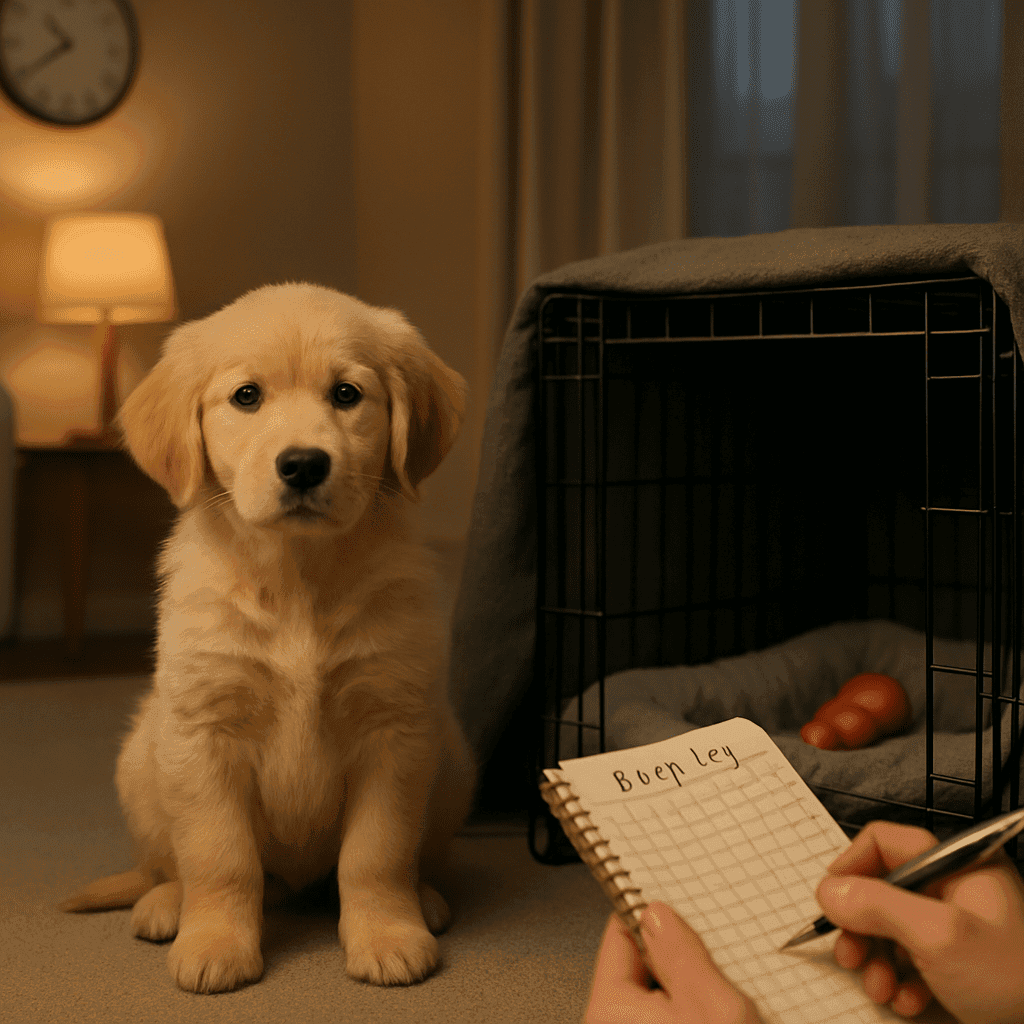
Puppy Witching Hour: Why Evenings Get Wild and a 3-Day Crate Sleep Reset Plan
Why Your Puppy Spins into Chaos Every Evening
It’s 7:30 PM. You’re sitting on the sofa, exhausted after a long day, and your puppy has become a sprinting, ankle-biting whirlwind. Zoomies erupt out of nowhere; sharp teeth find your hands, your socks, the edge of the rug. You wonder if you’ve done something wrong—or if your puppy is broken. You haven’t, and they aren’t. This is the witching hour, a completely normal puppy phase, and in just three nights, this simple, kind crate reset plan will help your puppy settle and let you finally rest—without ignoring genuine distress.
In homes around the world, somewhere between 6 PM and 9 PM, a switch flips. A puppy who was snoozing sweetly an hour ago thunders across the floor, body-slams the sofa, bites at moving shadows, and seems deaf to every command they knew earlier that day. This is the puppy witching hour—a burst of frenetic, often mouthy, evening activity.
It isn’t bad behavior; it’s biology. Puppies are naturally crepuscular, meaning they are genetically wired to be more active at dawn and dusk. In the wild, that evening spike would have been for hunting and patrolling. In your living room, it looks like chaos. On top of that natural rhythm, two other forces collide:
- Overtiredness: Like a toddler who missed a nap, a puppy who hasn’t had enough daytime sleep becomes a tiny, irritable blur by evening. They aren’t burning off excess energy—their brain is fried and they can’t self-regulate.
- Overstimulation: A day full of new sounds, children playing, the vacuum, the walk, the visitor—even happy stimulation adds up. By evening, your puppy’s stress cup is full, and their ability to cope evaporates.
Add teething discomfort into the mix, and you have a perfect storm of biting, zooming, and ignoring every calm cue. A 10-week-old Labrador who collapsed into a bitey tornado at 7:45 PM after a day with the kids isn’t being defiant; she’s desperate for relief she can’t name. A small apartment puppy who body-slams the sofa every night at the exact same time isn’t trying to drive you mad; his system is telling him it’s time to move, but he doesn’t yet know how to switch off.
How long does the witching hour last? For most puppies, the full-on evening madness fades noticeably by 4–5 months of age, as their nervous system matures and a predictable routine kicks in. The 3-day reset you’re about to use speeds up the night-settling part dramatically, although you may still see brief early-evening zoomies for a few more weeks. The key is to stop trying to out-exercise the cyclone—that often backfires and creates an overtired, even more wound-up puppy. Instead, we’ll redirect that energy into a calm wind-down and a sleep routine your puppy can trust.
If the witching hour happens at a drastically different time of day, or is accompanied by trembling, yelping, or uncharacteristic aggression, you may be looking at pain, fear, or a medical issue—see the Safety Signals section later in this article.
Before You Begin: Your Evening Bedtime Setup
You can’t slam a screaming puppy into a crate at 8 PM and expect magic. The 3-day reset needs a foundation. Start tonight, even before Night 1, by setting up a reliable wind-down ritual. This directly lowers cortisol and helps your puppy’s brain switch from “party” to “rest.”
The 60-minute rule: All exciting play, active training, fetch, tug, and high-arousal games stop at least one hour before you plan to crate your puppy. If crate time is 8 PM, no zoom-fueling after 7 PM.
What to do instead in that quiet hour:
- Offer a long-lasting chew like a frozen Kong stuffed with a little soaked kibble or plain xylitol-free peanut butter (freeze it ahead). Chewing is calming and self-soothing.
- Do a short, gentle sniffy walk or an indoor nose game—scatter a few treats in a snuffle mat or a rolled-up towel so your puppy uses their brain, not their muscles.
- Keep the lights dim, voices soft, TV or music low. Ambient “brown noise” or a calming canine playlist can mask outside sounds.
Crate setup: Place the crate in your bedroom or just outside your door—not isolated in a far-off room. Cover it with a breathable crate cover to create a den feel, but leave one side open for airflow. Add comfortable bedding and one safe chew (a frozen Kong or a durable chew toy). The crate must be a positive place, never a punishment. If your puppy already shows fear of the crate, pause this plan and spend a few days on positive crate introduction games before beginning the reset.
Final potty rule: Take your puppy outside for a boring, on-leash potty trip no more than 15 minutes before crate time. Stand still, whisper “go potty” once, and wait up to 2 minutes. No play. This sets the stage for the Night 1 protocol.
An example wind-down timeline:
- 7:00 PM – End all active play.
- 7:05 PM – Brief potty break.
- 7:15 PM – Give frozen Kong on a mat beside you; gentle calm cuddles if puppy accepts them.
- 7:45 PM – Final silent potty break.
- 7:50 PM – Back inside, lights low, soft voice.
- 8:00 PM – Crate with a calm phrase and the Kong.
Ideal bedtime for an 8–12-week-old puppy is usually between 8 PM and 10 PM. The exact time depends on your schedule, but aim for a consistent slot.
Night 1: The First Crate Reset & Your Cry Response Rules
This is the core of the plan. You’ll follow a precise, sound-based response system that removes the “do I go or not?” panic at 8:05 PM.
The crating ritual:
- Final potty trip as close to crate time as possible.
- Place a high-value treat (a smear of peanut butter, a small piece of chicken) inside the crate, and let your puppy walk in on their own.
- Say your calm phrase—something like “settle time” or “goodnight”—in a soft, steady voice.
- Close the door gently, turn off the main light, and leave the room without prolonged eye contact or fuss.
Cry Type Decoder – When your puppy vocalises, listen for the type, not just the volume:
| Sound | What it usually means | Wait time before checking | Action if still vocalising |
|---|---|---|---|
| Low, grumbly whine, stops and starts, quietens when you shift in bed | Low-level protest or mild frustration | 2 minutes | Stay quiet; do not enter. If self-soothes, great. |
| Sharp, repetitive bark, may pause then restart | Frustration or “I want out now” | 5 minutes | Wait. If still barking after 5 min, do a silent potty check (below). |
| Yelp, scream, howl, or panicked, high-pitched sound that makes your stomach drop | True distress, fear, or pain | 0 minutes – check immediately | Enter quietly, do a brief potty trip, comfort if necessary, and reassess (see safety section). |
What a “check” looks like: You go to the crate without any excitement. Clip on the leash, say nothing (or a whispered “let’s go potty”), and carry your puppy if necessary to the outdoors. Stand still like a statue. If your puppy eliminates, praise softly (“good potty”) and immediately return to the crate. If no potty within 2 minutes, back to the crate with the same quiet phrase. No play, no eye contact, no lingering. You are not punishing; you are setting the expectation that night waking leads only to a boring pee break.
If crying resumes after a check, restart the wait timer based on the new sound type. For example, if your puppy barked >5 min and you took them out but they didn’t potty, then they start whining once back in the crate, wait 2 minutes from that new whine.
Real-world Night 1 scenario: 8:05 PM – puppy crated. 8:08 PM – low whining begins. You set a mental 2-minute timer. 8:10 PM – still whining but low. 8:11 PM – silence. Puppy settles and chews the Kong. 8:30 PM – loud barking erupts. You wait 5 min (until 8:35). Still barking. You do a silent check—puppy doesn’t potty. Back in crate. 8:38 PM – quiet. Puppy sleeps until 2:00 AM when a potty-sounding whine starts; you take them out as per the decision tree.
What to expect: Night 1 may include 20–40 minutes of intermittent crying total, with quiet stretches in between. This is normal. It is not failure. However, continuous screaming for more than 10 minutes without any pause is a hard stop—see the Safety Signals section.
Biggest mistake: Dashing in for a mild whine too quickly teaches the puppy that crying brings you back; or conversely, ignoring a true yelp and leaving a terrified puppy to panic. Use the sound map, not a blanket “ignore them” rule.
Night 2: Morning Tweaks & Reading Progress
After Night 1, you have data. Even if the night felt hard, your log (more on the log in the Toolkit section) tells you patterns, and small tweaks can make Night 2 noticeably better.
First, review your Night 1 log. Look for:
- Did the bulk of crying happen right after crate time, then stop for a long stretch? That suggests a settling protest, not a routine problem.
- Did crying cluster right before a potty break? The puppy may wake needing to go; fine.
- Was there a long, quiet sleep block, say 3 hours? That’s progress.
Morning adjustment: If Night 1 had prolonged crate-time crying, consider moving your puppy’s morning wake-up time 15 minutes earlier the next day. A slightly earlier morning helps shift the sleep-wake cycle so your puppy is ready for bed at the usual evening time. For example, if your puppy normally wakes at 6:30 AM, set your alarm for 6:15 AM, quietly wake them, and start the day with a calm potty and breakfast.
Evening awake window tweak: Based on your puppy’s age, extend the last awake period—the time between ending the final nap and the wind-down hour—by 15 minutes. If you previously started the wind-down at 7:00 PM because the final nap ended at 6:00 PM, try keeping the puppy gently awake until 6:15 PM the next day, then begin the wind-down at 7:15 PM. Do not extend by more than 15 minutes; overtiredness will backfire.
What progress looks like: Even a 30% reduction in total crying time from Night 1 to Night 2 is a big win. Maybe whining lasted only 8 minutes instead of 15, or that first sleep block stretched from 2 hours to 3.5. The goal isn’t zero crying; it’s a puppy who calms faster and sleeps in longer chunks.
Night 2 example using a log: Night 1 log: crate at 8 PM, whining 8:05–8:12 (owner waited the 2 min rule, puppy settled), silence until 12:30 AM, bark and potty success, then quiet until 5 AM. Analysis: settling protest was short, bladder held 4.5 hours. Night 2: owner shifts morning up 15 min to 6:15 AM, moves evening awake window by 15 min, and repeats the identical crating ritual. Expect less initial protest.
If Night 2 is worse than Night 1, first check that your puppy is napping enough during the day (18–20 hours total sleep for an 8–12-week-old). Too little daytime sleep leads to overtired chaos. Ensure daytime naps happen in a quiet, covered crate or pen.
Night 3: Locking In the New Sleep Routine
By Night 3, you’re building a habit. Your puppy’s brain is beginning to learn that the crate, the wind-down, and the dark mean rest, not isolation.
Follow the same protocol—wind-down hour, final potty, calm crating phrase, the cry decoder—but you can start trusting your ears more. Respond to obvious distress or potty-sounding whines, but don’t stare at the clock for every soft murmur. Many puppies on Night 3 cry less than 5 minutes total and settle into 3–4 hour sleep blocks with one potty break.
Begin to fade the log. Only jot down major events: an overnight potty trip, or any extreme distress (which should be rare now). After 3 consecutive nights of predictable, manageable settling, you can stop logging entirely and keep the routine.
A typical Night 3 snapshot: Crate at 8 PM, a couple of low whines in the first 2 minutes, then quiet. Puppy wakes at 2 AM with a potty whine, you take them out silently, they pee, back in the crate. Sleep until 6 AM. Total crying time: under 5 minutes. That’s a massive shift from Night 1’s 30 minutes.
Long-term lock-in: The wind-down hour, the calm crating phrase, and the boring potty-only night breaks become permanent. As your puppy reaches 14–16 weeks, they may drop to one overnight potty break or even sleep through until morning. Keep the wind-down sacred even after the witching hour wanes; it’s the foundation of your puppy’s calm evening for life.
Avoid the mistake of thinking “it’s fixed” and abandoning the ritual on the fourth evening. That’s like stopping brushing your teeth because you don’t have cavities today. Also, don’t suddenly move the crate to a different floor or a far-off room right after the reset; keep the location stable for at least a couple of weeks.
If Night 3 is a regression (more crying than Night 2), revisit your Night 2 adjustments. Did you accidentally keep the puppy up too late during the day? Is new teething discomfort surfacing? A frozen washcloth to chew before bed can soothe sore gums.
The Midnight Potty Break Decision Tree
The most sleep-stealing moment is 2 AM, when your puppy whines and you can’t remember if it’s protest or a full bladder. This decision tree removes the mental load while you’re half-asleep.
Start with a simple rule: a healthy 8–12-week-old puppy can hold their bladder for roughly their age in months plus one (3–4 hours) overnight, because metabolism slows during deep sleep. But for safety and success, we use a 2-hour trigger.
At night, when your puppy vocalises:
- Check your log (or memory): How long has it been since their last potty?
- If 2 hours or more have passed, assume potty need. Take them out silently—no lights, no talking above a whisper, no play.
- If less than 2 hours, go to step 2.
- Identify the sound type using the Cry Type Decoder:
- Whine or low bark and <2 hours: Wait according to the cry type timer (2 min for whine, 5 min for bark). If the vocalisation stops, no potty trip needed.
- Yelp/scream: Check immediately regardless of time.
- During any potty trip:
- Keep the trip boring: leash on, walk to the same spot, stand still.
- If your puppy doesn’t eliminate within 2 minutes, return to the crate without consequences.
- If they do go, whisper “good potty” and straight back inside.
Real 2 AM scenarios:
- 1:30 AM, puppy whines. Last potty was at 11:00 PM – 2.5 hours ago. Decision: take out. Puppy pees immediately, back in crate. Minimal disruption.
- 3:15 AM, puppy barks. Last potty at 2:00 AM – only 1.25 hours ago. Decision: wait the 5-minute bark timer. Bark continues 4 minutes then stops. No potty trip needed.
How to tell a potty whine from protest: Potty-sounding whines tend to be lower-pitched, more rhythmic, and may build gradually. Protest barks are often sharper, more abrupt, and may stop momentarily when you shift in bed. After a few nights, you’ll start to hear the difference.
Common stumble: Turning an overnight potty trip into a social moment. If you talk, cuddle, or offer a treat, you train the puppy to wake up for that reward. Be a boring bathroom escort.
Troubleshooting: If your puppy soils the crate despite timely breaks, consider: (a) the crate is too large—puppy should have just enough room to stand, turn, and lie down; (b) you’re feeding or watering too late—remove water 2 hours before bedtime; (c) a possible urinary tract infection, especially if accidents are frequent, tiny, and the puppy strains. See your veterinarian.
When to Pause: Safety Signals & When to Call the Vet
Safety note: This reset plan is designed for puppies showing normal witching-hour hyperactivity and mild protest crying. It is not designed for puppies in genuine panic, pain, or illness. Your puppy’s well-being comes before any schedule.
Stop the plan immediately and comfort your puppy if you see:
- Continuous, high-pitched screaming, yelping, or howling with no pause for 10 minutes or more.
- Frantic clawing at the crate door, chewing the bars to the point of injury, heavy drooling, or excessive panting (not just from a warm room).
- Vomiting, diarrhea, shivering, or extreme lethargy during the night or the next morning.
- Any sign of physical injury or uncharacteristic aggression.
What to do: Open the crate calmly, remove the puppy, and check their body for wounds, swelling, or a too-tight collar. Offer water. Soothe them without frantic energy. If the behavior persists even when the puppy is held or free in a puppy-proofed room, you may be seeing a medical problem or a more serious fear response, not just evening zoomies.
When to call your veterinarian: Any sign of illness, injury, or if your puppy seems painful outside the crate as well. Also, if you notice frequent, small puddles of urine, or straining to urinate—these can indicate a UTI and need medication.
When to consult a certified positive-reinforcement trainer or veterinary behaviorist: If the 3-day plan consistently triggers a panic response despite a perfect setup, your puppy may have separation anxiety or a deeper behavioral issue. A tailored, force-free plan from a professional is essential. That is not a failure—it’s responsible parenting.
This protocol does not replace veterinary or professional behavioral advice. For further guidance on humane training methods, see the American Veterinary Society of Animal Behavior position statement on positive reinforcement. Never use anti-bark collars, spray bottles, or any punishment in or near the crate. These damage trust and increase fear.
Your Witching Hour Reset Toolkit: Copy This Log and Decision Tree
No need to memorize everything. Below is the exact toolkit you can copy into your notes app, a piece of paper, or a whiteboard beside the crate. Keep a pen nearby and fill it in during breaks in the night—neatness doesn’t matter, just the data.
Nightly Reset Log
Copy this table and use it each night:
| Date | Time | Cry Type (whine/bark/yelp) | Wait Time (min) | Action Taken (waited/checked) | Notes (settled? potty? duration) |
|---|---|---|---|---|---|
Fill in a row whenever your puppy cries or you take a potty break, even if brief.
Cry Type Decoder Quick Reference
| Sound | Meaning | Wait Time | Action |
|---|---|---|---|
| Low, stop-start whine | Normal protest, low urgency | 2 min | Stay silent; give puppy chance to self-soothe |
| Sharp, repetitive bark | Frustration | 5 min | Wait; if persists, do silent potty check |
| Yelp, scream, howl, panicked high pitch | True distress | 0 – Check NOW | Go in calmly, take for silent potty break; if no potty, comfort if needed & reassess |
Potty Break Decision Tree (Tape Near Crate)
- Puppy wakes & vocalises.
- Has it been 2+ hours since last potty?
- → Yes → Take out silently. Puppy eliminates? Yes: praise quietly, back to crate. No after 2 min: back to crate.
- → No → Identify sound:
- Whine → Wait 2 min.
- Bark → Wait 5 min.
- Yelp/scream → Check immediately.
- If you take them out, keep the trip boring: no lights, no play, no eye contact.
- Return to crate calmly.
Place these sheets beside the crate and refer to them at night. Over-complicating the log isn’t helpful; a single line “8:15 whine, 2 min, waited, settled after 3 min” is perfect.
For a full age-appropriate daily routine that supports good overnight sleep, Generate your puppy schedule with our free Puppy Schedule Generator. It builds a custom schedule with nap, meal, and potty times so your puppy’s daytime rhythm sets the stage for calmer evenings.
Frequently Asked Questions
Why does my puppy get crazy at night?
It’s a mix of natural evening activity drive (crepuscular rhythm), overtiredness from not enough daytime sleep, and overstimulation from the day. Teething can add to it. Your puppy isn’t hyperactive or bad—they’re a normal baby animal who hasn’t yet learned to regulate.
How long does the witching hour last?
The full-blown nightly chaos typically fades by 4–5 months of age as your puppy matures and a bedtime routine takes hold. You may still see brief zoomies in the early evening for a few more weeks, but the 3-day crate reset dramatically speeds up nighttime settling.
Should I let my puppy cry in the crate?
It depends on the cry. Low-level, stop-and-start whining is a protest you can wait out with the 2-minute rule. Sharp barking, wait 5 minutes. But a yelp, scream, or panicked howl means distress—go to them immediately. This is not a “cry it out” free-for-all.
When should I take my puppy out for potty during the night?
Use the 2-hour rule and the above decision tree. If it’s been at least 2 hours since the last break and they whine, take them out silently. If less than 2 hours, assess the sound. A true toilet whine is usually low and rhythmic; a protest bark is sharper and may pause when you stir. Keep every trip boring.
What if my puppy doesn’t calm down after 3 days?
First, triple-check your wind-down setup and that your puppy isn’t overtired during the day. Ensure the crate is comfortable and you’re following the response rules without accidentally rewarding barking. If the plan still triggers intense panic or no improvement, consult a certified positive-reinforcement trainer or a veterinary behaviorist. It might be separation anxiety or an underlying medical issue, and that’s not your fault.
Can I use this plan if my puppy hates the crate?
Only if they