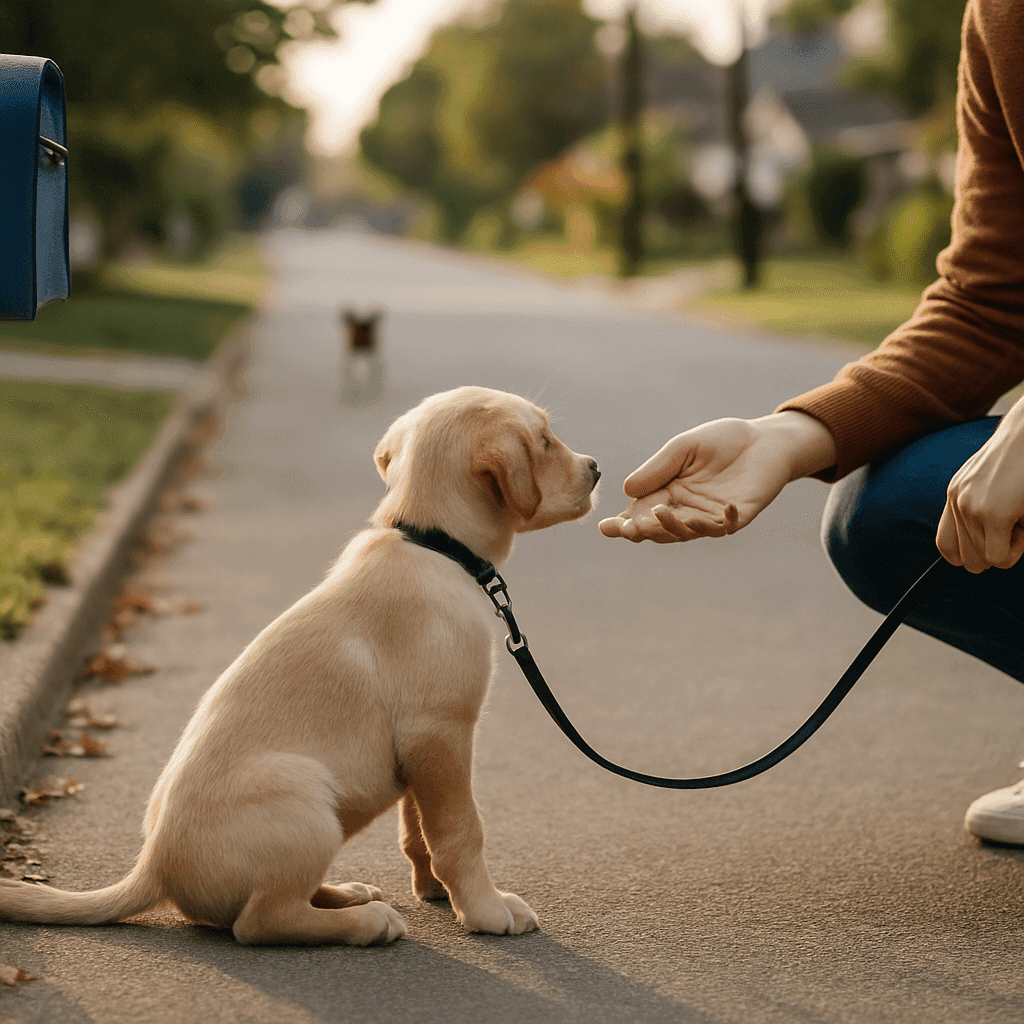
Puppy Scared of Other Dogs: A Gentle Confidence Ladder for First-Time Owners
You’re on a quiet morning walk with your 14-week-old puppy, leash loose, everything peaceful—until a neighbor’s dog appears three driveways down. Your puppy freezes, tail tucks, and presses against your legs like the sidewalk just turned into a cliff’s edge. Your stomach drops. Is this normal? Did you mess up socialization? Should you pick her up or make her face it?
Take a breath. This moment is more common than you think, and it’s not a verdict on your puppy’s future. In the next few minutes, you’ll learn why puppy fear of other dogs happens so often, the one well-meaning move that backfires every time, and a fill-in-the-distance confidence ladder that turns “I’m scared” into “I’m safe” one driveway at a time.
Is It Normal? (And Are You Doing This One Thing Wrong?)
Yes, it is completely normal for puppies to go through phases where other dogs feel overwhelming. Puppies have two main fear periods: the first around 8–11 weeks, and a second that typically runs anywhere from 6 to 14 months. During these windows, their brains are rapidly rewiring, and things that seemed fine yesterday can suddenly feel threatening. A 16-week-old Golden Retriever who bolts behind your legs when a small fluffy dog barks three doors down is right on schedule. She’s not broken, and you didn’t cause this.
The difference between healthy caution and a more serious issue lies in what happens next. A normal freeze often lasts 10–30 seconds; the puppy’s body might still be a little tense, but she can break her stare, sniff the ground, glance back at you, or take a treat if the other dog is at a comfortable distance. True fear that needs a gentler approach often includes a tucked tail, trembling, whale eye (seeing the whites), lip licking, or a refusal to re-engage at all. Neither is aggression; these are fear responses, not an attempt to harm.
Now for the one thing many first-time owners do without realizing it’s making things worse: picking up the puppy and carrying her toward the other dog. You lean down, scoop her up, and walk closer saying, “It’s okay, just say hi.” It feels kind, but from your puppy’s perspective, you’ve removed her only escape route and are moving her into the path of the scary thing. That teaches her that fear was justified—and that you aren’t listening. Instead, when you see that freeze, move away to a distance where she can breathe again. You’ll rebuild trust faster by giving her the choice to retreat than by overriding it.
If your puppy has been frozen and shut down around other dogs since the day you brought her home and is now 6 months old with zero improvement, skip ahead to the professional section at the end. Otherwise, keep reading—you’re about to get a system that works with her brain, not against it.
What’s Spooking Your Puppy? The Trigger Map
Before you set up any training, you need to know what exactly is setting your puppy off. Fear isn’t always “all dogs.” It’s often very specific, and once you name the trigger, the problem shrinks from “my puppy is scared of everything” to “my puppy is uneasy with large, dark, bouncy dogs who make direct eye contact.” That’s a solvable puzzle.
Run through this checklist with your next few walks. Put a mental checkmark next to anything that makes your puppy tense up:
- Size: Large dogs vs. small dogs (or vice versa).
- Coat color: Many pups find black or dark-coated dogs harder to read; some freeze when they see a black Lab but wag at a white Bichon.
- Noise: Sudden barking, growling, or high-pitched yapping.
- Movement: Fast, zigzag play, bounding, or wrestling.
- Staring: A dog that locks eyes and holds a direct gaze.
- Ear carriage: Pricked, upright ears versus floppy, soft ears—some pups find pointy ears unnerving.
- Location: Does the reaction happen on-leash on the pavement but not when the same dog is behind a fence? In the park but not on a quiet street?
A classic example: a Cavapoo who happily greets small white dogs in the vet’s lobby but pancake-flattens when a black Labrador bounces within 30 feet on the street. Another pup might be completely at ease with a slow senior dog but panic when two young Huskies start their bark-and-chase routine in a fenced yard. You don’t need a diagnosis; you just need the pattern. Circle what fits—that’s your puppy’s trigger profile. You’ll use it to set the ladder’s first rung, choosing starter practice sessions that involve the mildest version of that trigger.
If literally every dog, no matter how small, quiet, or distant, sends your puppy into full-blown panic, jump to the professional section sooner. For everyone else, take your trigger map and let’s build your ladder.
Your Confidence Ladder: 5 Steps of Distance and Calm
This ladder is the heart of the plan. It replaces vague “just go slow” advice with numbered rungs, real-world distances, and a clear move-forward rule. You’ll be using a technique often called “Look at That” (LAT): the moment your puppy glances at the other dog, you mark the moment with a word (“Yes!” or a click) and immediately deliver a high-value treat. This isn’t bribing; it’s rewiring. Your puppy’s brain learns: seeing that dog predicts chicken, not danger.
The golden rules first:
- Treats must be tiny, smelly, and irresistible—think warm chicken, freeze-dried liver, or a pea-sized blob of liverwurst.
- A session lasts only 2–3 minutes or 5–8 reps maximum. Short and sweet prevents overload.
- Only move closer when your puppy has had three consecutive sessions at the current distance with a loose body, eats treats without hesitation, and can look at the dog and disengage within about 5 seconds.
Your 5-Rung Ladder
Grab a pen and your phone’s notes app. Below is your fillable log. Copy it, print this page, or scribble it onto an index card that lives with your leash.
| Rung | Distance (fill in your real-world marker) | What You’ll Do | Success Signal | Date/Notes |
|---|---|---|---|---|
| 1 – Threshold Spot | _______________ (e.g., blue mailbox across the street) | Stand quietly. The moment your puppy notices the other dog, feed a treat before any freeze. Repeat a few times. | Puppy eats treats, body stays loose, can look away. | |
| 2 – Calm Glance Station | (Stay at Rung 1 distance for first session, then later possibly 5–10 ft closer after success) | Say “Look at that!” softly the instant your puppy glances at the dog, then treat. 5–8 reps. | Puppy glances and disengages within about 5 seconds, no whale eye. | |
| 3 – Half-Car Closer | _______________ (move half a typical car length closer, ~5–10 ft) | Same LAT protocol. Only attempt after 3 calm sessions at Rung 2. | Calm eating, no stiffness, quick recovery. | |
| 4 – Different Dog, Same Distance | _______________ (original threshold distance but with a new or slightly noisier dog) | Repeat Rung 1-2 patter with the new trigger. | Still willing to take treats, body not frozen. | |
| 5 – New Location, Safe Start | _______________ (bench at a different quiet park, or through a window) | Use the same distance-first approach. Always end on an easy win. | Puppy recovers quickly, looks to you after noticing the dog. |
How to find your Rung 1 distance: Walk with high-value treats to a spot where your puppy will see other dogs from far away. Watch for the first tiny sign of awareness—a pricked ear, a slight head turn—and feed a treat immediately. If she won’t take it, you’re too close. Back up 20 feet (the length of a short driveway) and try again. The distance might be the opposite side of a residential street (40–50 ft), the width of a school bus (30 ft), or even three parked cars end to end (about 30 ft). Mark your spot with something permanent: the blue mailbox, the third driveway, the fire hydrant beside the lamppost.
Real session example: You stand at the blue mailbox, puppy at your side, a Golden Retriever appears 45 feet away. You say “Look at that!” the second your puppy’s eyes hit the dog, then pop a piece of warm chicken into her mouth. She chews, glances again, you repeat. After six reps, she glances at the dog and immediately turns back to you—score. That’s a calm disengagement. Repeat two more days at the same spot until she’s offering that turn-away without prompting. Then you shrink the gap by half a car length (roughly 5–10 feet) and start Rung 3.
Moving too fast is the number-one mistake. One good session doesn’t mean “move closer tomorrow.” Wait for the pattern of three in a row. Progress is a calm pattern, not a lucky moment.
If your puppy won’t take treats at any distance, upgrade the treat value first. If even warm liver pâté is ignored, check the environment: is a loud motorcycle passing every few seconds? Try a quieter time of day. If the problem persists, the underlying anxiety may need professional eyes—see the 4-week rule section.
Reading Your Puppy’s Body: The Yes/No Signals of Progress
One of the biggest traps is mistaking a frozen, shut-down puppy for “calm.” A dog who stands rigid, tail straight out or tucked, and doesn’t move isn’t relaxed—she’s overwhelmed. Use this quick Yes/No translator to decide whether to keep going or back up.
YES – Keep Going (signs the session is working)
- Body is loose, tail wags softly or hangs neutrally
- Eyes are soft, blinking normally
- Ears are at half-mast or moving to catch sounds
- Sniffing the ground or looking around casually
- Takes treats gently, without snapping
- Looks at the other dog and then naturally disengages within 3–5 seconds
NO – Stop or Go Back (signs stress is climbing)
- Tail clamped, stiff, or tucked tightly
- Whale eye: the half-moon of white showing as the puppy turns her head away but keeps eyes on the dog
- Lip licking (when no food is present) or yawning repeatedly out of context
- Freezing completely for more than 10 seconds, body rigid
- Refusing a high-value treat she was eagerly eating seconds ago
- Body lowered, ears pinned flat, moving in slow motion
Here’s the rule: One “no” signal = pause. Immediately increase distance by 10–20 feet and toss a couple of treats on the ground for a reset. Three “no” signals = end the session. Clip the leash, go home, and no fuss. It’s not a failure; it’s data that the rung was too hard. The following day, return to the previous, easier rung where she was successful.
Mixed signals happen, too. A puppy who eats treats but keeps her tail tucked is telling you she’s coping but not comfortable. Stay at the current distance, shorten the session to 1 minute, and do not move closer until you see a fully loose body.
When to Stop a Session: The Stress Signal Checklist
Check this list before each rep to avoid the “just one more try” trap. If you see any of these five signals, resist the urge to push through.
Stress Signal Quick-List: 5 Signs to End a Session
- Yawning when not tired or sleepy – A wide, exaggerated yawn with no sleepiness following it.
- Lip licking repeatedly in a short period – Fast flicks of the tongue when there’s no food around.
- Whale eye – The whites of the eyes showing, especially when the puppy’s head is turned slightly away.
- Freezing or body going tense for longer than 10 seconds – Standing rigid, tail out stiff, not responding to gentle cues.
- Refusing a previously high-value treat that was taken eagerly moments before – Ignoring chicken, liver, or whatever was working.
How to use it: If any one signal appears, immediately increase distance by 10–20 feet and do one more easy treat toss to reset. If a second signal follows, end the session calmly—no scolding, no disappointment. Congratulate yourself for reading your dog and protecting her trust.
Example: Your puppy was happily catching chicken bits, then a distant dog barks twice and she ignores the next piece. That’s treat refusal. Step back to the bench across the street, scatter a few treats on the grass, and call it for the day. You just collected priceless information: the bark at that distance was too much. Tomorrow, start further back.
The Don’t-Do List: Mistakes That Make Fear Worse
Almost every well-intentioned owner has done at least one of these. No shame—each has a simple replacement that plugs right into the ladder.
| Don’t | Do Instead |
|---|---|
| Pick up and carry the puppy toward the other dog (removes escape, signals danger) | Move to a comfortable distance and start Rung 1. Let her observe from safety. |
| Force a nose-to-nose greeting (flooding the puppy with too much too soon) | Walk parallel to the other dog at a distance where your puppy stays loose. Work toward a casual parallel walk before any meet. |
| Scold, leash-pop, or use a stern voice when the puppy freezes (fear + punishment = deeper fear) | Stay neutral. Mark and treat any small brave choice, like looking at you. |
| Chatter in a high-pitched, worried voice (“It’s okay, baby, it’s okay!”) which signals that something really is wrong | Use calm, quiet praise. Speak to your puppy in a steady, everyday tone. |
| Wing it without a plan; try different distances every time | Fill in the ladder log. Repeat a successful rung until the success signal is solid, then inch forward. |
If you’ve already done a few of the “don’ts,” that’s actually good news—you’ve found the biggest levers for change. The ladder rebuilds trust because it puts the puppy’s emotional state first, every single rep.
When to Call a Professional: The 4-Week Safety Rule
Safety note: This article and ladder are for fear-based behaviors only. If your puppy shows any aggression—hard stare, forward body weight, growling while moving toward the other dog—or extreme panic (screaming, urinating, bolting into traffic, self-harm) even at distances over 200 feet, stop immediately and consult a certified positive-reinforcement trainer or a veterinary behaviorist.
For fearful puppies who don’t have that level of distress, the ladder can still be your primary tool, but there are clear times to bring in a professional. Watch for these four signs:
- Offensive aggression. Forward posture, hard stare, deep growling with intent to keep distance, lunging without retreat. This needs a behavior professional who can assess risk and design a safety-first plan.
- Extreme panic responses. Screaming, urinating/defecating, trying to bolt under cars, biting at the leash or at herself when a dog comes into view, even 200 feet away. This is not a DIY job.
- Complete refusal to eat or drink outside. If your puppy won’t take any treat or water on walks anymore, her baseline anxiety is too high for the ladder alone. Rebuilding needs medical and behavioral support.
- No progress after 4 weeks of consistent ladder work. That’s roughly 12–16 sessions, 3–4 times per week. If your puppy’s threshold distance hasn’t shrunk by even a few feet, or she still lip-licks and refuses chicken at 100 feet, it’s time for fresh eyes.
Asking for help isn’t giving up. It’s recognizing when a guide can spot something you can’t. Look for credentials like CCPDT (Certified Professional Dog Trainer), IAABC, or a veterinary behaviorist (DACVB). When you call, ask directly: “Do you use force-free, positive-reinforcement methods?” A good professional will say yes without hesitation.
Frequently Asked Questions About Puppy Fear of Other Dogs
Q: Is it normal for my puppy to be scared of other dogs?
A: Absolutely. It’s very common, especially during the fear periods (8–11 weeks and again around 6–14 months), or if a puppy hasn’t had gradual, positive exposures. Fear isn’t aggression, and with a gentle ladder approach, most pups build confidence beautifully.
Q: How do I tell if it’s fear or aggression?
A: Fear typically looks like shrinking, tail tucking, looking away, lip licking, and trying to create distance. Aggression tends to show as forward body posture, a hard unwavering stare, raised hackles, and growling while moving toward the other dog. The ladder is designed for fear. If you’re seeing forward movement with hard eyes, skip to the professional section.
Q: What distance should I start the confidence ladder at?
A: Start at the spot where your puppy notices the other dog but still eagerly takes high-value treats. For many fearful pups, that’s 50–80 feet—across a wide street. Use permanent markers like the blue mailbox, the third driveway, or a fire hydrant so you can be consistent session to session.
Q: What if my puppy won’t take treats near other dogs, no matter the distance?
A: First, upgrade to something truly irresistible—tiny bits of warm rotisserie chicken or liverwurst often break through. Next, check if the environment has other triggers, such as traffic roar or a construction site. If treat refusal continues even with top-value rewards and a quiet setting, the underlying anxiety may be too high for a DIY ladder. Follow the 4-week rule and consult a professional.
If your puppy also freezes or hides from unfamiliar people, you’re not alone—fear of strangers often travels with dog fear. Our guide on Puppy Scared of Strangers uses a similar distance-based introduction method that you can pair with this ladder. And to boost your puppy’s overall optimism between outdoor sessions, check out Crate Games for Building Puppy Confidence Indoors. These low-pressure games make the world feel less overwhelming without any forced interaction.
You now have a ladder that turns “I’m scared” into “I’m safe,” one driveway, one treat, one calm glance at a time. Copy the fillable log above into your notebook or phone, and fill in that first threshold marker today. Choose a quiet hour, pack diced chicken, and run a single 3-minute session at the blue mailbox. That’s all it takes to start.
For a full daily routine that supports calm, predictable days, try our free Puppy Schedule Generator. It builds age-based potty breaks, sleep windows, and training slots so you and your puppy both know what to expect—and confident routines make confident dogs. Generate your puppy schedule here.
Sources and Safety References
For more on puppy fear periods and safe socialization, refer to these expert guides: