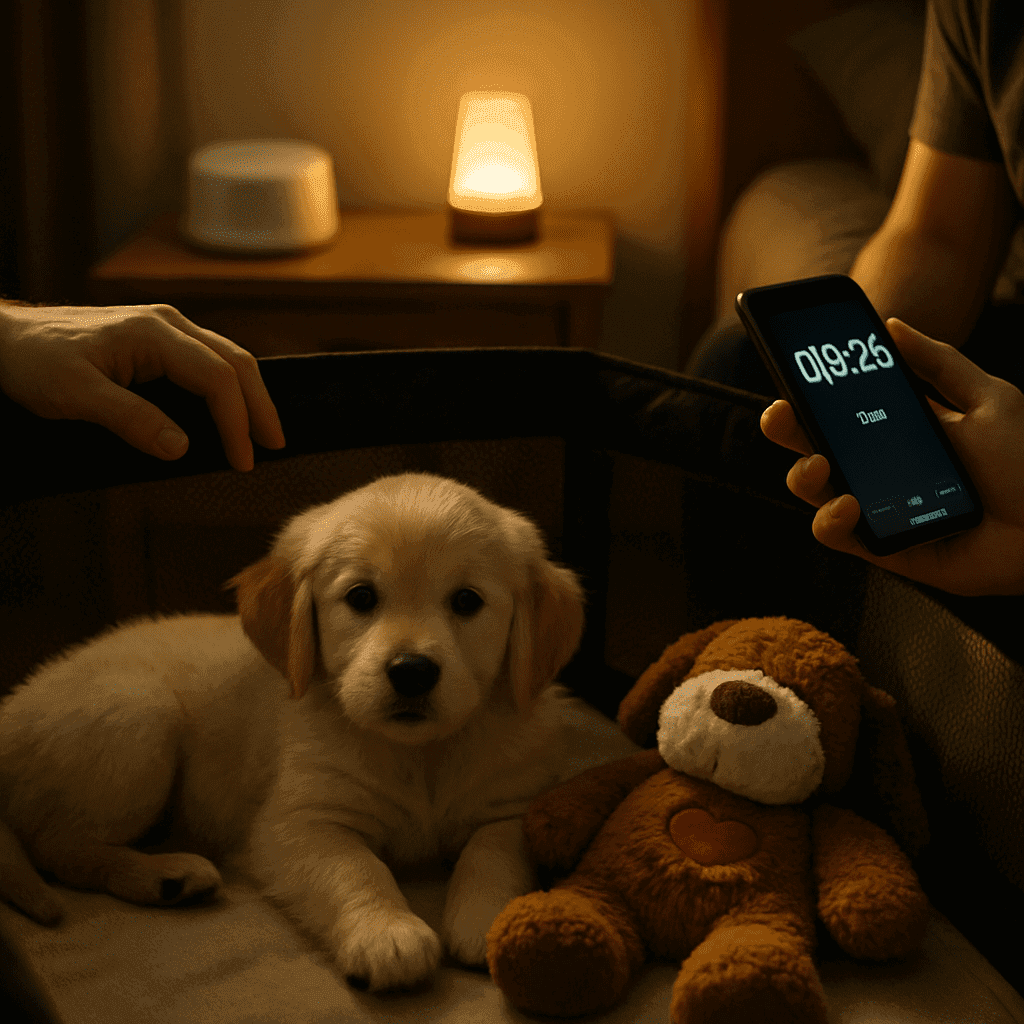
Puppy Playpen Training: The 3-Day Reset Plan to Make the Pen Feel Safe and Stop the Crying
Safety note: This protocol helps with normal adjustment crying—the kind that waves and fades. It is not for a puppy who is screaming, panting, drooling, vomiting, or trying to hurt themselves. If you see any of those signs, stop, comfort your puppy, and call your veterinarian. Trust your gut; no training plan is worth terrorizing a panicked puppy.
It’s 2 a.m. Your 10-week-old puppy is standing in the playpen, making a sound that lands somewhere between a smoke alarm and a wounded seagull. You’re lying in bed, eyes wide, heart thumping, scrolling through advice that swings from “never let them cry” to “ignore it, they’ll figure it out.” Both feel wrong. You’re exhausted, guilty, and half-convinced your puppy thinks you’ve abandoned them forever.That 2 a.m. paralysis is exactly what Jamie felt when she first brought her Labrador pup home. Desperate to stop the crying, she’d rush to the pen the second the whimper started, scoop him up, and whisper sweet nothings. By night three, the puppy had learned a clear lesson: “If I scream long enough, Mum appears and I get a cuddle.” The crying got longer and louder. Jamie dreaded bedtime.That’s when she tried a completely different approach—not ignoring, not rushing in, but a timed, boring-response plan that taught her puppy the pen was safe and that silence, not volume, brought calm company. Within three nights, the screaming shortened to a brief 4-minute whimper followed by a deep, sigh-filled sleep. You can do the same. This article gives you the exact sequence of actions from 9:30 p.m. to morning, with no guesswork.Playpen Setup & Bedtime Ritual (Do This First Every Night)
The overnight pen is not a holding cell; it’s a mini-den. How you set it up and how you lead into bedtime determines whether your puppy walks in with a wiggly tail or with dread. Do this 30-minute wind-down every night so the timed protocol starts on a calm foundation.Location: Put the pen in your bedroom for the first few nights, 2–3 feet from your bed. The puppy can hear your breathing, but they can’t see every toss and turn. This closeness reduces panic without teaching that crying brings you closer. If you live in a studio apartment, angle the pen so the door faces a wall or a piece of furniture, not your sleeping face.Sound and light: A white noise machine or low-volume talk radio (think BBC Radio 4 level) masks door slams and midnight fridge raids. Keep a small nightlight on; total darkness can scare a young puppy who’s just left the littermate pile. Room temperature should sit between 68–72°F (20–22°C). A cold puppy is a crying puppy.Comfort items that make a real difference: Place a Snuggle Puppy with the simulated heartbeat inserted into the pen. Puppies used to sleeping against a warm heart often settle when they feel that gentle thump. An Adaptil diffuser plugged in nearby releases a synthetic version of the calming pheromone a nursing mother dog produces. Neither product is essential—the protocol works without them—but they can lower the baseline stress enough to make the first night tolerable. Inside the pen, add one completely safe chew: a classic KONG with a thin smear of puppy paste or a bit of frozen banana, so the puppy has a quiet, licking-soothing activity. No rawhide, no stuffed toys that can be shredded and swallowed.Safety, water, and collar: Remove your puppy’s collar before pen time. A collar can catch on pen panels or crate clips. Use a spill-proof water bowl clipped to the pen side; never withhold water at night. If your puppy is still dribbling into the bowl and splashing, swap to a small, heavy ceramic bowl that stays upright.The 10-minute final potty break: Exactly 10 minutes before you plan to close the pen gate, take your puppy outside on a leash for the most boring toilet trip of the day. Stand still. No eye contact, no cooing, no playing, no treats. If puppy eliminates, a quiet “good” is the max. Then straight back inside, no detour to the kitchen. This teaches that nighttime is not party time.The goodnight cue: As you lower your puppy into the pen, say the same three words every night in a flat, reassuring tone: “Time to sleep, good pup.” Then turn away, walk to your bed, and start your timer. The consistency of the phrase becomes a cue that nothing scary is about to happen.Nightly Prep Checklist: Before You Close the Playpen Gate
If after all of this your puppy still cries, check for teething pain: offer a chilled, damp washcloth knotted inside the pen to gum on. Move the pen 1 foot closer if needed. The setup isn’t “one and done”; it’s a nightly tune-up.- Final potty break completed 10 minutes ago (puppy eliminated #1 and #2)
- Fresh water available in spill-proof bowl, not removed
- One safe chew toy (KONG, Nylabone) and the Snuggle Puppy with heartbeat on
- Adaptil diffuser plugged in nearby (if using)
- White noise machine or talk radio playing at low volume
- Room temperature between 68-72°F (20-22°C), nightlight on
- Puppy’s collar removed, pen secured, no loose threads or hazards
- Your phone timer set to 5 minutes (Night 1), placed by your bed
- You’ve rehearsed the calm phrase: “Shhh, you’re okay.”
- Any other people in the house know the protocol and will not intervene
Crying Decoder: Fear, Potty Need, or “Just Testing”?
Before you can respond correctly, you need to know what you’re responding to. Blanket “ignore all crying” advice fails because it treats a potty emergency the same as a demand bark. Here’s how to decode the cry in under five seconds.| Why They’re Crying | Sound & Pattern | Body Language | Typical Timing |
|---|---|---|---|
| Fear | High-pitched, continuous, may escalate to a scream. Little to no pause. | Ears pinned back, tail tucked, cowering in the corner, trembling. Might try to hide under something. | Starts almost immediately when you leave the room or after a loud noise outside. |
| Potty Need | Insistent sharp barking or yipping that gets louder fast. Usually stops during a squat attempt. | Pacing, sniffing the floor, circling, pushing at the pen door. The whole body is restless. | Usually 1–3 hours after the last break, often at the same time each night. |
| Attention / Testing Boundaries | Rhythmic barking or whining with 3–5 second gaps where they go silent and listen for footsteps. Often resumes when they hear you shift in bed. | Ears forward or swiveling, head tilted, tail may wag when they hear you. No crouching or hiding. | Often begins after a few minutes of quiet, once they’ve realized you haven’t disappeared entirely. |
Night 1 – The 5-Minute Response Rule
This is the night that breaks the “cry = cuddle” loop. Every move is scripted so you don’t stand in the hallway arguing with yourself. Here’s the exact timeline from 10:00 p.m. onward.- 10:00 p.m. – After the bedtime ritual, place your puppy in the pen, say your goodnight cue, and walk to your bed. Start a 5-minute timer on your phone.
- 10:02 – Puppy begins to whine. You lie still, watching the timer. If the crying stops for at least 10 full seconds at any point within those 5 minutes, reset the timer. Do not go in. That 10-second gap is the first self-soothing victory.
- 10:07 – The crying was continuous for the full 5 minutes. Stand up slowly. Walk to the pen without speaking. Place your hand flat on the mesh (or on the panel near the puppy) at their shoulder height. Do not make direct eye contact. In a low, calming voice, say exactly: “Shhh, you’re okay.” Stay for 30 seconds. No picking up, no petting, no treats.
- 10:07:45 – Wait for 10 seconds of complete silence after you’ve spoken. The instant you get it, turn and leave without a word. If the puppy starts crying again as you walk away, keep going.
- If crying restarts – Set a new timer for 7 minutes and repeat the same 30-second hand-on-mesh visit. Do not escalate your voice. Never pick the puppy up.
- After four repetitions (roughly 30 minutes total) without a single quiet break, take your puppy for a silent, leashed potty trip. Outside, stand still for 3 minutes. If no elimination, return to the pen and restart the 5-minute timer fresh.
What if they scream the second you retreat?
Don’t turn back. Set your timer for 7 minutes and trust the structure. Turning back teaches that intensity levels up, you’ll respond. Keep your breathing steady; your own calm will eventually become your puppy’s model.Night 2 – Stretching the Timer from 5 to 10 Minutes
Night 2 assumes your puppy got at least one spell of self-settled quiet on Night 1—even if it lasted only a minute. Now we stretch the waiting interval so the puppy learns that you won’t pop up every time they make a peep.How to start: Repeat the full bedtime setup—same time, same potty trip 10 minutes before, same cue. At the first whimper, start a 10-minute timer with no 5-minute warm-up.The new rule: During those 10 minutes, listen for any 10-second quiet spell. The moment you hear it, reset the timer. If the timer reaches zero with continuous crying, perform the brief mesh hand and shush, but limit your stay to 20 seconds instead of 30. Leave as soon as you have 10 seconds of silence.If after two full 10-minute cycles the puppy hasn’t quieted at all, take one silent potty break and restart the 10-minute approach. No going back to 5 minutes—that would undermine the progress.Why the 10-minute leap matters: Puppies learn patterns quickly. If you consistently show up at 5 minutes, they’ll cry exactly until the 5-minute mark. Stretching to 10 minutes teaches that longer quiet spells get them what they want—a brief, boring check and then sleepy reassurance.Track your win: Write down the time from pen placement to the first 1-minute self-settled quiet span (where the puppy is silent and lying down). This number is your progress marker. One owner noted: “Night 2, puppy cried 8 minutes, then went silent for 1½ minutes and fell asleep. I wanted to go peek, but I stayed in bed—that was the turning point.”If Night 1 was a disaster—no quiet, nonstop screaming—do not advance to 10 minutes. Repeat the Night 1 protocol but move the pen 3 feet farther from your bed. The extra distance reduces the accidental reinforcement of hearing you shift. Then try Night 2 rules the following night.Night 3 – Working Toward 15 Minutes and Self-Settling
By Night 3, your goal isn’t zero noise; it’s that the puppy quiets themselves within 15 minutes before you ever need to walk over. Many puppies will still let out a short protest, but the intensity drops dramatically.Timer setting: If Night 2 ended with a solid self-settle (at least 1 minute of quiet before you intervened), set your initial timer to 12 minutes. If your puppy still needed a hand-on-mesh visit last night, stay at 12 minutes but add a harder rule: wait for 30 seconds of silence before you approach, not just 10 seconds.How the night should feel: The puppy whines for 4–6 minutes, pauses, turns in a circle, lies down, and maybe whines again softly for another 2 minutes, then falls silent. You stay in bed, watching the timer. At the 12-minute mark, if the crying has been intermittent with quiet gaps, you do not go in at all. The puppy is learning self-settling. Enter only if the crying is loudly continuous for the full 12 minutes, and even then, limit the visit to 15 seconds, no hand on mesh unless absolutely necessary—just stand near the pen and say “shhh” once, then leave.Morning rule reminder: Even if your puppy wakes at 5:30 a.m. and begins a soft protest, do not open the pen until you’ve counted 30 seconds of total silence (any gap). This stops the chain of “cry = door opens” that can undo your work.What does normal progress look like? By Night 3, many puppies will cry for less than 8 minutes and then sleep through until a single 3–4 a.m. potty break. If your puppy manages even 4 minutes of crying followed by a quiet down, that’s a win worth celebrating. Some soft whimpering in short bursts is developmentally normal—like a child mumbling before sleep. Don’t panic.If you see no improvement at all by Night 3, check for medical issues: teething pain, a urinary tract infection, or tummy upset can cause nighttime screaming that no training can fix. When in doubt, pause the protocol and see your veterinarian. The puppy separation anxiety signs guide helps you tell the difference between normal protest and true distress that needs professional help.The Morning Wake-Up Routine (Don’t Rush the Exit)
Mornings are where tired owners accidentally undo all the good work. You hear the first whimper at 5:45 a.m., you need coffee, and you swing open the pen while the puppy is bouncing and yelping. To the puppy, that reads: “Loud frantic noise made the human appear and let me out!” That lesson will be repeated every single morning.How to exit the pen without creating a demand monster:- When you wake and the puppy is already crying, lie still and wait for the tiniest gap of silence—even 5 seconds. That gap is your ticket to open the pen. No excited greeting, no high-pitched “Good morning!” Just a quiet “hey pup” and immediately clip on the leash.
- If the puppy is doing the potty dance (pacing, sniffing urgently) and the silence gap won’t come after 10 minutes, set a 5-minute timer. If no quiet during that window, take a completely dull leashed potty trip—straight out, stand still, straight back. No breakfast, no play.
- Delay breakfast by 5–10 minutes after the potty trip. Breaking the expectation that “pen opens = instant food” stops the frantic morning energy that seeps into bedtime later. After the potty trip, you can put the puppy back in the pen with a frozen KONG for a calm 15 minutes while you brush your teeth.
Daytime Playpen Games That Speed Up Nighttime Calm
A puppy who only sees the pen at night associates it with isolation and darkness. That turns the pen into an emotional punishment. Flip the script with three short daytime exercises that rewire the pen as a source of good stuff.Game 1: Sit-and-Chew (5 minutes) – Place a stuffed KONG or a bully stick in the open pen. Sit on the floor right next to it with a book, laptop, or your breakfast. Ignore the puppy. Let them wander in voluntarily, lie down, and chew. When they’re settled, close the pen door. Stay there working calmly for 5 minutes. No talking, just your presence. They learn that the pen is a cosy spot to chew, not a place of separation.Game 2: In/Out Treat Toss (3 minutes) – With the pen door open, toss a small treat inside. When the puppy walks in, say “good” in a neutral tone. After 10 seconds, open the door and let them walk out. Repeat 5 times. Gradually increase the wait time to 20, then 30 seconds before release. Never force the puppy in; the treat does the invitation.Game 3: Distance Dash (builds slowly) – While your puppy is focused on a chew in the closed pen, stand up and walk to the bedroom door for 5 seconds, return, and drop a treat in the pen. Next time, step into the hallway for 10 seconds, return, treat. Over a week, work up to 30 seconds out of sight. The pattern teaches that you leaving the room is a predictor of a treat opportunity, not abandonment.Use these games at least twice a day, ideally in the mid-afternoon and early evening. Never use the pen for time-outs or after you’ve yelled at the puppy—that poisons the pen’s emotional value. If you need a secure space after a potty accident, use a different gated area or a tether until the emotion is calm, then reintroduce the pen with a treat scatter later.If your puppy panics even during 30-second daytime sessions with you in the room, don’t close the door yet. Get an open-top pen and sit inside it with the puppy on a cushion for a few sessions. Once the puppy can relax with you there, you step out for one second, then back in, building from zero.For a full age-appropriate daily rhythm that builds independence without overwhelm, you can use the free Puppy Schedule Generator to map out naps, training, and pen games throughout the day.
When to Stop the Protocol: Stress Red Flags and Vet Alerts
This plan is built on the understanding that a bit of fussing is normal as the puppy learns the pen is safe. But there is a line. Crossing it does harm. Here are the red flags that tell you to stop immediately.Absolute stop signs:
If you see any of those, open the pen right away. Comfort your puppy; check their body for a stuck claw, an embedded thread, or signs of pain. Do not resume the protocol that night. Wait until you have a veterinarian check, especially to rule out a urinary tract infection, intestinal blockage, or teething-related complications.Timing rule: If severe distress continues for more than 10 minutes after you’ve opened the pen and soothed them, call your vet or the nearest emergency clinic. Explain exactly what you observed: “My puppy was screaming, panting heavily, and biting the pen bars; after 10 minutes of comfort, they’re still trembling and won’t drink.” That information helps the vet decide urgency.Don’t gaslight yourself. When the internet tells you “it’s just manipulation,” but your puppy’s body says panic, listen to the puppy. No training plan is more important than your dog’s well-being. The AVSAB position statements on humane dog training clearly advise against flooding a puppy in fear and encourage reading stress signals accurately. You’re not weak for stepping in; you’re responsible.What’s normal after lights-out:- Sustained high-pitched screaming with no pause for more than 5 seconds
- Heavy panting when the puppy hasn’t been running, paired with drooling, trembling, or wide, dilated pupils
- Frantic biting at bars, trying to push their head through gaps, or throwing themselves against the mesh
- Vomiting or diarrhea in the pen
- Collapsing limply in a corner, extreme lethargy upon release, or not rousing when you approach
- Soft whining that fades within 5–10 minutes
- Intermittent barks with long pauses, finally settling to chew a toy and sleep
- Brief crying right after a potty break that settles once they’re back in the pen
- Lying against the mesh with a sigh before drifting off
- Continuous screaming without a break for longer than you’d expect a tired puppy to protest
- Trembling or drooling heavily with no known temperature trigger
- Escape attempts that could cause injury
- No decrease in crying intensity after three nights of correct use