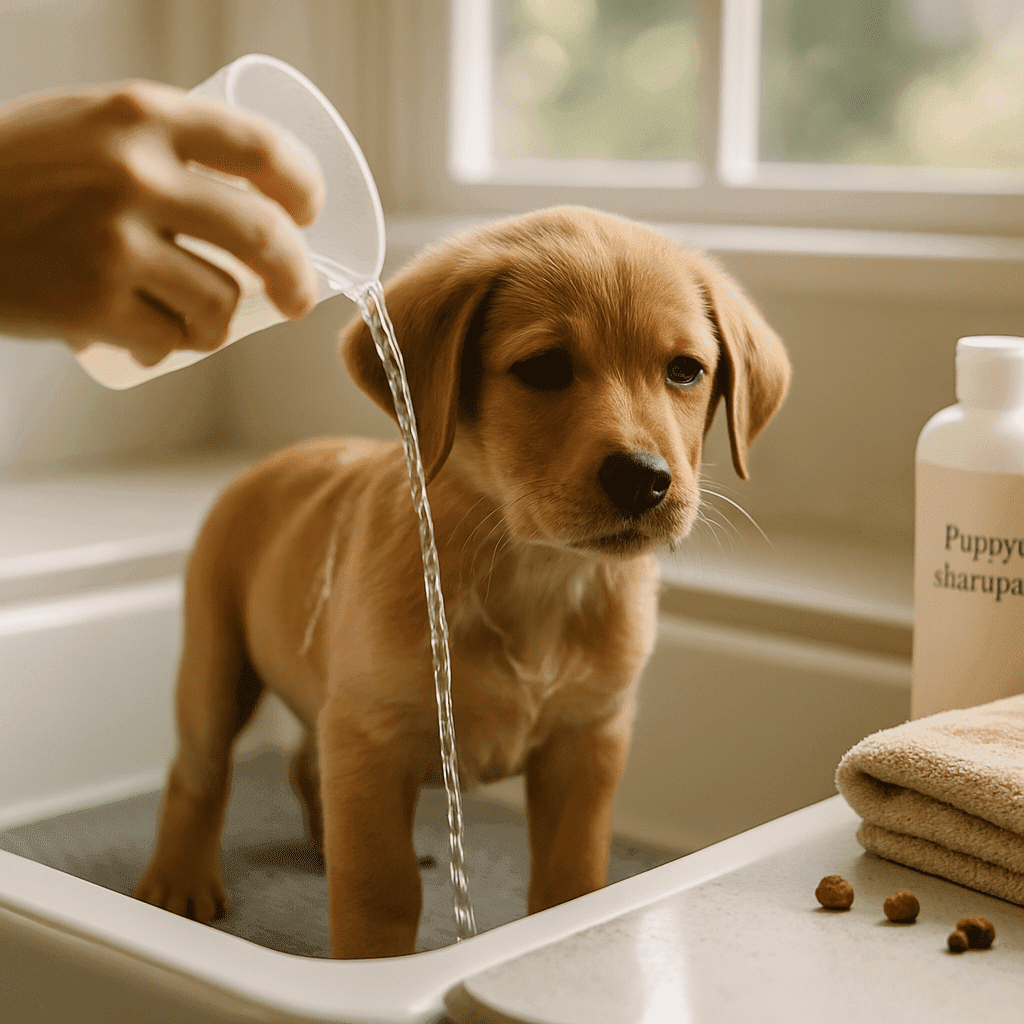
Puppy’s First Bath: A Calm, Safe Step-by-Step Plan for First-Time Owners
Safety note: Never bathe a puppy with skin infections, open wounds, diarrhea, vomiting, or extreme lethargy. For puppies under 8 weeks, only give warm-water sponge baths with a damp cloth. Always test water temperature with your inner wrist—100-102°F max. Stop immediately if your puppy screams, pants excessively, attempts to bite, or goes limp. If you are unsure about your puppy’s health or vaccine status, call your veterinarian before bathing. This guide is not a substitute for professional medical advice.
Before You Even Turn on the Water: The 4-Step Pre-Bath Setup
Most bath disasters start with a missing towel or a slippery floor. When your puppy is already in the tub and you’re fumbling for shampoo, anxiety escalates fast. Set yourself up for a calm, no-scramble experience by doing these four things first—before your puppy even enters the room.Step 1: Choose your location
For tiny puppies (under 12 weeks or toy breeds), the kitchen sink or a shallow baby bath is safest. High-sided adult tubs can feel like a canyon. If you must use a regular bathtub, set down a non-slip bath mat (suction type) and place a rolled towel against the wall to prevent sliding. In a small apartment bathroom, the sink with a rolled towel as a bumper works well; just make sure both your hands are free and the counter is clear.Step 2: Gather every supply within arm’s reach
You’ll need:- Puppy-safe tearless shampoo (labeled “pH-balanced for puppies,” oatmeal-based if possible)
- Two absorbent microfiber towels (one for drying, one for wrapping)
- A large plastic cup or a gentle spray nozzle set to “mist” or “shower” (never jet)
- Cotton balls (optional, to place loosely in outer ears for floppy-eared pups)
- A soft washcloth just for the face
- High-value treats cut into tiny, pea-sized pieces
- A frozen stuffed Kong or long-lasting chew for after the bath
Step 3: Secure a non-slip surface
Test the mat or folded towel by pressing your hand firmly—it shouldn’t budge. If your bathroom is too small for a mat, use a large, damp towel pressed flat and held at the edges. The fear of slipping triggers a panic spiral; a stable footing is non-negotiable.Step 4: Fill your rinsing cup and check water temperature
Fill the cup or sprayer with lukewarm water. Test it on your inner wrist—it should feel faintly warm, never hot. The target is 100-102°F (38-39°C). If you’re using a spray nozzle, adjust to the shower setting (wide, soft stream) and test the pressure on your own arm. Once the water is ready, stand the cup beside the tub. Do not run the faucet with the puppy present; the sound and sudden splash can terrify him.Set a timer: this setup should take 5 minutes max. Then go get your puppy.Is Your Puppy Old Enough? The Age & Condition Checklist
Before you even wet a paw, run through this quick safety checklist. Baths aren’t just about cleanliness—they can affect health when the timing is wrong.The Age Go/No-Go Table
| Age & Health Scenario | What to Do |
|---|---|
| Under 8 weeks old | Warm-water sponge bath only—no immersion, no tub. |
| 8–16 weeks, healthy, no recent vaccines | Full gentle bath allowed. Still keep it under 10 minutes. |
| 16+ weeks, healthy | Full bath with gradual desensitization if the puppy is fearful. |
| Vaccinated within last 48 hours | Call your vet for their specific post-vaccine bathing guideline. Most say it’s fine if the puppy is acting completely normal, but always confirm. |
| Puppy has diarrhea, vomiting, is lethargic, or has open sores | No bath. Call your veterinarian first. |
| Puppy arrived home less than 72 hours ago | Wait until they’ve settled and bonded a little. A bath can be too much too soon. |
The Scared Puppy Decision Tree: Calm, Slightly Nervous, or Panicked?
This is the moment you’ll need a plan—not just a vague “be gentle.” The first 30 seconds of water contact tell you everything. Use this decision tree to guide your next move.Step 1: Assess your puppy’s behavioral bucket
- Calm: Tail relaxed or happily wagging, taking treats readily, standing or sitting without resistance, curious about the water.
- Slightly Nervous: Shifting weight back and forth, occasional low whine, a little tail tuck but still taking high-value treats, maybe trying to sit down in the water.
- Panicked: Frantically scrambling to jump out (more than 3 attempts), high-pitched yelping, trying to bite your hand, ears pinned flat back, refusing treats completely.
Step 2: Follow the matching fork
If Calm → Proceed with the full step-by-step bath (below). Check your puppy’s body language every 2 minutes. He stays relaxed? Great. Continue.If Slightly Nervous → Use the 5-Minute Confidence Protocol.- Stop pouring water on the puppy’s back. Run a tiny stream of water from the cup over his feet only while feeding a steady stream of tiny treats. Praise softly: “Paws here… yes, good stand.”
- After 2 minutes, trickle water over the back legs and up to the rump—still no water on the head. Keep treats flowing.
- After another 2 minutes, if the puppy relaxes (tail wags once, ears lift), you may continue rinsing the back up to the shoulders. Do not rinse the head today.
- If the puppy is not improving after the first 2 minutes, move to the Panicked plan immediately.
Track Tiny Wins with the Calm-O-Meter
| What You Saw | What You Did | Small Win? |
|---|---|---|
| Nervous, but took treats after cup on feet | Confidence Protocol, feet only | Yes – mark it |
| Tucked tail relaxed after 3 min | Continued back half only | Yes – progress |
| Yelped and launched out | Wrapped in towel, dry run tomorrow | Yes – you listened and prevented trauma |
The 10-Minute Step-by-Step Bath (With Timing & What to Say)
When your puppy is calm enough to proceed, use this exact sequence. The script phrases keep your voice steady and your puppy oriented—no nervous “good boy” on repeat. Set a timer on your phone.Phase 1: Warm-Up (0–2 minutes)
- Cup pour on the shoulders and back only. Say: “Water time… good pup.”
- Watch for stiffness. If he startles, pause and go back to treats for 30 seconds.
- Never pour water on the head.
Phase 2: Shampoo (2–5 minutes)
- Squeeze a pea-sized amount of puppy shampoo into your palm—not directly on the puppy. Lather your hands, then smooth from the neck backward, avoiding eyes and ears. Use: “Nice soft circle, steady pup.”
- Gently massage down the back, sides, and legs. Avoid scrubbing vigorously; slow, circular pressure is calming.
Phase 3: Rinse (5–8 minutes)
- Using the cup (or mist spray), rinse repeatedly until the water runs completely clear. Soap residue leftover causes itching later. Say: “Rinse time… good stand.”
- Keep the head dry. Focus on the back, legs, and underbelly. If your puppy gets restless, skip one leg and make a note to wipe it with a damp cloth tomorrow.
Phase 4: Face and Head (8–9 minutes)
- Dampen the washcloth with clean, warm water (no shampoo). Wipe outward from the eyes to the ears. Wipe the muzzle and under the chin. Never pour water directly onto the face.
- If you placed cotton balls in the ears, remove them now gently.
Phase 5: Final Comfort (9–10 minutes)
- Say firmly but warmly: “All done! Brave puppy!” Lift him straight out into the waiting towel. Do not let him scramble out alone.
- Wrap him immediately; the goal is to end on a feel-good note, not a soggy, confused exit.
Normal or Not? Signs to Keep Going, Slow Down, or Stop Immediately
Understanding what’s normal helps you avoid rushing to abort when your puppy is actually okay. Use this guide to read the room in real time.Normal reactions:- A shake or shiver when first wet
- A short whine when water touches the back, then stopping within seconds
- Trying to sit down in the water (but not panicking)
- Looking back at you for reassurance
- A few full-body shakes during drying
- Continuous high-pitched yelping or screaming
- Frantically scrambling to jump out repeatedly without any calm moments
- Snapping or trying to bite your hand or arm
- Excessive panting, drooling, or glazed eyes
- Collapsing or going completely rigid
6 First-Bath Mistakes That Backfire (And How to Avoid Them)
You’re human; mistakes happen. Here’s how to spot the big ones before they damage your puppy’s bath tolerance.- Using human or baby shampoo. You finish, and your puppy’s skin looks fine. But two days later, flaking and itchiness appear. Human skin pH is around 5.5, while a dog’s is closer to 7.0–7.4. Human products strip the natural oils and disrupt the skin barrier. Only use puppy tearless shampoo. If you’re mid-bath and realize you forgot it, stop and just use warm water with a cloth—never any human soap.
- Not testing water temperature with your inner wrist. Even “warm” water from the tap can be too hot. The wrist test mimics your puppy’s thinner skin sensitivity. Do it every single time.
- No non-slip surface. One slippery slide and the puppy’s brain wires a panic memory to bath time. A suction mat or wet towel is mandatory.
- Getting water or soap in the ears or eyes. Shampoo near the eyes stings, and water deep in the ear canal can lead to infection. Use a washcloth on the face, and consider loose cotton balls for floppy ears (remove right after).
- Running the faucet with the puppy in the tub. The sound and random splashing startle. Fill the cup or bucket before the puppy enters.
- Rushing drying with a hot hair dryer. A hot, loud dryer can burn delicate skin and create a lifelong fear of motor noises. Towel dry with two microfiber towels. If you must use a dryer, set it to Cool, hold it 12 inches away, and keep it moving. If the puppy shows any distress, skip it.
After the Bath: Drying, Treats, and the 30-Minute Cuddle Rule
The ending is just as important as the bath itself. A cold, shivering puppy left alone undoes your careful work. Use the “dry-warm-love” sequence.- Pat, don’t rub, with the first microfiber towel. Rubbing can tangle fine puppy fur and feels abrasive. Press gently, soak up surface moisture, then swap to the second towel.
- Wrap your puppy like a burrito—front legs inside, back legs snug. Keep him in a warm, draft-free room (above 68°F). Touch-test the underbelly after 15 minutes; if still damp, continue gentle towel pressing.
- Offer a frozen stuffed Kong or a special chew. This builds an “after-bath bliss” association. While he’s licking, talk softly and stroke his ears if he allows.
- No outdoor potty break just yet if it’s cold or drafty. Set up an indoor pad if needed, or wait until he’s fully dry to the touch.
- Keep the calm cuddle going for at least 30 minutes. He should be completely dry and relaxed before returning to normal activity.
What If It All Falls Apart? The Stop, Soothe, and Try Again Plan
Maybe the decision tree told you to stop. Maybe you stopped but still feel like you failed. Here’s how to reset without guilt—and make the next attempt stronger.Step 1: Quit early, not late. A 2-minute attempt that ends with treats and a cuddle is a win. A 15-minute struggle teaches fear. Tell yourself: “I’m teaching my puppy that I respect his fear. That’s training, not failure.”Step 2: The Reset Day Protocol. Tomorrow, do not bathe. Instead:- Place a dry towel in the empty, dry tub or sink.
- Scatter a handful of tiny treats.
- Let your puppy jump in and out on his own 3 times for about 2 minutes each.
- No water. No pressure. End with “Good explore!” and treats.
From Terrified to Tolerating: Your Puppy Bath Progression Planner
Progress isn’t a straight line. Celebrate small milestones, not just the perfect picture. Use this planner to see how far you’ve come.Milestone 1: No panic stop during the bath—even if you only got the back half wet. Achieved? Date: ______Milestone 2: Puppy stands without needing a constant treat stream for at least 1 minute. Check.Milestone 3: Puppy allows a cup pour over the shoulders without flinching or tucking tail. Check.Milestone 4: You can use a gentle spray nozzle on mist setting without any fear response. Check.Milestone 5: Puppy shakes off calmly after the rinse and walks willingly toward the towel for drying. Check.Monthly maintenance: Once a month, do an “empty tub treat party” just to reinforce that the tub is a nice place.If your puppy consistently gets stuck at Milestone 2 after six baths, consult a certified trainer. Some breeds with water sensitivity (many herding dogs, for example) may never truly love baths, but tolerance is realistic for almost every puppy with this approach.What if regression happens? A loud noise during a bath can set you back. No big deal. Go back to the previous milestone’s protocol (e.g., back to dry run + treats) for one session, then move forward again.Common First-Bath Questions (FAQ)
Can I use baby shampoo or human soap in an emergency?
No. The pH difference between human skin and dog skin can cause dryness, irritation, and even hot spots. If you’re mid-bath and realize you have no puppy shampoo, simply finish with warm water using a clean cloth and hold off on the shampoo until you have the right product. A water-only rinse is far safer than risking a skin reaction.How often should I bathe my puppy?
Every 3–4 weeks is a good rule of thumb for most puppies. Bathing too often strips the natural oils that keep the coat healthy and the skin protected. The exception: if your puppy rolls in something truly gross, a rinse with puppy shampoo is fine—but follow it with the after-bath cuddle rule and don’t make it a habit. Use the progression planner in this article to keep baths calm, not overdone.What if my puppy has a skin condition or allergies?
Consult your veterinarian before giving any bath. They may recommend a medicated shampoo, a specific bathing frequency, or a no-bath period. The age and safety boundaries in this guide still apply, but always defer to your vet’s advice when a health issue is present.My puppy hates the blow dryer, what can I do?
Skip the dryer entirely. Two microfiber towels plus 30 minutes in a warm room dry most puppies completely. If you must use a dryer, introduce it separately as a fun game: turn it on (cool setting only) from across the room while playing with toys or feeding treats, never during bath time. Gradually shorten the distance over several days. Many puppies learn to tolerate the dryer this way without ever linking it to the stress of a wet bath.Your Next Step: Do a Dry Run Today
You just read a lot of information. Don’t let it sit in your head. The very best thing you can do right now is copy the decision tree and the Ready-Before-You-Wet checklist below, or bookmark this page. Then, today, put a dry towel in the empty tub (or sink), scatter a few treats, and let your puppy explore. No water. Spend 5 minutes just being in the space. Tomorrow, when you need to bathe him, you’ll both be starting from a calmer place.Looking for more structure? Use the Puppy Schedule Generator to plan feeding, potty, and play times around bath days so your puppy is relaxed and not over-tired.
The Ready-Before-You-Wet Checklist
- Puppy-safe tearless shampoo (oatmeal or puppy formula)
- Two absorbent microfiber towels (one for drying, one for wrapping)
- Non-slip mat or thick towel secured to bottom of tub/sink
- Large cup (or a gentle spray nozzle with adjustable flow) for rinsing
- Cotton balls to loosely place in outer ear (optional, for floppy-eared pups)
- High-value treats cut into tiny pieces, within easy reach
- Warm, draft-free room, ambient temperature above 68°F
- Water temperature tested to 100-102°F on inner wrist
- Soft washcloth for face
- Frozen stuffed Kong ready for after-bath