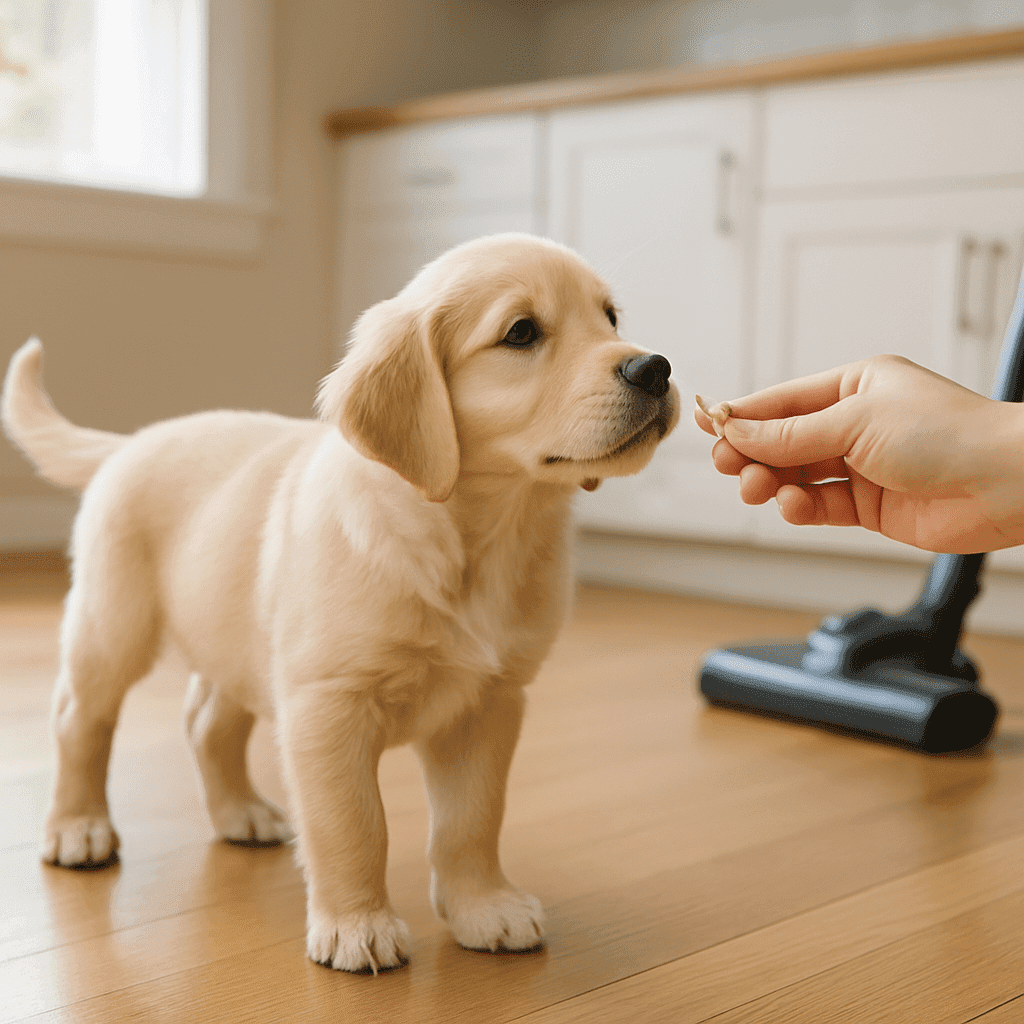
Is It Normal for a Puppy to Be Scared? A Gentle 5-Step Confidence Ladder for First-Time Owners
You flick the switch, the vacuum roars to life, and your puppy—who five seconds ago was a bouncy ball of fluff—flattens to the floor. Tail clamped, eyes wide, scrambling backward into the corner. Your stomach drops. Did I break my puppy? Is this normal?
If that scene feels familiar, take a breath. You're not alone, and your puppy isn't broken. In fact, fear in young puppies is not only normal—it's an expected, built-in survival mechanism. What matters is how you respond. This article will give you a clear, distance-based 5-rung confidence ladder to turn fear into curiosity, and at the end, you'll find a copyable Puppy Fear Flip Toolkit you can use on your phone or print at home.
It’s Not Just Your Puppy: Why Fear Is Normal (and What It Looks Like)
Yes, it is normal for a puppy to be scared at first. Puppies pass through two key fear periods: the first between 8 and 11 weeks of age, and a second around 6 to 14 months. During these windows, their brains are primed to notice potential danger. In the wild, a pup that ignored a strange sound or novel silhouette might not survive. That instinct doesn't disappear in your living room—it just looks like a puppy suddenly terrified of the vacuum, the stairs, or your neighbor in a beanie.
What does normal fear look like? A typical response is a quick startle followed by a few seconds of wariness, then cautious investigation from a distance. Your puppy might bark, back up, or duck behind your legs. As long as she's willing to take a treat and can be redirected after a short break, the fear is developmentally appropriate. For example, Max, a 10-week-old Labrador, flattened and scrambled under a chair when the vacuum turned on. Ten minutes later, with the vacuum off and a trail of kibble, he crept out to sniff it. That's normal. Luna, a 9-week-old Cavapoo, barked and retreated from a man wearing a baseball cap; her owner panicked, thinking it was aggression, but Luna simply had never seen that silhouette before.
These fears are almost always caused by lack of experience, not trauma. Your puppy's world is a blank slate, and things that move, make noise, or look unfamiliar are automatically registered as "potentially scary." The mistake to avoid is racing to prove the object is safe by dragging the puppy closer or shoving a treat right next to the vacuum. That can backfire fast. Instead, you'll use the ladder that follows.
If your puppy’s fear seems extreme—trembling, drooling, refusing to eat even high-value treats for hours, or fear that doesn't soften after repeated exposures at a respectful distance—jump ahead to the “When to Pause or Get Help” section.
The 5-Rung Puppy Confidence Ladder: Your Step-by-Step Guide
This ladder uses distance as your safety currency and pairs it with treats to change how your puppy feels. The science is plain: desensitization (starting so far away the puppy doesn't react) plus counterconditioning (adding something great while the trigger is present) rewires the puppy's brain from "that's scary" to "that predicts cheese." Every rung has a measurable rule. Don't jump ahead.
Here's the ladder, with examples for a vacuum, but you can swap in any trigger.
Rung 1 – Distance Watch
Start 20 feet away from the scary object (turned off). Let your puppy notice it, then immediately treat her for looking at the object and back at you. Do 3–5 repetitions of 3–5 seconds each. End the session long before she’s worried.
Rung 2 – One Step Closer
Move the puppy to 10 feet. Same drill: calm observation, treat, retreat. She must still accept treats willingly, with a soft body. If she hesitates, return to Rung 1 for another day.
Rung 3 – Treat While It Happens
At 5 feet, turn the scary thing on low (or activate the trigger in a mild way) while you deliver a continuous stream of tiny, high-value treats. Keep exposure to 5–10 seconds max. The moment the trigger stops, treats stop. This builds the association that triggering equals tasty stuff.
Rung 4 – Touch & Go
At 2 feet, allow a tiny movement. For the vacuum, push it an inch forward while the puppy is eating. For a doorbell, ring it softly. Treat immediately and end the session after one or two reps. The puppy learns that movement doesn't spell disaster.
Rung 5 – Calm Coexistence
Eventually, your puppy can settle within arm's reach while the trigger runs normally, without needing a constant treat stream. This is your goal, but it may take days or weeks.
Always end on a win. If the puppy shows any sign of stress, increase distance by at least 5 feet and do one easy rep before stopping. The session duration should be 1–3 minutes early on, never more than 5 minutes.
| Rung | Trigger Condition | Distance | Duration per Rep | Reps | Treat Cue |
|---|---|---|---|---|---|
| 1 – Distance Watch | Off/neutral | 20 ft | 3–5 sec | 3–5 | When puppy looks at object then back |
| 2 – One Step Closer | Off/neutral | 10 ft | 3–5 sec | 3–5 | Same as Rung 1 |
| 3 – Treat While It Happens | On/mild | 5 ft | 5–10 sec | 2–3 | Continuous stream while active |
| 4 – Touch & Go | Slight movement | 2 ft | 5 sec | 1–2 | Treat immediately, end session |
| 5 – Calm Coexistence | Normal use | Arm's reach | Indefinite | — | Occasional reinforcer |
If at any rung your puppy refuses treats or shows a red signal (see Progress Signs section below), immediately increase distance by 5–10 ft and try again, or end the session and return to the previous rung next time. Never power through.
Map the Triggers: Vacuum, Stairs, Strangers, and More
Before you dive into the ladder, take 5 minutes to note down exactly what triggers your puppy’s fear. Owners often fixate on one item (like the vacuum) and miss others that are quietly eroding the puppy’s confidence. Some fears are developmental: puppies may be wary of stairs because their depth perception is still maturing, or they may startle at large boxes and umbrellas because these objects “loom.” Understanding that these reactions are normal helps you avoid labeling your puppy as anxious.
Common puppy fear triggers include:
- Sound triggers: vacuum, blender, hair dryer, doorbell, thunder, traffic.
- Visual/object triggers: hats, sunglasses, large boxes, trash bags, wheeled objects like skateboards.
- Environmental triggers: stairs, slippery floors, metal grates on the street.
- Social triggers: strangers (especially men, children, or people using canes/walkers), other dogs of unfamiliar sizes.
- Handling triggers: being picked up, collar grabs, having paws or ears touched.
Write down the 2–3 triggers that are affecting your puppy most right now, and tackle only one at a time. In the copyable toolkit at the end, you'll find a blank trigger map to fill in, including a slot for your puppy’s current comfortable distance—because the ladder always starts where your puppy already feels safe.
If a trigger is impossible to control (like a neighbor’s dog that barks unexpectedly), focus on management first: draw the curtains, use white noise, and start the ladder at a time when you can pre-set the distance.
A Real Session: From 20 Feet to Couch with a Scared Pup
Let’s walk through a real-life vacuum ladder with an 8-week-old Golden Retriever puppy who panicked the first time the vacuum ran. The owner had a small kitchen and a connected living room, so they could create distance easily.
Day 1 – Rung 1, 20 ft. Puppy was in the kitchen, vacuum off and placed near the front door (20 ft away). Owner sat on the floor with a handful of shredded chicken. The moment the puppy glanced at the vacuum and then back, she received one piece. They repeated 3 times, 5 seconds each. Puppy stayed relaxed, tail wagging.
Day 2 – Still Rung 1, but owner touched the vacuum. Distance 20 ft. Owner rested a hand on the vacuum handle while the puppy watched. Treats for calm glances. No stress.
Day 3 – Rung 2, 10 ft. Puppy moved to 10 ft away, vacuum off, owner touching it. Puppy took two treats but then lip-licked and looked away. Red signal. Owner immediately said nothing, tossed a treat back to the 15 ft mark, and the puppy ate it with softer body language. They ended the session there on a win.
Day 5 – Rung 3, 5 ft, vacuum on low. After a day of rest, they returned to 15 ft for one easy session, then advanced to 5 ft. Vacuum on low for 8 seconds while owner fed chicken continuously. Puppy ate happily, no red signals.
Day 7 – Rung 4, 2 ft, vacuum moved an inch. Puppy was at 2 ft, eating treats. Owner turned vacuum on low and pushed it forward one inch. Puppy glanced but kept eating. Session ended in 2 minutes.
Day 10 – Rung 5. Puppy voluntarily jumped onto the couch while the vacuum ran in the hallway, no treats needed. That’s the goal, and it took 10 days of very short sessions with zero force.
The key takeaway: progress is measured in days, not hours, and backing up when you see a tiny stress signal is actually progress—it teaches your puppy that you'll keep them safe.
Progress Signs & Stop Signals: Reading Your Puppy’s Body Language
Your ladder lives or dies by your ability to read your puppy. A frozen puppy is not a calm puppy—often she’s terrified and shut down. Here’s a quick guide to green lights (go ahead and consider moving up) and red lights (immediately increase distance and de-escalate).
Green Lights – You Can Add a Rung
- Soft, relaxed eyes with slow blinking.
- Ears in a neutral position, not pinned.
- Body loose and wiggly; tail held horizontally or in a gentle sweep.
- Taking treats gently, without grabbing frantically.
- Voluntarily looking at the trigger then back at you.
Red Lights – Pause and Increase Distance
- Whale eye (you see the whites of the eye).
- Lip licking or yawning outside of tiredness.
- Tucked tail, trembling, cowering behind you.
- Backing away or trying to hide.
- Refusing even high-value treats like liverwurst or cheese.
If you spot a red signal, don’t freeze. Calmly increase distance by at least 5 feet. Toss a treat to get the puppy moving and do one easy rep at the larger distance so you end on a green signal. Track your progress: if you have 3 consecutive sessions at a given rung with zero red signals, you can move to the next rung. If a red signal appears, return to the previous rung for at least two sessions before trying again.
Troubleshooting Matrix
| If Puppy Shows... | Then Do This... |
|---|---|
| Whale eye, lip lick, or backing away at 5 ft | Immediately return to 10+ ft, feed treats there, end session |
| Trembling or treat refusal at any distance | Increase distance until treats are accepted; if still refuses, stop for the day |
| Barking or lunging at trigger | Stop; this may require professional guidance (see next section) |
| Snapping or growling | Cease ladder, do not proceed; consult a behaviorist |
When to Pause or Get Help: Vet and Behaviorist Boundaries
The Puppy Confidence Ladder is designed for mild to moderate fear where the puppy can still eat at a distance and is not aggressive. However, some behaviors signal that you need professional help—not a DIY ladder.
Safety note: Fear can sometimes be caused by pain or illness. If your puppy’s fear appeared suddenly with no obvious trigger, or if she shows other symptoms like vomiting, diarrhea, limping, or appetite loss, call your veterinarian immediately. Even without overt symptoms, if touching a normally social puppy causes her to scream or cower, a hidden injury could be the cause.
Behavioral red flags that warrant a certified behaviorist (look for credentials like CCPDT or IAABC):
- Aggression: growling, lunging, snapping, or biting in a fear context, even at a distance.
- Pervasive fear of everything—the puppy can’t find comfort even in familiar spaces and refuses food and play.
- No improvement after 2–3 weeks of consistent, correct ladder work with one trigger, or the fear is spreading to more triggers daily.
- Puppy stops eating or toileting because of constant fear.
If you’re ever unsure whether your puppy’s reaction crosses from normal fear to a health emergency, use the Puppy Panic Button to triage symptoms and get immediate guidance. It’s a free tool that helps you decide when to call the vet right now.
Avoid These Confidence Killers (What Not to Do)
When a puppy is scared, good intentions can do more harm than good. The American Veterinary Society of Animal Behavior (AVSAB) warns that forcing a puppy to confront a fear without the ability to retreat can cause lasting trauma. Avoid these common mistakes:
- Flooding: Holding your puppy in place or trapping her in a room with the scary thing until she “gets used to it.” This floods the puppy’s nervous system and often creates a lifelong phobia.
- Punishment: Yelling, leash pops, scolding, or any dominance-based approach. Scared puppies don’t learn “this is safe” from being told they’re wrong; they just learn that you’re also scary.
- Cueing fear: Saying “it’s okay” in a high-pitched, worried voice. Your tone can telegraph anxiety, and the puppy may think you’re also afraid. Instead, stay calm and matter-of-fact.
- Jumping rungs too fast: Just because the puppy seemed fine yesterday doesn’t mean she’s ready for the next rung. Fear can spike unpredictably. Always confirm three green sessions before advancing.
- Blocking escape: Never corner the puppy so she can’t move away. The ladder works because the puppy can choose to increase distance, which makes her brave enough to stay.
If you accidentally pushed too far and the puppy shut down, don’t guilt yourself. Give her 48 hours of no pressure, then return to Rung 1 with extra-high-value treats and a large distance. One misstep doesn’t ruin everything—but repeated flooding can.
Start Today with the Puppy Fear Flip Toolkit (No Download, Just Copy)
You don’t need a printer to start. Below is your Puppy Fear Flip Toolkit—a quick-reference ladder summary, a blank trigger map, a session log, a stop signal cheat sheet, and a pre-session checklist. Copy these tables into your phone’s notes, a notebook, or screenshot them. They’re all you need to run your first session right now.
Quick-Reference Ladder
| Rung | Distance | Trigger State | What to Do | Duration |
|---|---|---|---|---|
| 1 – Distance Watch | 20 ft | Off/neutral | Treat calm looks | 3–5 sec, 3–5 reps |
| 2 – One Step Closer | 10 ft | Off/neutral | Treat calm looks | 3–5 sec, 3–5 reps |
| 3 – Treat While It Happens | 5 ft | Active on low | Continuous treat stream | 5–10 sec, 2–3 reps |
| 4 – Touch & Go | 2 ft | Slight movement | Treat immediately, end session | 1–2 reps |
| 5 – Calm Coexistence | Arm's reach | Normal use | Occasional treats | Unlimited |
Blank Trigger Map
| Trigger | Category (Sound/Object/Person/Environment) | Current Comfortable Distance (ft) | Notes |
|---|---|---|---|
Session Log Template
| Date | Trigger | Rung | Distance (ft) | Duration (sec) | Body Language (Green/Red) | Notes |
|---|---|---|---|---|---|---|
Stop Signal Cheat Sheet
- Red: whale eye, lip licking, backing away, tucked tail, trembling, treat refusal → Action: increase distance 5+ ft, offer high-value treat, end session if needed.
- Green: soft eyes, relaxed ears, gentle treat-taking, tail neutral, voluntarily looking at trigger → Action: consider moving to next rung after 3 sessions with no red signals.
Pre-Session Quick-Check
- Identify the single trigger and confirm yesterday’s comfortable distance.
- Prepare 10–15 tiny, smelly treats (chicken, cheese, liver).
- Set a timer for 3–5 minutes max; put your phone aside.
- Check puppy’s baseline: relaxed and playful, not already stressed.
- Know your stop signal; be ready to increase distance immediately.
Pick one trigger, start at 20 feet, try Rung 1 for 5 seconds, and log it. That’s your entire first session. The routine matters just as much as the ladder itself—a predictable day with regular meals, naps, and potty breaks reduces underlying anxiety.
To build that foundation, try the Puppy Routine Builder to create an age-appropriate daily schedule.
Later, if you want video demonstrations and a deeper dive into socialization without flooding, join our email list—we’ll send you a free video series on building puppy confidence. But for now, the copyable toolkit above is enough to change your puppy’s fear into curiosity, one rung at a time.
Frequently Asked Questions
Is it normal for a puppy to be afraid of the vacuum?
Absolutely. The vacuum combines loud noise, unpredictable movement, and a strange appearance—three things most puppies haven’t encountered. The ladder works beautifully for vacuums: start with the vacuum off and 20 feet away, treat, then gradually add distance and sound.
How long until my puppy stops being scared?
It depends on your puppy and the trigger. A mild fear like the vacuum may resolve in 3–4 short sessions over a week. Deeper fears, especially of people or novel environments, can take weeks of consistent, brief work. The key is to measure progress by your puppy’s body language, not by the calendar.
What if my puppy doesn’t take treats when scared?
That’s a strong red signal—she’s over threshold. Immediately increase distance until you find a spot where she’ll take even a tiny piece of kibble. Try upgrading your treats to something irresistible, like liverwurst or warm chicken. If she still won’t eat, end the session and try again later, much farther away.
Can I use this ladder for fear of people?
Yes, but proceed with extra caution. Start with the person visible across the street, stationary, not staring. Use the same rungs, but never force interaction. If your puppy shows any sign of fear-aggression (growling, snapping), stop the ladder and consult a certified behaviorist before reintroducing the trigger.
Sources and safety references
Sources and safety references: American Veterinary Society of Animal Behavior (AVSAB) position statement on puppy socialization; AKC guidance on new puppy fear periods; PetMD articles on puppy fear and desensitization.