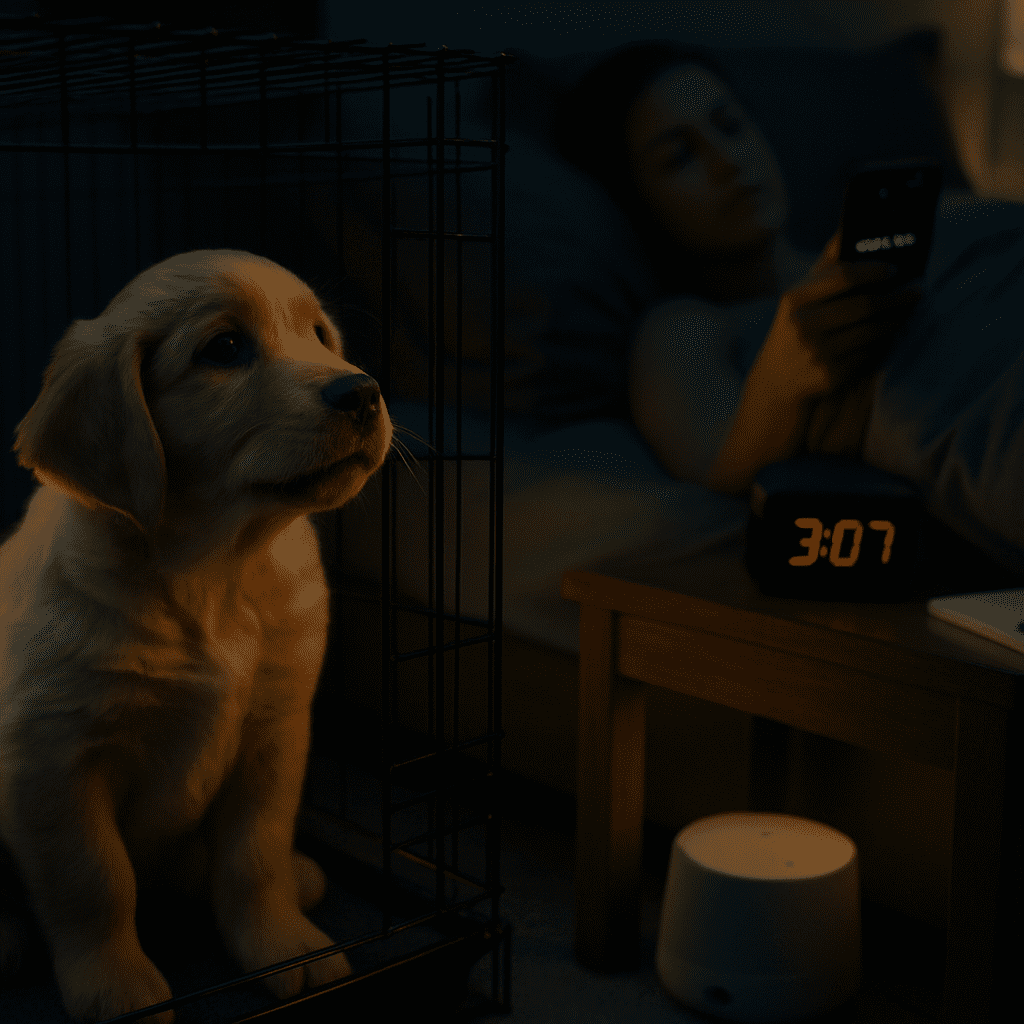
Puppy Crying in Crate at 3 AM: A Night Reset Plan for Exhausted First-Time Owners
It’s 3:07 AM. You’re lying in bed, eyes wide open, heart pounding, while your puppy cries from the crate again. Maybe you’re thinking, puppy, I’m laid here now at 3am, it’s literally been a week of this. You’re exhausted, frustrated, guilty, and scared that every choice is wrong.Take a breath. You are not failing. You’re a tired human raising a baby animal who has been dropped into a strange world. What you need is not vague advice like ignore it or pick him up every time. You need a calm, repeatable plan that tells you exactly when to wait, when to soothe, when to check, and when to take your puppy out.This is a 3-night reset for a healthy puppy in a safe, properly fitted crate. It does not rely on punishment, dominance, yelling, or leaving a panicked puppy to scream endlessly. It teaches your puppy that the crate is safe, quiet works, and nighttime is boring.Safety note: Before you start this night reset, confirm your puppy seems physically well. If your puppy has vomiting, diarrhea, unusual lethargy, coughing, trouble breathing, refusal to eat, repeated crate accidents despite potty breaks, or any sudden change that worries you, pause the training plan and call your veterinarian. This article cannot diagnose medical problems. If crying becomes frantic and unrelenting for more than 45 minutes without pauses, or your puppy is hurting himself by chewing bars, scraping his nose, or clawing hard at the crate, treat that as a distress signal rather than normal protest crying. If you are unsure whether you are dealing with a health or safety problem, Use the Puppy Panic Button as a calm triage step, then contact your vet when needed.
Before 10 PM: The Bedtime Setup That Prevents Half the Crying
A lot of 3 AM crate crying starts before bedtime. If your puppy goes into the crate overstimulated, thirsty, under-pottied, or confused, you are much more likely to hear barking later.Your goal before bed is simple: lower arousal, empty the bladder, create a predictable ritual, and make the crate feel like the obvious next step.The 45–60 minute wind-down
About 60 minutes before crate time, end the exciting stuff. No rough tug, chase games, wrestling, zoomies, or hyped-up fetch. Those games are great earlier in the day, but right before bed they switch your puppy’s brain on instead of off.Use this template for a 10 PM crate time:- 6:00 PM: Dinner for a 10-week-old puppy.
- 7:30 PM: Lift the water bowl for most young puppies, unless your vet has told you otherwise.
- 9:00 PM: Last calm activity begins. Try a slow sniff walk, a simple treat scatter, or a low-arousal puzzle.
- 9:35 PM: Quiet house. Dim lights. No exciting visitors, squeaky toys, or play fights.
- 9:50 PM: Final potty trip.
- 10:00 PM: Crate cue, white noise, lights out.
Use a repeatable crate ritual
Puppies learn patterns faster than lectures. Pick a phrase and a sequence you can repeat every night:- Final potty.
- Walk calmly to crate.
- Say, ‘Bed time now.’
- Place puppy in crate with a safe chew or familiar blanket if appropriate.
- Turn on white noise or a low fan.
- Cover the top of the crate if your puppy relaxes with a den-like feel, leaving airflow.
- Lights out.
The 3 AM Crying Response Ladder: Wait, Soothe, Check
At 3 AM, your nervous system hears crying and screams, Do something. The problem is that if you run to the crate every time your puppy whimpers, your puppy learns that crying is the button that summons you.The answer is not to abandon your puppy. The answer is a response ladder.Tier 1: Wait 5 minutes
When crying starts, check the time and wait 5 minutes of continuous crying. Do not open the crate. Do not make eye contact. Do not whisper, shush, or sit beside the crate yet.If your puppy pauses for 30 seconds, reset the timer. That pause matters. It means your puppy is trying quiet, and quiet is the behavior you want to grow.Normal sounds during this stage may include:- soft whimpering
- a few protest barks
- start-stop whining
- a mournful little howl that fades
Tier 2: Give one calm verbal soothe
If your puppy cries continuously for 5 minutes, say one calm phrase from your bed or doorway: ‘You’re okay. Settle now.’Keep your voice low and boring. No baby talk. No repeated shushing. No emotional speech. The goal is to reassure without turning the moment into attention.Then go silent again.Tier 3: After 10 more minutes, do a silent visual check
If crying continues for another 10 minutes after the verbal soothe, get up and do a silent visual check. Look for obvious problems:- paw caught in bedding
- collar or tag snagged, if your puppy wears one indoors
- soiled blanket
- crate door issue
- puppy wedged awkwardly
- signs of panic or self-injury
A 3 AM example
Your puppy starts crying at 3:07 AM. You lie still until 3:12. He cries the whole time, so you calmly say, ‘You’re okay. Settle now.’ He keeps crying. At 3:22, you do a silent visual check. He is safe, dry, and looking at you. You return to bed. At 3:35, he finally settles.That is not failure. That is a difficult but useful learning repetition.If your puppy becomes more frantic after hearing your voice, skip the verbal soothe next time and use silent checks only. Some puppies find any human sound exciting.Is This a Potty Cry? The 2-Minute Decision Tree
The hardest question at night is: Is my puppy crying because he needs to pee, or because he wants me?Use this decision tree instead of guessing.Ask yourself three questions:
- Has it been longer than your puppy’s likely overnight potty capacity? 8–10 weeks: about 2–2.5 hours 11–14 weeks: about 3–4 hours 16 weeks and older: often 4–5 hours, sometimes more, depending on the puppy
- Did your puppy drink water within the last hour before bed or wake up from heavy sleep?
- Is the cry sudden, frantic, and escalating faster than normal protest whining?
The boring potty break protocol
A nighttime potty break should be so dull your puppy would not choose it for fun.- Use a dim flashlight or nightlight, not bright overhead lights.
- Carry very young puppies to the potty spot if possible.
- Use the closest safe potty area, not a wandering walk.
- Say ‘Go potty’ once.
- Give 2 minutes.
- If puppy potties, give a quiet ‘good’ and return to the crate.
- If puppy does not potty within 2 minutes, go straight back to the crate.
Examples
A 9-week-old small breed puppy last pottied at 10 PM and cries at 1:30 AM. That is likely a real potty need. Take him out silently.A 13-week-old Lab last pottied at 10 PM, had water lifted at 7:30 PM, and starts soft whining at 2 AM. That may be attention or normal waking. Use the ladder first unless the cry becomes urgent or unusual.If your puppy potties immediately every single time you take him out, plan one proactive alarm before the cry happens on Night 2. For example, if he always cries at 1:45 AM and pees right away, set an alarm for 1:30 AM, do a boring potty break, and return him to the crate before he practices crying.Normal vs. Not Normal Night Crying
Some crying is part of crate adjustment. Some crying means you should stop and reassess.Usually normal
These patterns are common in the first nights of a reset:- crying for 5–15 minutes when first placed in the crate, then settling
- whimpering or light barking that starts and stops
- crying when you leave the room, then quiet within 10 minutes
- soft whining that decreases in volume over several nights
- one planned potty break for a very young puppy
More concerning
Pause the plan and reassess if you hear or see:- continuous screaming, howling, or shrieking for more than 45 minutes without pauses
- frantic escalation after every check-in
- chewing crate bars, scraping the nose, or clawing hard enough to injure paws
- repeated peeing or pooping in the crate despite appropriate potty breaks
- vomiting, diarrhea, lethargy, not eating, coughing, or other illness signs
Morning Quiet Protocol: Do Not Reward the Howls
Morning matters. If your puppy learns that loud crying opens the crate and starts a party, he may try the same strategy earlier and earlier.Set a realistic wake-up time. A young puppy may not sleep quietly until 8 AM. For many 8–12 week puppies, 5:30 or 6:00 AM is a more realistic early goal while their bladder and sleep rhythm mature.The 10-second silence rule
When you hear morning stirring, wait 30 seconds out of sight. If your puppy is quiet for 10 seconds, approach calmly and open the crate when all four paws are still.If your puppy is whining, wait for a tiny quiet gap. You are not ignoring him for an hour. You are waiting for a small moment of calm so the door opens for quiet, not noise.Then:- Say ‘Good morning’ in a neutral voice.
- Open the crate without excitement.
- Take your puppy straight to potty.
- Save cuddles, breakfast, and play for after the potty trip.
Night 2 and 3: How to Read Progress
Do not judge the plan only by whether you slept perfectly. Night 1 may still be rough. Progress often looks like less crying, shorter crying, or faster settling—not instant silence.Track these numbers:- total crying minutes
- longest continuous crying episode
- number of verbal soothes
- number of silent checks
- number of potty breaks
- whether puppy settled without help at least once
- Night 1: 3 episodes, 45 total minutes of crying.
- Night 2: 2 episodes, 25 total minutes.
- Night 3: 1 episode, 12 total minutes.
Change only one variable at a time
If Night 2 is still awful, do not change the crate location, bedtime, water timing, soothing style, and morning release all at once. You will not know what helped.Try one adjustment:- Move bedtime 30 minutes later if puppy is not sleepy.
- Add a longer calm sniff session before bed.
- Use stronger white noise if household sounds trigger waking.
- Add one planned potty alarm if your puppy consistently pees on night breaks.
- Remove verbal soothing if your voice makes the puppy more excited.
When the Plan Fails: 4 Common Problems and Fixes
If you follow the plan and your puppy is still crying hard after 3 nights, do not assume crate training is ruined. Treat it like a puzzle.| Problem | What may be happening | What to change |
|---|---|---|
| Crying gets worse after check-ins | Your presence or voice may be exciting | Skip verbal soothing. Use a 10-minute initial wait and 15-minute second wait, then silent check only. |
| Puppy has repeated crate accidents | Potty schedule may not match age, or there may be a medical issue | Add a planned potty alarm and call your vet if accidents continue. |
| Puppy sounds panicked all night | Crate may be too isolated, cold, uncomfortable, or distress may be more than protest | Move crate near your bedroom doorway temporarily and consult a force-free trainer if panic continues. |
| You cannot cope emotionally | Sleep deprivation is breaking your ability to stay consistent | Sleep within sight of the crate for one night, then move 1–2 feet farther away each night. |
Your 3-Day Night Reset Log
Tracking matters because your exhausted brain will lie to you at 3 AM. It will say, This has been going on forever. A log shows whether the crying was 7 minutes, 17 minutes, or 47 minutes. It also reveals patterns you would otherwise miss.Copy this table into a notebook or notes app and keep it beside your bed.| Night | Time started | Cry sound | Duration | My response | Potty result | Settled at | Note |
|---|---|---|---|---|---|---|---|
| Example | 2:45 AM | Whimper to bark | 8 min | Waited 5 min, then verbal soothe | No potty break | 3:05 AM | I felt guilty, but he settled. |
| Night 1 | |||||||
| Night 1 | |||||||
| Night 2 | |||||||
| Night 2 | |||||||
| Night 3 | |||||||
| Night 3 |
- Whimper: soft, start-stop, often tiredness or mild protest.
- Bark: sharper demand sound, often attention-seeking if puppy is otherwise fine.
- Howl: loneliness or frustration, especially in a new environment.
- Frantic scream: urgent, escalating, hard to interrupt; check safety and potty needs sooner.
Permission slip for exhausted owners
You are not abandoning your puppy. You are teaching a baby dog how to feel safe, pause, and settle. Short, controlled periods of crying inside a safe crate are different from prolonged panic or distress. Your job is not to prevent every sound. Your job is to respond predictably, meet real needs, avoid punishment, and reward calm.That is compassionate training.Your 3 AM Night Reset Essentials Checklist
- Last meal is at a consistent time.
- Water is lifted 2–3 hours before bed, adjusted for age and health.
- No rough play in the final 60 minutes.
- Puppy gets a calm sniff session, lick mat, or quiet puzzle.
- Final potty happens 5–10 minutes before crate time.
- Crate is safe, comfortable, non-drafty, and not isolated in a scary area.
- White noise or fan is on.
- Leash, flashlight, and potty shoes are ready.
- Night Reset Log is beside the bed.
- You know the rule: wait 5, soothe once, wait 10, silent check.
- Morning release requires 10 seconds of quiet.