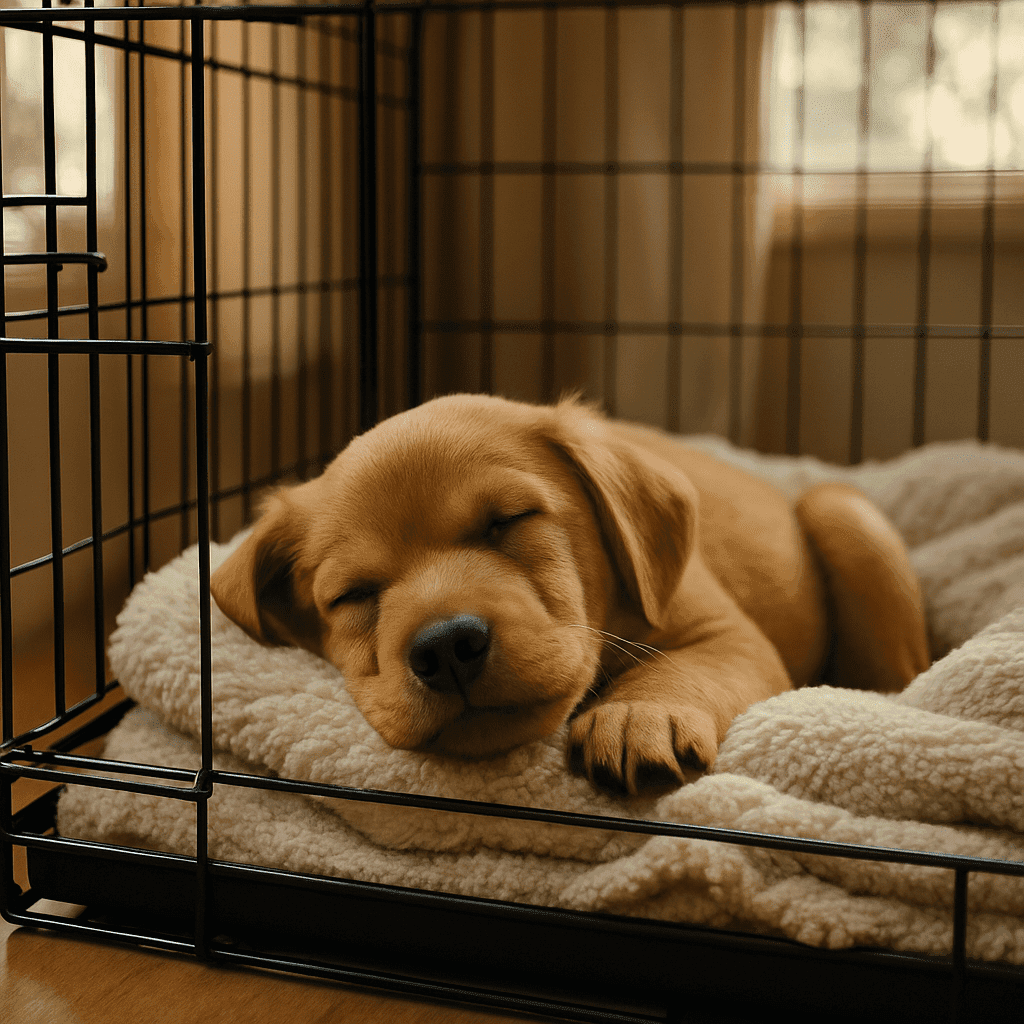
Puppy Wakes at 3 AM Demanding a Treat for Potty? A 3-Day Crate Sleep Reset Plan for Exhausted Owners
Why 3:41 AM Became Treat Time
Your puppy didn't wake up one morning and decide to manipulate you. Puppies learn patterns through repetition, and overnight, when you're exhausted and on autopilot, patterns can form fast. Here's the loop that likely built itself without you noticing.
At some point, your puppy woke at night. Maybe they needed to potty, maybe they just stirred. You responded, took them out or checked on them, and when they pottied successfully, you rewarded them. That's solid daytime potty training advice. But at 3 AM, that same reward sequence teaches something slightly different: "Waking my human, making some noise, and peeing equals treats, soft voices, and a few minutes of attention."
Fast Answer
To stop your puppy from waking you up at 3 AM for a treat, progressively make nighttime potty trips functional but boring. Remove treats, lights, and any excitement. Shift rewards to daytime or morning. This change will help your puppy understand nighttime is for sleeping, not celebrations.
By the time you're seeing the 3:41 AM wake followed by the 3:47 AM repeat performance, your puppy has refined the sequence. They've learned that even a tiny potty, or sometimes just going through the motions, restarts the treat machine. The problem isn't that you rewarded potty training. The problem is that nighttime potty trips accidentally became a mini celebration, and your puppy is smart enough to crave more.
The good news: this pattern is usually fixable without punishment, forcing your puppy to hold it beyond their ability, or abandoning potty training entirely. The reset works by keeping nighttime potty access functional and boring while moving the rewards to daytime and morning, where they belong.
How the Loop Built Itself
Picture this from your puppy's perspective over several nights.
Night one: Puppy wakes at 2:50 AM, whines, you take them out, they pee, you give a treat and soft praise. Puppy learns that night whining leads to reward.
Night three: Puppy wakes at 3:30 AM, whines, pees, gets a treat. Settles briefly, then at 3:45 AM tries whining again. You're tired, so you take them out again. Maybe they squeeze out a few drops or just stand there. You still offer a small treat because you're trying to be consistent. Puppy learns the second wake also pays.
Night five: The timing tightens. 3:41 AM, potty, treat. 3:47 AM, whine, repeat behavior, another potty attempt, maybe another tiny reward. The loop is locked in.
This isn't stubbornness. It's a puppy doing exactly what their environment taught them: performing a behavior that reliably produces a desired outcome.
What the Reset Actually Changes
The 3-day plan in this article does not remove your puppy's ability to potty at night if they genuinely need to. Instead, it removes the excitement, food reward, and social payoff from the wake cycle. Overnight potty is kept functional without the treat party that told your puppy that 3 AM is a great time to be awake.
Progress with this reset can look like: longer sleep stretches, shorter protest, or wakeups shifting from 3:41 AM to later. The goal is to break the learned cycle so your puppy's true needs become clearer.
Mistake to avoid: Labeling your puppy as stubborn, bad, or dominant. This is a learned pattern, not a personality flaw. The fix is changing the pattern, not punishing the puppy.
Tonight's New Rule: Potty Breaks Get Boring Again
Before you start the full 3-day plan, remember this rule at 3 AM: "Boring potty only. No treats. No lights. No party."
The Boring Potty Protocol
When your puppy wakes overnight and needs a potty trip, here's what to do:
- Keep the room dim. Use a nightlight or a phone screen away from the puppy, not overhead lights.
- Walk calmly to the crate, open it without excitement, and either leash your puppy or carry them directly to the potty spot.
- Say nothing, or use one quiet phrase like "potty" in a low voice.
- Stand still, give your puppy 3-5 minutes to go. No walking around or playing.
- If they potty, quietly acknowledge with a soft "good" and return inside. If not, return anyway.
- Back inside, no kitchen detour, cuddles, or quick snack. Place your puppy in the crate, close it, and return to bed.
The entire trip should take under 7 minutes and feel uneventful enough that your puppy has no reason to repeat it.
What Changes Immediately
Starting tonight, the treat that used to appear at 3:41 AM disappears. Your puppy may whine or try the behavior again at 3:47 AM to check if the treat machine is broken. That's normal. It's a puppy testing whether the old pattern still works. When the boring trip repeats without payoff, the behavior weakens.
Mistake to avoid: Giving a jackpot treat, cuddle, toy, or kitchen visit at 3 AM. Each exciting response adds another night to the reset.
The 3:41 AM Decision Flow: Take Out, Wait, or Resettle
This is the hardest part of the reset and where many owners struggle. You need to protect your puppy from accidents without rewarding every whimper.
Step One: Check the Log and the Clock
Ask two questions before you move. First, when did your puppy last potty? If you're using the 72-hour log, you'll know. Second, is the cry urgent or a complaint?
For a young puppy who last pottied at 10:30 PM and wakes at 2:00 AM, four hours may be realistic. For a puppy who pottied at 3:30 AM and is crying at 3:47 AM, seventeen minutes later is not realistic. This distinction changes everything.
Step Two: Choose Your Response
If it's been a realistic interval, take your puppy out. Follow the boring potty protocol. If not, wait 2-3 minutes before responding. This gives your puppy a window to resettle without your presence becoming part of the reward.
If whining continues past 2-3 minutes but isn't frantic, use a quiet resettle cue: one soft "settle," then silence. No opening the crate, no conversation, no treat.
If crying escalates or continues past 10 minutes despite recent potty and resettle attempts, refer to the 10-minute protocol later in this guide.
Real Scenarios You'll Face
3:41 AM: Puppy whines. Check the log: last potty was 11:00 PM. This is likely a real need. Take them out.
3:47 AM: Whines again. Recently did a boring potty trip. Likely treat-demand or protest. Wait 2-3 minutes.
4:15 AM: Whines again. Wait 2-3 minutes. Most puppies are not in genuine distress here.
Mistake to avoid: Deciding based on annoyance. Use the log, puppy's age, and time since last potty.
The 3-Day Crate Sleep Reset Plan
This is the centerpiece of the reset. You'll follow three distinct nights, each building on the last.
Day 1: Collect Baseline and Remove the Party
Day 1 is about observing and making one firm change: remove the treat from overnight potty trips.
Set your puppy up with a calm bedtime routine: final potty around 10:30-11:00 PM, quiet crate entry. No rough play or big meal an hour before sleep. Water should be available but can be taken up 60-90 minutes before bed if your vet agrees.
When your puppy wakes overnight, follow the boring potty protocol. If young and needs a night potty, plan it rather than waiting for crying. An 11-week-old might make it to 3:00 AM.
If your puppy produces the 3:41 AM wake, handle it according to the decision flow. In the morning, reward calm crate exit and the first outdoor potty with genuine warmth and a treat.
Day 2: Respond Based on Data
Your log will start showing a pattern. Maybe your puppy woke once, did a boring potty, and resettled briefly. Keep tracking and use the log to guide your response.
If puppies are genuinely peeing at night, it’s not a treat-demand problem. Keep trips boring.
If treat-demand extinction is in progress, stay consistent. If your puppy sleeps a longer stretch than Day 1, mark it as progress.
Day 3: Shift Emphasis to Morning
By Day 3, make the morning routine the reward event. When your puppy wakes for the day, take them outside, reward their potty with praise and play.
If your puppy needs one overnight potty, that's fine if it ends in sleep. Logs showing longer stretches or shorter protests are signs of success.
Progress Signals vs. Red Flags
| Progress Signal | What It Means |
|---|---|
| 3:47 AM wake disappears or shortens | Treat-demand loop is breaking |
| First wake shifts from 3:41 to later | Sleep stretch is lengthening |
| Short crying after crate return | Resettling without reward works |
| Dry crate in the morning | Bladder capacity is aligning |
If zero improvement after three nights, reassess crate comfort, schedule, and possible medical issues. The plan's next step is investigation, not intensity.
Mistake to avoid: Removing all nighttime potty opportunities from a young puppy.
Use the Crate Sleep Reset Log for 72 Hours
When you're running on broken sleep, your memory lies. A simple log turns chaos into something you can read and act on.
How to Track Each Night
Grab a notebook or notes app to capture key overnight data. Keep it next to your bed.
- Bedtime: Time into the crate.
- Last potty before bed: Time and result.
- Wake time: Exact time puppy woke you.
- Potty result during trip: Peed, no potty, etc.
- Treat given? Yes or no.
- Crying after return to crate: Duration.
- Morning condition: Crate dry or wet?
What Patterns to Look For
Circle repeat wakeups within 10-20 minutes after a successful potty trip. If "3:41 AM, peed, no treat," is followed by "5:30 AM, woke for day," the treat-demand repeat is disappearing.
If "3:41 AM, peed, treat given," repeats soon after, you have a treat party loop.
Each morning, use the log to adjust the next night. Extend the wait time if changes indicate less frequent waking.
Mistake to avoid: Changing multiple variables and guessing what caused the change. Change one thing, log it, and let the 72-hour view guide you.
If the Crying Hits 10 Minutes, Do This
This is the moment owners break. If crying persists 10 minutes, the urge to give a treat is overwhelming. Here’s a structured response.
The 10-Minute Reassessment
Check the log. Did your puppy just potty? How long since the last potty? Are urgent signals present?
If the puppy pottied in the last 30 minutes and cries, stay calm. Give them space to learn night is for sleeping.
If unsure, do a presence reset: walk to the crate calmly, place a hand near, or use a soft cue like "settle." Return to bed or sit quietly nearby without engaging further.
If the cry sounds urgent, do one boring potty trip. No treat, no play, no lights. If they potty, calmly acknowledge and return to crate.
When the Cry Is Different
Complaint whining rises and falls, stops within a few minutes. Distress sounds frantic, escalating, with digging, scratching, or drooling.
If your puppy is in distress, don’t treat it as demand whining. Pause the reset and address the crate comfort issue.
Mistake to avoid: Letting a puppy cry in escalating panic. Distress is not stubbornness.
Half-Asleep Mistakes That Restart the Treat Game
Most of these mistakes aren't failures. They happen when trying to solve a problem at 3 AM.
The Accidental Reward Swaps
Mistake 1: Treating nighttime potty like a celebration. Move the treat container out of the bedroom.
Mistake 2: Talking or turning on lights after every cry. Practice silence. One word is plenty.
Mistake 3: Waiting until the puppy is frantic. Use planned potty breaks instead of reacting.
Mistake 4: Changing rules every night. Commit to 72-hour rules.
Mistake 5: Giving a treat at 3:41 and then again at 3:47. If you give in, don't abandon the plan. Restart the boring-potty rule.
What to remember: These are not moral failings. You're tired and doing your best.
When It's Not Just a Treat-Demand Wakeup
This plan focuses on treat-demand wakeup patterns. Some are legitimate needs or require vet attention.
Normal Overnight Potty Needs
A young puppy may need one or two overnight potty trips depending on age. An 8-week-old puppy can't hold their bladder all night. This isn’t a failure.
Concerning Signs That Need a Vet
If your puppy shows these signs, contact your vet:
- Diarrhea or loose stool, especially twice overnight
- Vomiting
- Lethargy or unusual tiredness
- Straining to urinate with little production
- Blood in urine or stool
- Significant increase in urination
- Repeated accidents despite age-appropriate breaks
If your puppy has diarrhea twice overnight, it's a health concern needing veterinary care.
When to Involve a Trainer
If your puppy is experiencing crate distress, seeking help from a qualified trainer is advised.
The 3-day reset assumes crate comfort. If the crate causes panic, fix comfort first.
Mistake to avoid: Forcing a puppy to hold it longer than their capacity or treating medical issues as training problems.
Practical Checklist
- Implement the boring potty protocol each night.
- Keep a 72-hour log of wake times, potty results, and behaviors.
- Eliminate exciting rewards for night potty trips, replace with morning rewards.
- Monitor for real signs of distress and adapt as needed.
- Ensure a calming bedtime routine.
Frequently Asked Questions
What if my puppy continues to cry after 10 minutes?
First, check the log for recent potty times. If there's no urgent need, use a calm presence to reassess. If behavior doesn’t change over nights, consult a trainer.
Is it normal for my puppy to still need a night potty trip occasionally?
Yes, young puppies may not yet hold their bladder through the entire night. Keep night trips calm and boring.
How do I know if my puppy’s cries are for attention or needs?
Use your 72-hour log. Note patterns such as time since last potty or desperation level of the cries.
What to do if my puppy wakes earlier each night?
If earlier waking becomes a pattern, reassess their evening activity and feeding schedule. Observe any environmental disturbances contributing to the pattern.