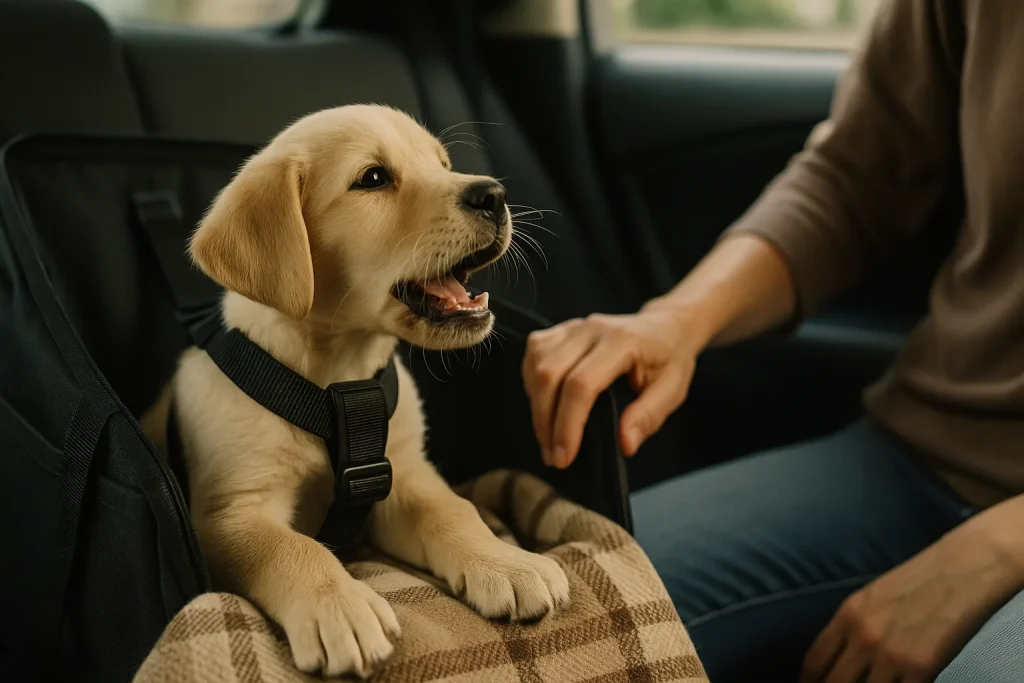
You buckle your puppy into the car, the door shuts, and the crying starts before you even leave the parking spot. Or maybe the whining only shows up at red lights, on longer rides, or the moment the car starts moving. However it begins, the pattern usually repeats because the puppy is being asked to cope with a version of the ride that is already too hard.
The fix is not to push through louder. It is to train the easiest version first, watch what your puppy can actually handle, and only make the next step harder when the current one is clearly successful. That is the whole plan.
Why your puppy cries in the car
Start by reading the pattern, not the noise. Different car-ride struggles need different next steps.
If the crying starts as soon as the puppy is confined, even before the car moves: the stress may be about the setup itself. The puppy may be worried about separation, restraint, or being in a new place.
If the crying starts when the car moves: motion, noise, or feeling unsteady may be part of the problem. If you also see drooling, lip licking, vomiting, or a miserable look that does not improve, treat it as a possible sickness issue rather than a training issue.
If the puppy is quiet while driving but cries when the car stops: the stop itself may be the trigger. Some puppies are reacting to the change in motion, the loss of momentum, or the anticipation of what happens next.
If the puppy is fine on short trips but cries on long ones: the current duration is probably too much. The ride is not failing at the beginning; it is failing when the puppy runs out of coping capacity.
Your job is to notice which version you have. That observation decides the next training step.
Build the easiest version first
Car training works best when the puppy can succeed almost immediately. Set up the first practice so it is calm, predictable, and brief.
Pick a quiet parked car. Keep the first session short. Use a safe, comfortable spot for the puppy to settle, such as a crate or harness setup that is already familiar. The goal is not a perfect ride yet. The goal is for the puppy to stay relaxed long enough to learn that the car can predict good things.
A good success signal is simple: the puppy can remain quiet, take food, and recover quickly after a small change.
If the puppy cannot settle, cannot eat, or looks more distressed each time, the step is too hard. Make one thing easier before you try again. That might mean shorter time, less movement, less noise, or a quieter location.
Teach a calm alternative before you ask for a real ride
Puppies need something to do besides cry. A settle behavior gives them a job that can replace the vocalizing.
Start outside the car first. Teach a simple settle spot on a mat, blanket, or bed. Reward the puppy for being there quietly. Keep the reward timing clean: quiet earns the treat, not crying.
Once that is easy, bring the same idea into the parked car. Put the puppy in the car, ask for the settle spot, and reward calm moments. If the puppy stays relaxed, add one tiny change at a time.
A useful progression looks like this:
- Sit in the parked car with the engine off.
- Reward quiet settling.
- Turn the engine on for a very short time.
- Reward calm again.
- Roll a few feet, then stop.
- Gradually make the ride a little longer.
You are not trying to finish a whole errand in one lesson. You are teaching the puppy that each small part of the ride is safe enough to stay calm through.
Is it okay to comfort my puppy when they're crying?
Yes, but the timing matters. Calm comfort is fine when it helps your puppy recover. What tends to backfire is rewarding the crying itself with a big reaction every time it starts.
If the puppy is mildly fussing but still able to recover, stay quiet, wait for a short pause, and then reward the quiet moment. If the puppy is in full panic, stop the session and make the next version much easier. Comfort alone will not teach calm if the setup is too difficult.
Use the progress decision to choose the next step
This is the part that keeps training from turning into guesswork. After each practice, decide which branch fits what you saw.
Progress when the puppy stayed quiet, took treats, and looked settled through the whole step. Add only one new challenge next time: a little more time, a slightly longer drive, or a brief stop.
Repeat when the puppy did pretty well but not perfectly. A few small whines that stopped on their own may mean the puppy is close, not failing. Repeat the same level until it looks boring.
Pause and simplify when the puppy starts whining sooner, refuses food, or has trouble recovering after the session. Go back to the last version that felt easy.
Step back much more when the puppy shows strong stress: frantic escape attempts, nonstop vocalizing, trembling, or a body that never loosens. That is not the moment to push forward.
The decision-changing question is simple: did the puppy succeed at this level, or did the puppy only survive it? Success means you can nudge the difficulty upward. Survival means you need to lower it.
What if my puppy only cries when the car stops?
Treat stops as their own practice point. If movement is okay but red lights or parking are not, add quiet stop practice on purpose. Pull over in a calm place, keep the session brief, and reward the puppy for staying settled while the car is still.
This helps the puppy learn that stopping does not mean something bad is about to happen.
What if my puppy is fine on short trips but cries on long ones?
Then duration is the variable to train. Keep the short trip as your baseline and stretch time slowly. If the puppy handles five minutes but falls apart at eight, you do not need a bigger correction. You need a smaller jump.
Try adding one minute or a very small distance increase, then repeat until that new level is easy. Long-trip success usually comes from boring, gradual wins.
Mistakes That Can Keep the Problem Going
A few common errors keep this problem alive:
- Starting with the real trip instead of a practice trip. If every lesson includes the hardest version, the puppy never gets a chance to learn.
- Moving too fast after one good session. One success is a start, not proof that the puppy is ready for a major jump.
- Rewarding too late. If the treat arrives during the cry instead of after a quiet pause, the message gets muddy.
- Ignoring comfort factors. A hot car, unstable footing, or a noisy setup can make progress much harder.
- Practicing while the puppy is already over threshold. Once the puppy cannot eat or settle, training quality drops fast.
If you get stuck, change just one variable and compare the result. Shorter ride, different route, calmer time of day, or less movement are all useful places to test. That keeps the pattern readable.
What if my puppy gets car sick?
Do not try to train through clear sickness signs. If the puppy drools heavily, vomits, seems miserable, or gets worse with even tiny amounts of movement, pause the training plan and talk with your veterinarian.
Motion sickness and training anxiety can look similar at first, but they are not solved the same way. If the body is telling you the ride feels bad, the next move is to simplify and check for a health issue.
When to simplify or get help
You do not need to keep increasing difficulty if the puppy keeps getting overwhelmed. Simplify the setup when progress stalls. Get help if the crying is intense, the puppy is not recovering, or the problem seems tied to pain, sickness, or sudden change.
A veterinarian is the right first stop when illness or discomfort may be involved. If the puppy is physically fine but still panics in the car after careful practice, a qualified behavior professional can help you shape the plan more precisely.
How long should each training session be?
Keep sessions short enough that the puppy can succeed. The best length is the one that ends while the puppy is still calm, not the one that turns into a struggle.
For some puppies, that means only a brief parked-car practice at first. For others, it means a few minutes of movement before you stop. Use the puppy’s body language, food interest, and recovery speed to decide when to end.
A good session usually leaves the puppy able to settle again quickly. A bad session leaves the puppy louder, tenser, or harder to recover. End on the good side whenever you can.
The path to a quieter car is not one big breakthrough. It is a series of rides that get just a little easier, with the puppy staying successful often enough to learn that the car is no longer a problem.