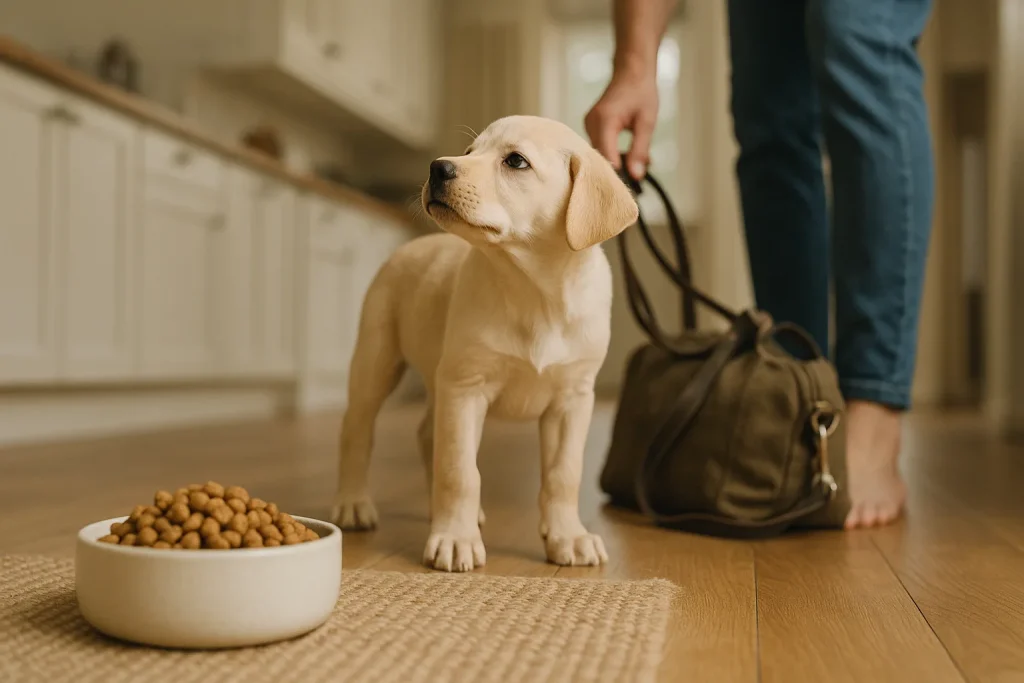
You bring your puppy home, set down the bowl, and get a look that says the meal is not happening. The most likely explanations are simple: the puppy is tired and overstimulated from boarding, or something about the trip has tipped over into a health problem. The clue that separates those two paths is not the bowl itself. It is the rest of the puppy: energy, drinking, vomiting, stool, and whether the appetite comes back at the next regular meal.
Start with the safest first response: offer the usual food in a quiet place, once, without pressure. If the puppy eats, you have your answer for now. Keep the routine normal and make a note of the skipped meal in case a pattern appears later.
If the puppy sniffs the food and walks away, remove the bowl and stop there. Do not keep changing the plan every few minutes. A low-stress setup gives you cleaner information and keeps you from confusing the issue with extra treats, toppers, or repeated coaxing.
The first branch: is this only a post-boarding slump?
A puppy that refuses one meal after boarding but still has bright eyes, normal interest in the room, and at least some willingness to drink is often showing a temporary stress response. That does not prove there is nothing wrong, but it does make a short observation period reasonable.
Your next move is simple: keep the home calm, keep the regular feeding schedule, and look for recovery at the next meal. If the puppy eats then, the episode was probably tied to the disruption of boarding and travel rather than a continuing illness. Record what happened anyway: the time you came home, the meal that was skipped, whether the puppy drank, and whether any stool or vomiting concerns were reported by the boarding facility.
This is also the point where owners often overcorrect. They try three foods, then hand-feed, then add toppers, then switch bowls. That kind of scrambling makes the pattern harder to read. A cleaner test is usually better: regular food, regular time, quiet room, then observe.
What to watch while you wait for the next meal
The next decision depends on what the puppy is doing between feedings.
If the puppy is alert, follows you around, plays briefly, or settles normally for a nap, that supports a milder explanation. If the puppy is unusually flat, withdrawn, or seems less responsive than usual, the picture changes. Appetite loss with low energy deserves more caution than appetite loss alone.
Drinking matters too. A puppy that drinks on its own is giving you a useful sign that the body is still settling. A puppy that refuses water as well as food is harder to watch at home.
Keep this as an observation rather than a diagnosis: record what changed, watch the wider pattern, and contact a veterinarian if the puppy appears unwell or the concern persists.
Use the observable signal to choose the next action
If the puppy eats at the next scheduled meal and behaves normally, continue the usual routine. You likely do not need to do anything else beyond monitoring and documenting the one-off skip.
If the puppy still refuses food at the next meal but remains alert, drinks, and seems otherwise normal, keep things simple and contact your veterinarian if the refusal continues into the next day or if this is not a pattern you have seen before. A puppy can have a brief appetite dip after a stressful stay, but repeated missed meals deserve a professional opinion.
If the puppy refuses food and also seems quieter than usual, call your veterinarian when the clinic opens. Have the boarding dates ready, along with the last time the puppy ate a full meal and whether the puppy has drank, vomited, or had diarrhea. That combination helps the veterinarian decide whether the issue sounds like stress, stomach upset, or something that needs an exam.
If the puppy refuses both food and water, or cannot seem to settle, the situation moves faster. Do not wait for the next routine meal to see what happens.
If the puppy has repeated vomiting, diarrhea, obvious pain, a bloated belly, pale gums, trouble breathing, collapse, or blood in vomit or stool, treat that as urgent and seek veterinary care right away. Those are not the kinds of signs to watch overnight.
What to bring or record before you call the veterinarian
When you contact the clinic, the most helpful thing you can do is give a short, factual summary. Write down:
- when boarding started and ended
- the time of the last full meal the puppy ate
- whether the puppy drank water after coming home
- any vomiting, diarrhea, coughing, or stool changes
- any notes from the boarding facility about eating, stool, energy, or medication
- whether the puppy is playful, subdued, or hard to wake
- any recent diet change, treats, or new food offered at boarding
These details help the veterinarian sort through the possibilities without guessing. They also keep you from having to reconstruct the timeline under stress.
What is general guidance, and what needs the veterinarian
General guidance can tell you how to observe, how to avoid making the problem worse, and which signs make the next step more urgent. It can also help you decide that one missed meal after a stressful boarding stay may be worth watching for a short period if the puppy otherwise looks well.
What general guidance cannot do is tell you whether your puppy has an infection, a stomach upset, a swallowed object, a reaction to diet change, or something else entirely. It also cannot set a universal deadline for when a puppy must eat again. That line depends on age, overall condition, hydration, and what else you are seeing.
That is why the most important boundary is this: if the refusal comes with vomiting, diarrhea, refusal to drink, unusual tiredness, pain, or any urgent sign, the decision has already changed. The safe move is veterinary contact, not more home experiments.
How to make the next feeding attempt easier
If the puppy is otherwise well and the issue looks like a stress dip, the next meal should be easier, not more complicated. Keep the room quiet. Use the usual food. Keep the timing familiar. Let the puppy come to the bowl without an audience.
Keep this as an observation rather than a diagnosis: record what changed, watch the wider pattern, and contact a veterinarian if the puppy appears unwell or the concern persists.
A shorter stay before a longer one can also show you how your puppy handles the transition, but the point is not to build a perfect system. It is to notice what changes the outcome and what does not.
When the problem has moved beyond a normal adjustment
A puppy that skips one meal after boarding and then rebounds is one thing. A puppy that keeps refusing food, drinks less, seems dull, or starts vomiting or having diarrhea is another.
That shift matters more than the original refusal. Once you see worsening energy, repeated digestive signs, or any sign of dehydration or distress, the question is no longer whether boarding was stressful. The question is whether the puppy needs to be examined.
If you are unsure which branch fits, choose the safer one and call the veterinarian. Bring the timeline, the boarding notes, and the exact signs you have observed. Those records are the fastest way to turn worry into a clearer plan.