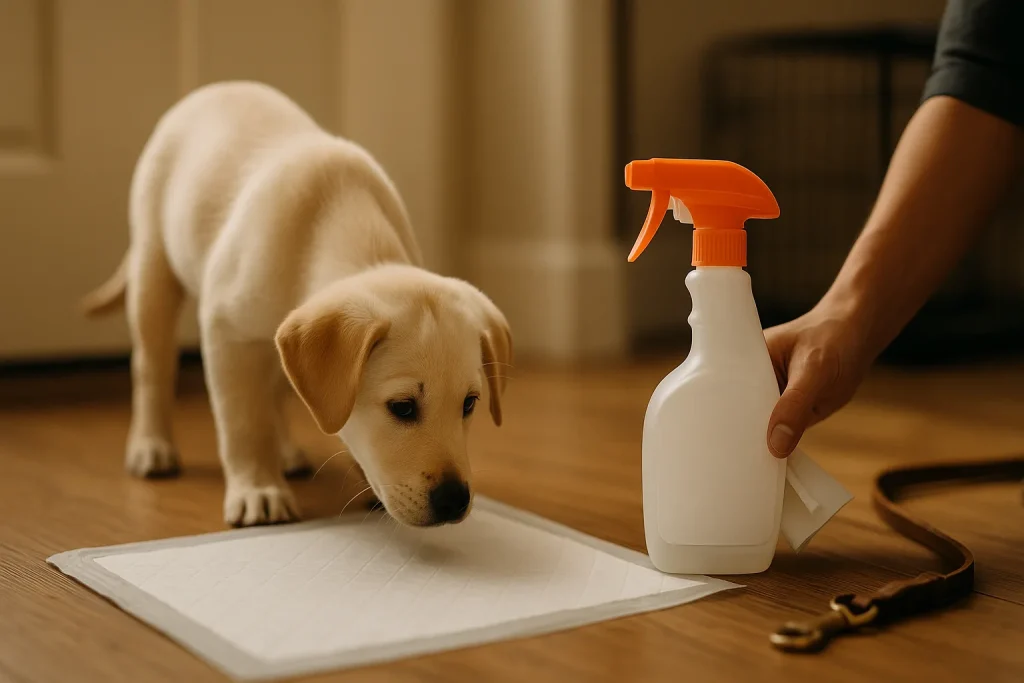
When a puppy freezes at the door or backs away the moment the leash comes out, the likely issue is not stubbornness. It is fear. The fastest way to help is to start with the easiest place your puppy can already succeed, then build toward the outdoors in small, calm repetitions.
This plan shows you what to watch, how to move forward without forcing confidence, and when to stop pushing and fall back to a safer step.
Start by recording the pattern you are actually seeing
Before you change the setup, spend a few days noticing the same few details each time. You are trying to learn where the fear starts, because that tells you which step is too hard.
Record:
- what happens at the door approach
- whether your puppy can sniff, stand, or squat once outside
- which surface seems hardest: grass, concrete, wet ground, stairs, porch boards
- whether the fear shows up only at certain times, such as night, early morning, or when the area is noisy
- whether your puppy relaxes as soon as you go back inside
Those notes are more useful than guessing. A puppy who pees indoors but freezes outdoors is giving you a location problem, not a refusal problem. That means the training target is confidence around the door and surface, not more pressure.
Make the first success easy enough to repeat
The first step is usually an indoor potty spot placed near the exit you want to use later. The point is not to keep the puppy indoors forever. The point is to create one repeatable success that is close to the feared location but still feels safe.
A simple setup is:
- a washable pad or turf tray
- a waterproof layer underneath
- the same door you plan to use for outdoor trips
- a quiet, predictable routine
Take your puppy there on a leash, wait calmly, and let the potty happen without cheerleading. When your puppy goes, reward briefly and then move on. You are teaching: this place is safe, this behavior is allowed, and nothing scary follows.
Success signal: your puppy walks to the spot, sniffs, and toilets without freezing.
If that fails: the spot may still be too close to the fear trigger or the environment may be too busy. Move it a little farther from the door and make the routine quieter before you try again.
Use a confidence ladder instead of a single leap outside
The main decision-changing tool here is a progression ladder. It gives you a way to advance only when the current step is clearly working, instead of guessing whether your puppy is "ready."
Think of the ladder as a series of easy location changes, not a series of harder commands.
Step 1: Potty safely in the indoor spot near the door
Stay here until your puppy uses the spot without hesitation. Keep the routine boring and predictable.
Advance when: your puppy goes there calmly more than once and the body looks loose, not pinned or tense.
If your puppy refuses: you have not failed. The step is just too close to the next challenge. Move the station back to the last place that worked.
Step 2: Place the potty spot right at the threshold
Now shift the pad or turf tray to the doorway area. This keeps the behavior familiar while making the door itself part of the training picture.
Success signal: sniffing, circling, and squatting without a retreat.
Difficulty adjustment: if your puppy stalls, lower the pressure by opening the door only partway, reducing noise, or returning to the previous indoor position for a day or two.
Step 3: Move the spot just beyond the door
Next, place the potty spot a small step outside, such as on a porch, step, or just beyond the threshold.
This is often where fear becomes obvious. Some puppies can do the indoor-to-threshold transition but balk as soon as the floor texture changes or the air feels different.
Advance when: your puppy reaches the spot, uses it, and comes back without a rush.
If that fails: the leap was too large. Go back to the threshold and rebuild there before trying again.
Step 4: Set the first outdoor potty zone close to the door
Once your puppy can handle the threshold and immediate outside area, move the potty spot a little farther into the yard or outdoor area.
Keep this move small. The goal is not distance. It is comfort.
Success signal: your puppy steps out, uses the spot, and does not appear to scan for escape the whole time.
Difficulty adjustment: if the puppy pees only after a long delay or tries to run back inside, return to the closer spot and stay there longer.
Step 5: Shift the spot toward the final outdoor toilet area
Only after your puppy is relaxed at the near-door outdoor spot should you move farther toward the place you eventually want to use every day.
Keep the same routine, same leash, same reward style, and same quiet tone. The change is only location.
Advance when: the puppy uses the current spot promptly and with a loose body.
This ladder solves the core training question: not “How do I get my puppy to go outside right now?” but “What is the easiest outdoor-adjacent success my puppy can repeat today?”
Watch for the signs that mean you should slow down
Progress is not measured by distance covered. It is measured by the puppy’s body language.
Slow down if you see:
- freezing at the door
- backing away from the leash or exit
- sniffing and then abandoning the spot
- crouching low without releasing
- turning to rush back inside
- taking much longer than usual to eliminate
These are not reasons to correct the puppy. They are signals that the current step needs more time or less difficulty.
A common failed fix is staying outside longer and hoping the puppy will “give in.” That often makes the fear worse. It also teaches the puppy to hold it until the pressure is gone, which can lead to accidents inside later.
What to do if your puppy holds it too long or has an accident inside
If your puppy starts holding urine for a long stretch, treat that as a sign that the step is too hard, not that the puppy is being difficult.
Go back to the last successful location immediately. Do not wait for a bigger emotional breakthrough. The body is already telling you the plan moved too fast.
If an accident happens inside:
- clean it thoroughly with an enzyme cleaner
- do not scold or hurry the puppy back to the scene
- note what changed right before the accident
- look for a trigger such as a louder outside sound, a harder surface, or a longer wait
If you need to leave the puppy alone, use a safe confinement area with the indoor potty spot available. That prevents a long hold and keeps the pattern from getting messier.
Fallback rule: when in doubt, return to the last spot that produced a calm, complete potty.
How long it usually takes to build confidence
There is no exact number of days that fits every puppy. Some dogs move through the ladder quickly once the setup is right. Others need several days at each step, especially if they have had repeated scares or are easily startled.
A useful way to think about timing is this: if your puppy is calmly repeating success at one level, you can consider a small next step. If the body gets tight, stop advancing and hold steady longer.
That is a better guide than the calendar.
When to bring in a qualified professional
If your puppy seems intensely afraid of the doorway itself, continues to freeze after several patient stages, or acts anxious in more than just potty situations, a qualified force-free trainer or veterinary behaviorist may be appropriate.
A veterinary check is also worth discussing if the puppy appears uncomfortable while urinating, strains, or seems to be avoiding the act itself rather than the location. Fear and discomfort can look similar from the outside.
Professional help is not a last resort. It is the right next step when the fear pattern is bigger than a simple confidence ladder can handle alone.
Keep the plan simple: record, adjust, repeat
The quickest path is usually not a bigger leash, a firmer voice, or a longer wait. It is a cleaner read on the puppy’s body language and a smaller training step.
If the puppy is successful, keep the step the same until it becomes ordinary. If the puppy hesitates, reduce the difficulty. If the puppy holds it too long, go back to the last place that worked.
That is the training loop that actually changes the behavior.
If you want a clearer read on timing, location, and what tends to go wrong, tracking those patterns over a few days can make the next step much easier to choose.