First Week Schedule: What To Do First, What To Avoid, And When To Worry
Your puppy sleeps all day, but you’re awake wondering if that’s okay. You’ve cleaned up three accidents by noon, and it’s only Tuesday. The breeder’s advice was a blur, and every online search gives a different rule. You’re not broken—you’re just in the first week.
This guide gives you a clear, repeatable schedule that tells you exactly what to do from hour one, what warning signs matter, and when you can finally relax. No fluff. No judgment. Just the plan.
Fast Answer: A Snapshot of Your Puppy’s First Week
- The only goal is safety and rhythm. Your puppy doesn’t need obedience training yet. They need to feel safe, learn where to potty, and settle into a predictable routine.
- The magic cycle: Wake → Potty → Feed → Potty → Short Play/Calm Time → Potty → Nap. Repeat all day. If you’re ever lost, come back to that order.
- 18–20 hours of sleep is normal. A puppy who crashes after 45 minutes of being awake isn’t sick—they’re doing exactly what their body demands. Let them sleep.
- Potty needs are relentless. While awake, take your puppy out every 30–60 minutes. Immediately after meals, drinking, waking, and play. At night, set an alarm for every 2–3 hours.
- Crying at night does not mean you’re cruel. It means your puppy is in a new world. Check for potty needs, then reassure quietly. If it continues past night 4–5 without any improvement, revisit the crate setup.
- The true “call the vet” red lines: refusing all food for more than 12 hours, watery diarrhea lasting beyond 24 hours or containing blood, extreme lethargy where the puppy can’t be roused, labored breathing, or continuous vomiting. For everything else, breathe.
What To Do First: Your Critical First 24 Hours
The moment you pull into the driveway, your puppy’s first experience of your home shapes the next few days. Follow this sequence—no skipping, no ad-libbing.
From the Car to the Crate: The Step-by-Step Timeline
1. The driveway potty stop (before you go inside).
Carry your puppy directly to the outdoor potty spot you’ve already chosen. Set them down and stand still. No playing, no excited voices—just a calm wait. If they pee or poop, give quiet, warm praise and a tiny treat. If they don’t, no big deal. The goal is to teach them that this spot = potty, right from the very first moment.
2. Enter one room only.
Don’t let your puppy explore the whole house. Bring them into a single puppy-proofed space—a kitchen, a laundry room, or a pen set up with their crate, water bowl, and a couple of safe chew toys. Too much space too soon leads to accidents you can’t catch and a puppy who feels overwhelmed instead of secure.
3. Offer water, then let them decompress.
Put down a bowl of fresh water. Don’t switch their food yet; offer the exact same food the breeder, shelter, or rescue was using. If you need to transition to a new food, you’ll do it gradually starting next week, not today.
4. Keep the world small and quiet.
No visitors. No television at full volume. No children chasing the puppy. Gentle handling only. This is a massive sensory adjustment, and overstimulation can lead to a puppy who can’t settle at all.
5. Crate setup for tonight.
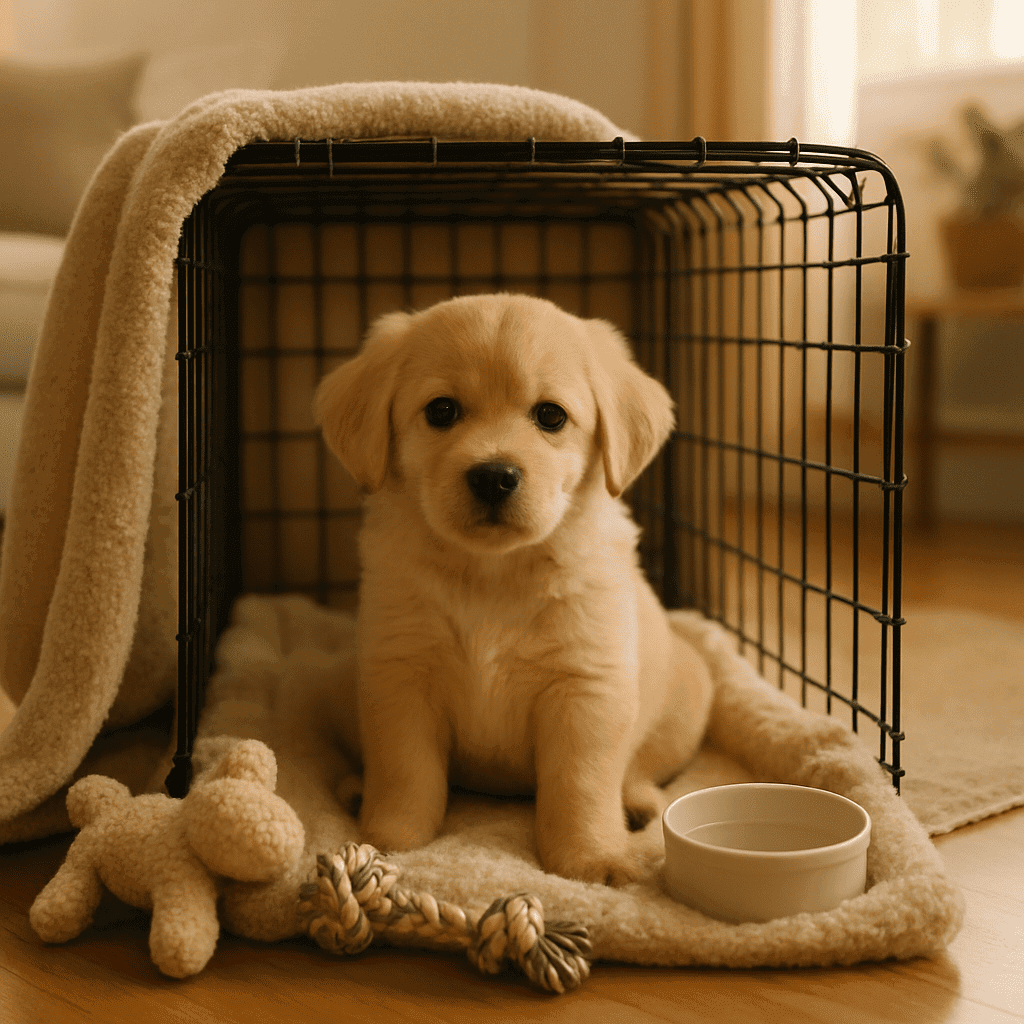
Where the puppy sleeps matters more than what they sleep on. Place the crate in your bedroom, right next to your bed. Cover three sides with a breathable blanket. Inside, put a washable crate mat, a worn T-shirt that smells like you, and a safe, non-destructible chew toy. The crate should be just big enough for the puppy to stand, turn around, and lie down. If it’s too large, use a divider. A cozy, den-like space reduces night crying.
The First Evening and Night
Around two hours before your own bedtime, take a final “boring” potty trip: no play, no wandering. If the puppy goes, great. If not, try again in 15 minutes. Then, settle them into the crate with the lights dim and the room quiet. Expect some whining. Wait 5–10 minutes. If the crying escalates into a distress scream, do a silent potty run—no talking, no cuddles—then return to the crate. Set your alarm now: you’ll need a midnight trip and a 3 a.m. trip, plus the 6 a.m. wake-up. Yes, it’s brutal. It’s also temporary.
What to never do on day one: skip the first potty trip, punish an accident, let the puppy free-roam, invite a crowd, or start formal training sessions.
Your Daily Puppy Schedule: The Hour-by-Hour Routine for Days 1–7
This is the rhythm you’ll tape to the fridge. It’s built around a puppy’s natural needs: short bursts of awake time followed by long, deep naps. The timing can shift by 30 minutes if your morning starts later, but the sequence must stay the same.
The Master Daily Schedule (Sample for an 8-week-old puppy)
| Time | Activity | Notes |
|---|---|---|
| 6:00 am | Wake & immediate potty trip | Carry to spot, stand still. Praise only after they go. |
| 6:15 am | Breakfast | Same food, same bowl, no distractions. |
| 6:30 am | Potty break (post-meal) | Non-negotiable. Puppies almost always need to go within 5–10 minutes of eating. |
| 6:45–7:00 am | Gentle play or short name training | 5–10 minutes max. Keep it calm; no chasing games that wind them up. |
| 7:00–9:00 am | Enforced nap in crate or pen | Cover the crate, keep the room quiet. If awake, a safe chew can settle them. |
| 9:00 am | Potty & short play | 5-minute outing, then a brief sniff-and-explore session indoors. |
| 9:30–11:30 am | Nap | Do not disturb. |
| 11:30 am | Potty, then lunch | After potty, offer second meal. |
| 12:00 pm | Potty break | Right after lunch. |
| 12:30–2:30 pm | Nap | |
| 2:30 pm | Potty & gentle play | Could be 5 minutes of rolling a ball or practicing “look at me.” |
| 3:00–5:00 pm | Nap | |
| 5:00 pm | Potty, then dinner | Final meal of the day. |
| 5:30 pm | Potty break | |
| 6:00–8:00 pm | Nap or quiet time | Low-key chewing activity; no roughhousing guests. |
| 8:00 pm | Potty, short calm outing | A quick walk to the spot and back. No play. |
| 8:30–10:00 pm | Wind-down period | Dim lights, soft voices. Puppy may nap or rest with a long-lasting chew. |
| 10:00 pm | Final potty trip of the evening | Same boring routine. Praise if successful. |
| 10:15 pm | Into crate, lights out | Set alarms for midnight and 3 a.m. potty runs. |
| Midnight | Silent potty run | Pick up, outside, put back. No eye contact, no talking. |
| 3:00 am | Silent potty run | Same. If the puppy is sleeping through, lucky you—but set the alarm anyway. |
Small-breed puppies (under 10 lbs expected adult weight) may need potty breaks every 20–30 minutes while awake and more overnight outings. Their bladders are tiny and they burn energy faster. Adjust any play session that seems too long—if your Chihuahua mix starts spinning or nipping after 5 minutes, it’s naptime.
Puppies 12 weeks and older can sometimes stretch overnight potty gaps to 4 hours if they’ve been sleeping soundly. Follow the same template but extend overnight alarms by one hour if the puppy stays asleep.
Enforcing Naps (Without Feeling Mean)
A tired puppy rarely settles on their own—they get frantic, mouthy, and completely incapable of making good choices. When you see that spiral, it’s not time for more exercise; it’s time for a nap. Place them in the crate with a stuffed Kong or a safe chew, cover the crate, and walk away. Some fussing is normal. If it lasts more than 10 minutes, run the silent potty check, then right back. Do not start play. Puppies learn quickly that crate equals rest.
Normal vs. Not Normal: When to Worry (and When to Relax)
Your puppy will do things that look alarming. Most of them are normal. A few are not. Use this table to tell the difference, and keep your vet’s phone number in your contacts.
| Behavior | Normal (No Worry) | Concerning (Call Vet) | Action |
|---|---|---|---|
| Crying in crate | 10–15 minutes then settling; first 3–4 nights | Nonstop screaming for hours, no improvement after 7 days, or signs of injury | Check for potty need, then comfort without pulling puppy out. If screams continue after a week, consult a trainer or vet. |
| Not eating | Skips one meal due to stress, but eats within 12 hours | Refusing all food for 12+ hours, or skipping food plus vomiting/lethargy | Warm the food slightly, offer in a quiet spot. If still refuses, call vet. |
| Loose stool / diarrhea | One or two soft stools, still active and playful | Watery stool, blood, mucus, more than 24 hours, or paired with vomiting/lethargy | Withhold food 12 hours, offer small portions of boiled chicken and rice. |
| Excessive sleep | 18–20 hours a day, wakes for food and potty | Impossible to rouse, floppy body, never wakes for meals | Let sleeping puppies sleep. If unresponsive, check gums (should be pink) and call vet. |
| Shivering / panting | Brief shiver when waking or light pant after play | Continuous trembling or open-mouth panting in a cool room | Check temperature (cool room, no blankets needed). Panting when hot is normal; at rest it’s a red flag. |
| Mouthing / nipping | Soft nipping during play, especially when tired | Hard bites that break skin, growling that accompanies a freeze | Redirect to a toy. If biting increases, enforce a nap immediately. |
The 5-Minute Night Crying Decision Tree:
- Puppy cries → wait 5 minutes. If they settle, leave them.
- If crying continues → take them outside on leash, stand still, no talking. If they potty, praise softly and return to crate. If not, return after 3 minutes.
- If screaming persists for 10+ minutes after that → check for discomfort (wet bedding, too cold). Offer a covered crate with a heartbeat toy, then step away. Do not open the door during full-blown screaming or you teach that screaming works.
- If night 5 brings zero improvement → try moving crate next to your bed, or consult a force-free trainer.
5 First-Week Mistakes That Almost Every New Owner Makes
1. Letting the puppy roam the whole house on day one.
Why it backfires: The puppy has no idea where to potty, which room is safe, or how to get back to you. They’ll eliminate behind the sofa and chew electrical cords you didn’t notice. Fix: Start with one room or a pen. Add new rooms after a week of accident-free behavior.
2. Scolding or rubbing their nose in accidents.
Why it backfires: It doesn’t teach them not to potty indoors. It teaches them to potty where you can’t see them. Fix: If you catch them mid-stream, interrupt with a neutral sound, scoop them up, and take them to the potty spot. Praise when they finish there. Clean all indoor spots with an enzymatic cleaner to remove scent traces—standard soap won’t work.
3. Inviting family and friends over in the first days.
Why it backfires: A puppy’s social battery is tiny. A parade of new people can push them into overarousal or fear. Fix: Protect their sleep. Let the puppy meet one or two calm adults in the second week, briefly, and no face-to-face pressure. Socialization is a slow burn, not a house party.
4. Skipping a schedule because “the puppy will tell me what they need.”
Why it backfires: Puppies don’t know when they need to potty or sleep. They’ll play until they collapse and pee where they drop. Fix: You are the timekeeper. Even if your puppy seems energetic, after 45–60 minutes awake they need a nap. Put them in the crate before the meltdown, not after.
5. Comparing your puppy to Instagram paragons or a friend’s older dog.
Why it backfires: Every puppy’s pace is different. Some sleep through the night at 10 weeks; others scream for two straight weeks. You aren’t failing; your puppy isn’t broken. Fix: Track your own data—accidents per day, minutes to settle, number of meals eaten—not someone else’s highlight reel.
Troubleshooting: Crying, Accidents, Refusing Food & More
Puppy Crying at Night
Try this first: The silent potty check described above. Make sure the crate is cozy (warm but not hot, a worn T-shirt with your scent, a covered top). A heartbeat puppy toy or a low white-noise machine can help.
If crying continues after night 3: Reassess placement. Some puppies do better with the crate directly next to the bed so they can hear your breathing. Others startle at every toss and turn and need the crate just outside an open door. Experiment. Never bring a crying, panicked puppy into your bed—it often creates a permanent sleep dependency that’s harder to undo.
When to get help: If the puppy screams for hours even after 7 nights of consistent routine, or if they seem to be in physical discomfort (stretching, belly tightness, repeated licking), a vet check is warranted.
Potty Accidents Piling Up
Accident response: Act neutral. A loud “no” or a grab will only make the puppy nervous about pottying in front of you. If you see the accident happening, scoop them up calmly, go straight to the spot, and stay until they’re done. If you find an old puddle, clean it with enzymatic cleaner and move on.
Prevention tweaks: If accidents happen every 20 minutes, increase potty trips to every 20 minutes while awake. Set a timer. Keep the puppy tethered to you or in a pen so you can catch pre-accident signals (sniffing, circling, sudden stillness). Every accident is data, not a moral failing.
Refusing Meals
A stressed puppy may ignore breakfast. That’s normal. Remove the bowl after 15 minutes and offer food again in 1–2 hours. Don’t start hand-feeding a healthy puppy who’s just holding out; that creates a picky eater. Warming the food or adding a little warm water can make it more enticing.
Red flag: If your puppy refuses two consecutive meals (more than 12 hours), or if lack of appetite comes with vomiting, diarrhea, or listlessness, call your vet immediately. Dehydration sets in quickly in tiny bodies.
Mouthing and Nipping Ramping Up
This almost always means your puppy is overtired. If the biting is frantic, hard, and paired with zoomies, put the puppy in the crate for a nap. During calm play, redirect to a chew toy. If they continue to bite hands, stand up and turn your back for 10 seconds—removing attention removes the fun. Never squeeze the puppy’s mouth or yell; it can create fear and damage trust.
Loose Stool Without Other Symptoms
One or two soft stools from stress or a subtle diet change are common. Skip the next meal, then offer small amounts of boiled, unseasoned chicken and white rice for 12–24 hours. Keep the puppy hydrated. If the stool is watery, contains blood, or the puppy becomes lethargic, see the vet same day.
Your First Week Survival Checklist
Print this and check off each day. It’s a gentle guide, not a report card.
- ☐ Morning: Carry puppy straight to potty spot. Record success or accident.
- ☐ 6:15 am: Feed breakfast. Note how much they ate.
- ☐ 6:30 am: Potty again (post-meal).
- ☐ 7:00–9:00 am: Enforce first nap.
- ☐ 9:00 am: Potty trip + 5-minute gentle interaction.
- ☐ 9:30–11:30 am: Nap.
- ☐ 11:30 am: Potty, then lunch.
- ☐ 12:00 pm: Post-lunch potty.
- ☐ 12:30–2:30 pm: Nap.
- ☐ 2:30 pm: Potty + calm play.
- ☐ 3:00–5:00 pm: Nap.
- ☐ 5:00 pm: Potty, then dinner.
- ☐ 5:30 pm: Potty break.
- ☐ 6:00–8:00 pm: Quiet nap or chew time.
- ☐ 8:00 pm: Potty, no play.
- ☐ 8:30–10:00 pm: Wind-down.
- ☐ 10:00 pm: Final potty trip.
- ☐ 10:15 pm: Into crate, set overnight alarms.
- ☐ Overnight: Midnight and 3 a.m. potty runs (if needed).
- ☐ Notes: Jot down accidents, appetite, energy, crying duration.
You’ve got the framework. For a schedule custom-fit to your puppy’s exact age and breed—with printable checklists and age-specific tips—Generate your puppy schedule.
Sources and Safety References
For more on puppy care and first-day tips: AKC Guidance. For managing puppy crying: PetMD Crate Training Tips.