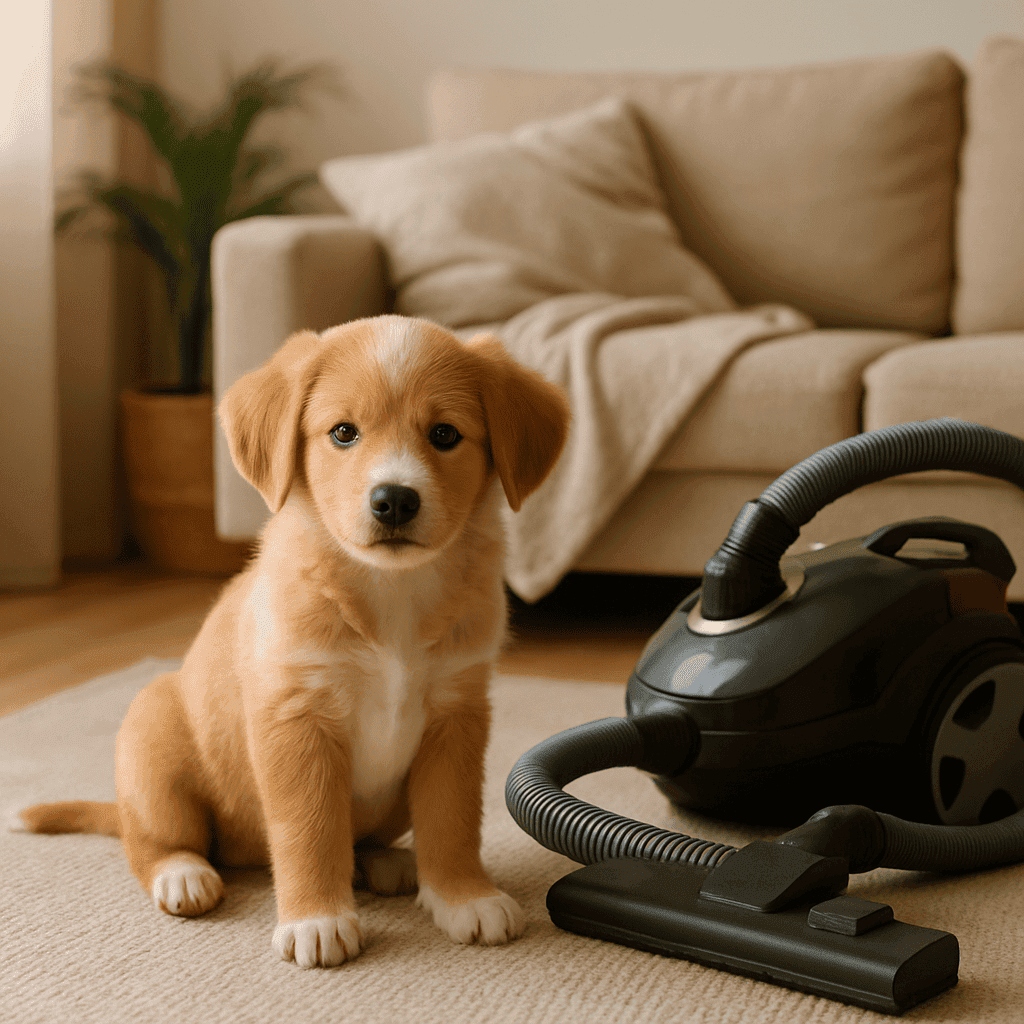
Helping Your Puppy Overcome Vacuum Fears: A Confidence Guide
Place the vacuum—completely off—in the same room as your puppy, about 20 feet away. Give him a high-value treat just for noticing it calmly. Let the moment last only 3 seconds, then end the session. Repeat that tiny exposure 3 separate times before you ever move the vacuum an inch closer. This isn’t about making him like the noise today. It’s about teaching his nervous system that the vacuum predicts good things from a safe distance. No force, no flooding, no "get over it." Just three calm seconds at a time, building a ladder of trust.
What To Do First Right Now
If your puppy just bolted, don’t try to fix this in the middle of the panic. Turn the vacuum off, put it away, and let him come out on his own. Tossing a treat a few feet from the sofa—not directly at him—can help him unfreeze. Do not pull him out or carry him toward the vacuum.
Once he’s relaxed, start the first mini-session later that same day. Put the vacuum in the corner of the room, turned off, 20 feet from where your puppy usually rests. Sit on the floor with him, scatter a few tiny treats, and simply end the moment. You’re teaching his brain that the vacuum can appear and nothing scary happens.
Understanding Your Puppy’s Fear
Vacuums hit three big puppy triggers at once: a large moving object, a sudden loud noise, and unpredictable direction changes. To a 10-week-old brain, that combination can read like a predator. A puppy hiding isn’t being dramatic; his nervous system is flooding with stress hormones.
The good news is his brain is incredibly plastic. Calm, repeated exposure at a safe distance rewires that fear response. Force him closer, and you risk creating a long-term phobia. Remember: it’s about building a new story—vacuum appears, treats happen, nothing bad follows. For peaceful interactions with other household noises, check out Calm first experiences with common household activities.
The Vacuum Confidence Ladder Explained
A confidence ladder is a gradual exposure plan that starts at a point where your puppy feels completely safe. With vacuums, you’ll control distance and noise level, moving from “vacuum off, far away” to “vacuum on, close by” over days or weeks.
The ladder works because it never lets the scary thing happen too close too fast. Each step should feel almost boring to the puppy. If you see relaxation, you can move closer. If there are signs of stress, pause or move back.
The ladder prevents learned helplessness by making his emotional state the guide, not your cleaning schedule. The hardest part is going slower than you want, but that’s exactly what works.
Step-by-Step: Applying the Ladder
You don’t need fancy equipment—just a hungry puppy, some chopped-up treats, and a vacuum you can move without turning on. Block off the session from other distractions. No TV, no kids running, no other pets.
The Vacuum Comfort Chart
| Step | Distance | Vacuum State | Session Duration | Calm Sessions Needed | Signs to Advance |
|---|---|---|---|---|---|
| 1 | 20 feet | Off, stationary | 3–5 seconds | 3 calm sessions | Puppy notices vacuum then returns to normal; takes treat; loose body |
| 2 | 15 feet | Off, stationary | 5–10 seconds | 3 calm sessions | Puppy remains relaxed; may glance at vacuum |
| 3 | 10 feet | Off, stationary | 10–15 seconds | 3 calm sessions | Puppy ignores vacuum or sniffs it; tail neutral or wagging |
| 4 | 10 feet | Vacuum moved gently (no motor) | 5 seconds of slight push | 3 calm sessions | No startle; continues taking treats |
| 5 | 15 feet | Vacuum on in another room, door closed | 5–10 seconds of muffled noise | 3 calm sessions | No trembling; ears may swivel but body stays loose |
| 6 | 15 feet | Vacuum on in same room, far away | 3–5 seconds | 3 calm sessions | Puppy stays in place; may look but doesn’t retreat |
| 7 | 10 feet | Vacuum on, slow movement away from puppy | 5–10 seconds | 3 calm sessions | Puppy tracks with eyes but stays relaxed |
| 8 | 8 feet | Vacuum on, gentle movement, sometimes toward | 10–15 seconds | 3 calm sessions | No retreat; may walk away slowly |
| 9 | 5 feet | Normal vacuuming behavior | 15–20 seconds | Until utterly boring | Puppy chooses to lie down or chew a toy |
Start at Step 1 every time with a new puppy. Even if he seems “brave” on day one, stay at the 20-foot mark for first sessions. Always end on a positive note.
When to Pause and Reevaluate
Sometimes your puppy will show signals of stress, such as heavy panting or pinned ears. If you see these, stop the session immediately. Recognize when his bucket is full and give him a full day off.
If reactions like shaking don't stop minutes after the vacuum leaves, or if there’s extreme fear, pause all ladder work and consult a fear-free trainer if needed. For further guidance, see fear desensitization and puppy socialization.
Common Mistakes and How to Avoid Them
- Going too fast because “he seemed fine.” One good session doesn’t mean you can skip steps. Stick to the chart.
- Using the vacuum as a chase game. Accidentally teaching him the vacuum is a threat. Allow retreat.
- Holding or restraining the puppy during exposure. Let him control distance and choose to approach or retreat.
- Using low-value treats. Use real meat, cheese, or peanut butter for motivation.
- Practicing when the puppy is already tired or hungry. Schedule sessions after a nap and a potty break.
- Confusing calmness with shutdown. True calm looks like loose body language and eye contact.
Tracking Progress and Celebrating Wins
Keep a log. Note each session’s date, step number, and reaction code (C for calm, H for hesitant, S for stress). Celebrate small wins like glancing at the vacuum not running away.
Quick Steps for Vacuum Confidence
- Start sessions at 20 feet
- Use high-value treats
- End after 3–5 calm seconds
- Repeat three times before moving closer
- Look for relaxed body language
- Pause if distressed
FAQ
Where do I even start with desensitizing my puppy to the vacuum?
Begin with the vacuum off, 20 feet away. Scatter treats nearby at a comfortable distance for 3 seconds. Repeat 2–3 times before any changes.
How long should each exposure session be?
Start with 3 seconds. Increase slowly based on calm body language, not guesses.
What body language should I watch for?
Look for a soft, wiggly body, neutral or wagging tail, and treat-taking.
What if my puppy is still scared after several attempts?
Revert to simpler steps and use higher-value treats. Stop vacuum work for a few days if needed.
Should I involve another person during the vacuum training?
Yes, as a calm presence. Avoid holding the puppy.
What if my puppy barks or lunges at the vacuum?
Increase distance and treat the behavior as uncertainty rather than aggression.
Can I just put my puppy in another room while I vacuum?
For now, yes, but work on exposure separately to build confidence over time.
Build the Routine That Supports Confidence
A well-rested and predictable schedule helps emotional resilience. Generate your puppy schedule for a solid daily rhythm.
Sources and safety references: