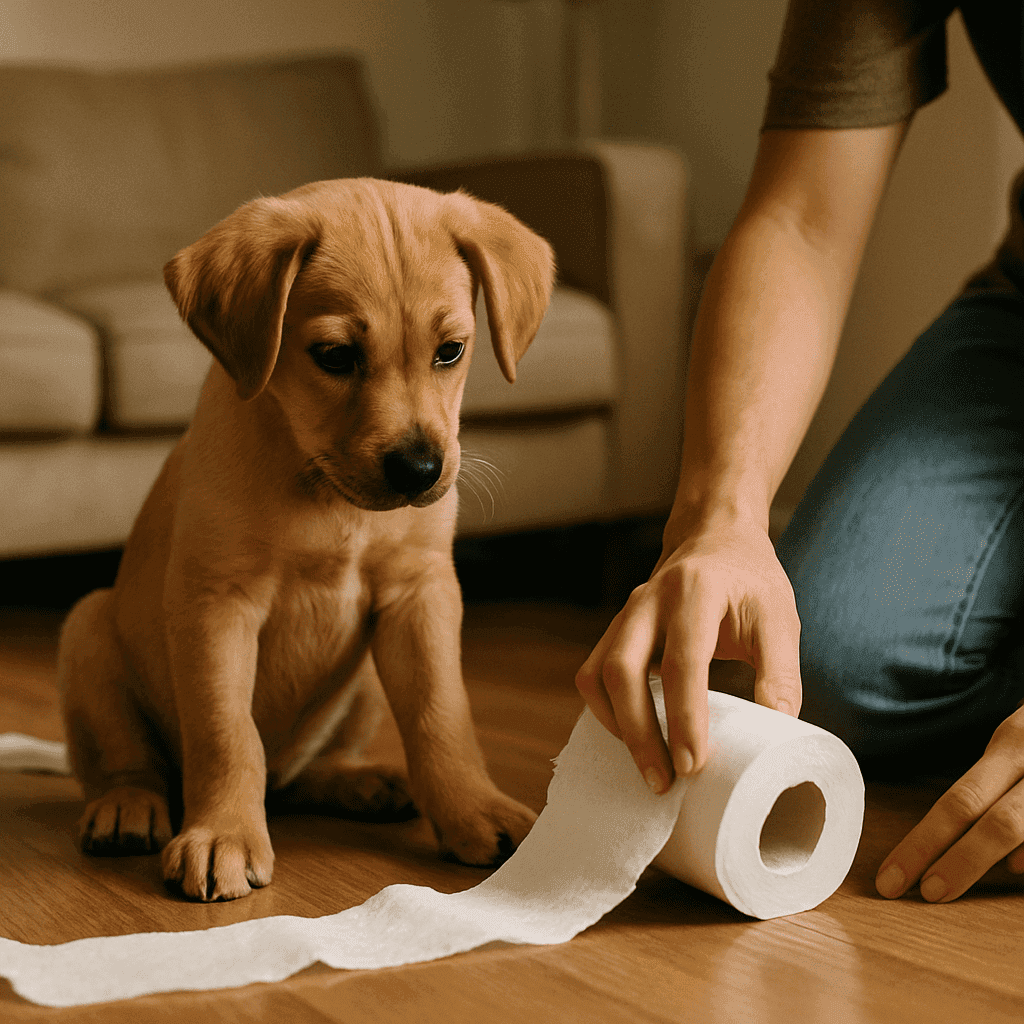
Your puppy just grabbed a sock and is trotting away like it just won the lottery. You call, maybe even clap once, and suddenly the sock is more interesting than you are. That moment is frustrating, but it is also very trainable. If you want to know how to teach a puppy to drop it, the safest answer is not force, not chasing, and not prying the mouth open. The safest answer is to teach your puppy that releasing an item leads to something better.
This guide shows you how to set up that lesson in a way a first-time puppy owner can actually use. The plan is simple: identify the hardest trigger, make the first reps easy, teach the first achievable response, then use a clear progress rule so you know when to repeat, pause, or simplify.
Identify the Hardest Trigger
Before you train, notice the exact version of the problem. A puppy who will drop a boring toy in the living room is not having the same issue as a puppy who clamps down on a stolen shoe during a chase. If you start with the hardest real-world version, you usually get barking, keep-away games, or stress instead of learning.
Write down the pattern you actually see:
- Where does it happen?
- What object does your puppy hold?
- What happened right before the grab?
- What do you do next?
- How does your puppy respond when you approach?
- Does your puppy recover quickly, or does the situation keep escalating?
That last question matters. The key distinction is not just whether your puppy disobeys. It is whether your puppy can disengage and recover. If the puppy cannot settle, cannot take food, or seems locked onto the object, that is your signal to make the setup easier before training more.
A few common examples help clarify the difference:
- A calm puppy holding a toy in the den is a good training setup.
- A puppy running full speed with a stolen sock while you chase is not.
- A puppy who happily trades a toy after a cue is ready for easier progression.
- A puppy who stiffens, runs, or growls when you approach needs a simpler plan.
The goal here is not to solve everything at once. The goal is to spot the version of the problem that is too hard so you can start below it.
Create an Easier Starting Point
The first training session should feel almost too easy. That is a feature, not a weakness. Puppies learn best when they are not flooded, not tired, and not competing with a high-value object.
Choose a low-distress setup:
- a quiet room with few distractions
- a boring toy your puppy likes but does not obsess over
- tiny, high-value treats ready before you begin
- a calm puppy, not one in the middle of zoomies or overtired behavior
If you have a puppy who gets wild in the evening, train earlier in the day. If the kitchen is too exciting, use a bedroom or hallway. If a plush toy is too exciting, switch to a less interesting toy. You only need one clear success signal at first: the puppy opens the mouth or releases the object without stress.
The biggest beginner mistake is practicing when the puppy is already over threshold. In that state, the puppy is not really learning the cue. You are just rehearsing tension. If success becomes inconsistent or stress rises, make one thing easier: reduce the object value, move to a quieter space, or use a better reward.
Safety note: If your puppy is guarding a dangerous item such as chocolate, grapes, xylitol, sharp plastic, needles, or something that could cause choking, do not turn it into a training session. Training is for teachable items, not emergencies. If you cannot safely remove the object, contact your veterinarian right away.
Teach the First Achievable Response
The easiest way to start is often a trade game. The puppy learns that letting go does not end the fun. It starts the next fun thing.
Use two toys that are safe, similar in value, and easy for the puppy to mouth. Keep the first sessions short and successful.
Step-by-step trade game
- Offer Toy A and let your puppy take it.
- Wait a moment. Do not grab at it.
- Bring out Toy B in a lively, interesting way.
- Say your cue, such as “Drop it,” right before or as the puppy begins to loosen the grip.
- The instant the puppy releases Toy A, mark the behavior with a cheerful “Yes!”
- Immediately give Toy B or deliver a treat.
- After a few repeats, end the session while the puppy is still doing well.
The timing matters. Reward the release, not the chase. If you are slow and the puppy re-grabs Toy A before you respond, you may accidentally reward the wrong pattern. Have your reward ready before you start.
If your puppy drops the toy but then freezes, looks worried, or refuses the next round, the setup may still be too hard. That is not failure. It is feedback. Go back to an easier object or a quieter room and try again later.
Why this works
You are not teaching the puppy to give up things because you said so. You are teaching the puppy that releasing an object predicts something worthwhile. That is a much stronger and safer habit than forcing the mouth open or creating a chase game.
Keep the tone light. A happy voice, a simple cue, and short repetitions are enough. You do not need a long session. In fact, short sessions are better for young puppies because they reduce frustration and keep the learning clean.
Use a Copyable Training Log
A simple log helps you see patterns instead of guessing. It also makes it easier to notice when the puppy is ready to progress or when the setup needs to get easier.
| Date | Object | Location | Stress signals? | Response to cue | Reward used | Next step |
|---|---|---|---|---|---|---|
| boring toy | quiet room | none / mild / high | released quickly / hesitated / refused | treat / toy / both | progress / repeat / pause / simplify |
You can copy that into a notebook or notes app. After a few sessions, the pattern usually becomes obvious. If your puppy succeeds in one room but not another, the room is part of the trigger. If your puppy responds to a toy trade but not food, the reward needs adjusting. If the puppy only succeeds when calm, timing matters too.
Build Difficulty Gradually
Once your puppy can reliably drop a low-value toy in a quiet room, you can increase difficulty little by little. Do not jump straight to the hardest real-world version because it feels convenient. Progress based on performance.
Use this grid to decide what to do next:
| What you see | What to do next | Example |
|---|---|---|
| Quick, calm release several times in a row | Progress | Try a slightly better toy or a mildly different room |
| Slow but willing release, with no stress signs | Repeat | Stay at the same level for another short session |
| Freezing, running away, growling, or swallowing faster | Simplify | Use a lower-value object and a quieter space |
| Stress signs show up early in the session | Pause | End the session and try later when the puppy is calmer |
The important part is that each branch changes the action. If the puppy is doing well, increase only one thing at a time. For example, change the toy but keep the room the same. Or keep the toy the same and add a tiny distraction. If you change too many things at once, it becomes hard to know what helped.
A few good progression steps are:
- same cue, slightly better toy
- same toy, new room with a small distraction
- same room, slightly longer hold before the trade
- same game, but with the puppy on a leash for safety in a more open area
If the puppy regresses, repeat the last successful level. That is usually the smartest move.
Troubleshoot Setbacks
If your puppy is not getting it, the issue is usually one of a few training variables. Try changing only one variable at a time so you can see what actually matters.
The puppy will not let go even for a treat or second toy
This usually means the object is too valuable, the reward is not valuable enough, or the setting is too exciting.
Try this:
- switch to a duller object
- use a better reward, like tiny chicken pieces or soft cheese if your puppy likes them
- move to a quieter room
- crouch down instead of looming over the puppy
The puppy drops it and immediately grabs it again
That usually means the reward timing is too slow.
Try this:
- mark the release with a quick “Yes!”
- toss the treat away so the puppy moves off the object
- have the reward already in hand before you cue
The puppy runs away when you say the cue
That can happen when the puppy has learned that your approach means the item disappears or a chase starts.
Try this:
- stop chasing completely
- return to the two-toy trade in a small, calm room
- use a happy, predictable tone
- make sure the cue predicts something good, not a struggle
The puppy freezes or turns away
This may mean the session feels too intense.
Try this:
- end the session
- give the puppy a break
- next time, use a lower-value object and a more relaxed room
If the same failure repeats after one controlled change, do not keep repeating the same exact setup. Change another variable and compare again.
Decide When to Pause or Seek Help
Most drop-it training stays in the normal puppy-training zone. Sometimes, though, the pattern changes enough that you should pause and get outside help.
Consider a veterinary check first if you notice:
- sudden refusal to open the mouth
- yelping when the mouth is touched
- drooling, pawing at the face, or chewing oddly
- refusing treats that were previously easy to take
- sudden lethargy or a big change in appetite during training
Those signs can mean the issue is not just training.
Consider a certified force-free trainer or veterinary behavior professional if you see:
- growling, snapping, or biting when you approach an item
- hard staring, freezing, or lip curling around valued objects
- worsening guarding behavior over several sessions
- fear that makes the puppy unable to recover
The decision point is simple: if the problem has shifted from basic training difficulty to safety, welfare, or persistent distress, simplify the plan or seek help. Continuing the same self-guided approach when the problem category has changed can make the issue harder.
If you are unsure whether the object is safe to remove or the puppy may bite, choose safety first. Stop training for the moment and get help.
A Simple Practice Plan for the First Week
If you like clear structure, this is an easy way to organize your first few sessions:
- Day 1: quiet room, low-value toy, two-toy trade
- Day 2: repeat the same setup if Day 1 was smooth
- Day 3: slightly better toy or a tiny new distraction, only if success was calm
- Day 4: repeat the last successful level
- Day 5: simplify if stress rose, or progress if the puppy stayed relaxed
Keep each session brief. A few successful reps are better than one long session that ends in frustration.
If you want more help with the rest of your puppy’s setup and first-week routine, you can also use the Build your puppy first-week starter kit tool as a next step for organizing the supplies that make training easier.
Frequently Asked Questions
What should I do first for how to teach a puppy to drop it?
Start with the easiest possible setup: a quiet room, a low-value object, and a high-value reward. Use a short two-toy trade game and reward the release immediately.
How many times should I repeat the cue in one session?
Keep it short. A few successful reps are usually enough for one session. If the puppy is still engaged and calm, stop while things are going well rather than pushing until the puppy gets tired or frustrated.
What if my puppy only drops it when I offer food?
That is still a useful start. Food is a good training aid if it helps create a reliable release. Later, you can gradually phase in other rewards or lower-value items.
Can I use “drop it” for dangerous objects?
Not as your only plan. If the puppy has a dangerous item, your first priority is safety, not a perfect training rep. If you are worried about a toxin, sharp object, or choking risk, contact your veterinarian.
Why does my puppy grab things and run away?
Many puppies learn that stolen objects start a chase game. Stop chasing, remove the payoff, and rebuild the cue with a trade game in a calm area.
How do I know when to make the exercise harder?
Progress only when the puppy releases calmly, recovers quickly, and can repeat the behavior a few times without stress. If you see hesitation, stress signals, or avoidance, repeat or simplify instead.
Teaching a puppy to drop it is really about making cooperation easy. Start with a setup your puppy can win, keep the first reps short, and let the puppy learn that giving things up does not end the fun. It starts the next good thing.