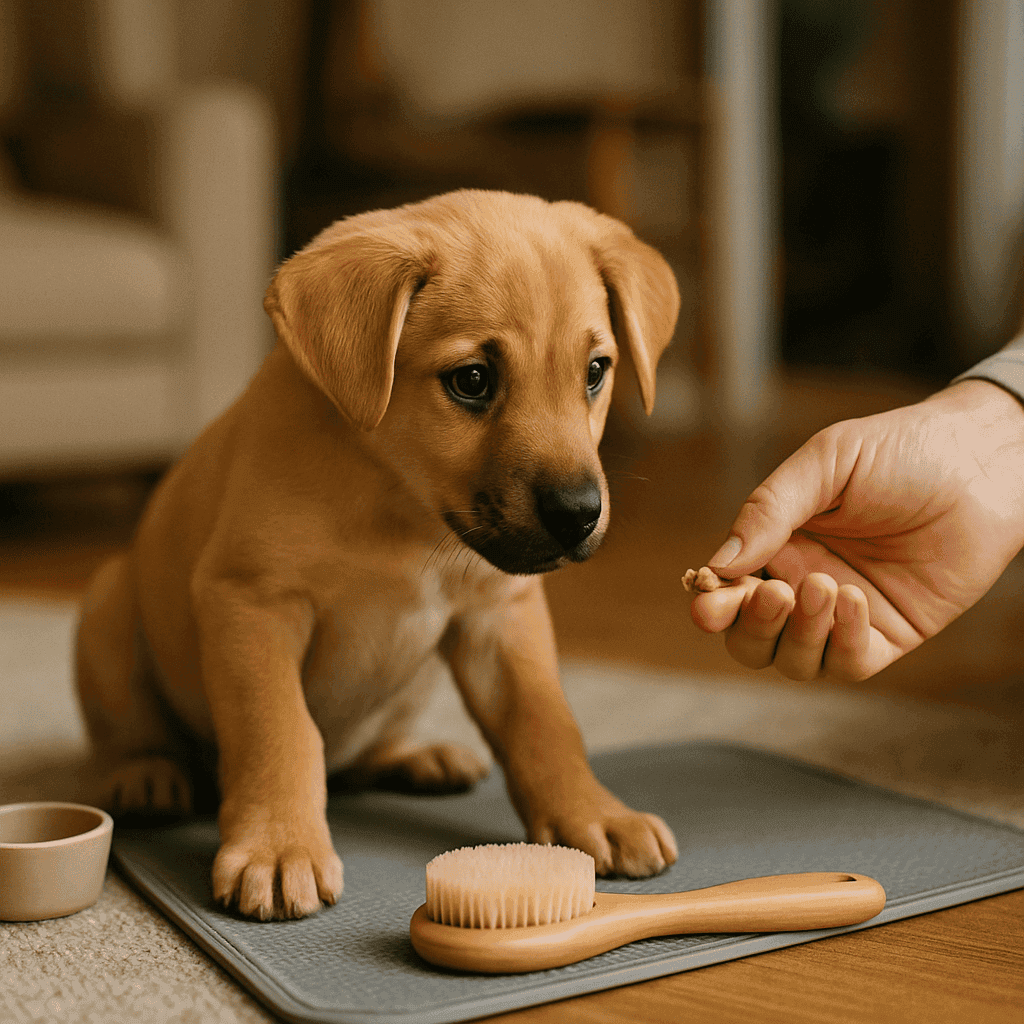
You pick up the brush. Your puppy darts under the couch, whines, wriggles, or spins to bite the handle. If that sounds familiar, take a breath. This is common, and it does not mean your puppy is “bad,” stubborn, or doomed to hate grooming forever.
For a first-time owner, brushing resistance can feel confusing because the puppy is sending mixed signals: one day they tolerate a few strokes, the next they act like the brush is a monster. Usually, that behavior comes from one of three things: the brush feels uncomfortable, the handling feels scary, or something actually hurts. Sometimes it’s a mix.
This article gives you a root-cause map, a coat-based brush guide, a simple 7-day desensitization plan, and a printable-style troubleshooting checklist you can use right away. No punishment. No force. No holding your puppy down “just to get it done.”
Fast Answer: Why Your Puppy Doesn’t Like Being Brushed (And What to Do Right Now)
The most common reasons a puppy resists brushing are fear, the wrong brush or pressure, and pain or skin sensitivity. A puppy that squirms away may be reacting to a brush that pulls or a body that is still learning touch. A puppy that snaps at the brush may be reacting to fear, overwhelm, or pain. A puppy that yelps or suddenly panics may have a hidden problem that needs attention.
Here’s what to do today:
- Stop forceful brushing if your puppy is actively fighting it. Chasing your puppy with a brush or pinning them down teaches them that grooming is scary and unavoidable. That usually makes the problem worse.
- Try a 10-second no-brush touch reset. Sit on the floor with tiny, high-value treats. Touch your puppy’s shoulder or side with your hand for 2–3 seconds, then give a treat. Repeat three times. If your puppy relaxes, leans in, or stays curious, you have a good starting point.
If your puppy screams, flinches hard, or panics even when you touch lightly with your hand, stop and check for pain or injury before you continue. That’s not something to push through.
The rest of this guide will help you figure out exactly what your puppy is reacting to and how to make brushing feel safe again.
The Root-Cause Decision Tree: Match Your Puppy’s Reaction to the Real Problem
Instead of guessing, match the behavior to the likely cause.
If your puppy squirms, wriggles, or walks away when the brush touches them: the likely issue is discomfort from pressure, a brush that pulls, or general handling sensitivity. Start with a softer tool and go back to hand-touch work for a few days.
If your puppy bites the brush itself: the brush probably looks strange, feels threatening, or has become an object your puppy wants to wrestle. The first step is to make the brush boring. Put it on the floor nearby and reward calm curiosity before you try to brush again.
Keep this as an observation rather than a diagnosis: record what changed, watch the wider pattern, and contact a veterinarian if the puppy appears unwell or the concern persists.
If your puppy hides when the brush appears: the brush has already become a predictor of something your puppy dislikes. Stop the brushing session and start pairing the brush’s presence with treats from a distance.
If your puppy yelps or flinches at one specific spot: suspect pain, a mat, irritated skin, a thorn, or another hidden problem. Check the area carefully and call your veterinarian if the reaction continues or the skin looks abnormal.
Keep this as an observation rather than a diagnosis: record what changed, watch the wider pattern, and contact a veterinarian if the puppy appears unwell or the concern persists.
A few breed and coat notes can help too. Thick-coated dogs like Golden Retrievers or Huskies can hide mats close to the skin. Short-coated puppies like Labs or Boxers may be more ticklish or annoyed by a stiff brush than truly painful. If your puppy behaves differently from one session to the next, keep a simple note of the time, the brush, the body area, and the reaction. Patterns are often easier to see on paper than in the moment.
Grooming Tool Guide: The Right Brush for Your Puppy’s Coat (Short, Long, or Sensitive Skin)
A lot of brushing battles start with the wrong tool. Puppy skin is sensitive, and a brush that is fine for an adult dog can feel scratchy or sharp to a small puppy.
Before you buy anything else, match the tool to the coat.
| Coat type | Common examples | Gentle tool style | Why it works |
|---|---|---|---|
| Short, smooth coat | Labrador, Boxer, Beagle | Rubber grooming mitt or soft bristle brush | Glides over the coat and feels more like massage than scraping |
| Double coat | Golden Retriever, Husky, Corgi | Long-tooth slicker or undercoat rake, used gently | Helps lift loose undercoat without digging into the skin |
| Long, silky coat | Maltese, Shih Tzu, Yorkie | Pin brush with polished tips plus a wide-toothed comb | Detangles more gently and helps find small mats before they get tight |
| Sensitive skin, any coat | Any puppy | Extra-soft bristle brush or rubber grooming glove | Low friction and less pokey than stiff pins |
A simple test can save you trouble: run the brush over your own inner arm. If it feels scratchy, pokey, or harsh to you, it will probably feel worse to your puppy. Also check for bent tines or rough edges. Old or damaged brushes can tug the coat and make a puppy squirm even if the tool is technically the right style.
For many short-coated puppies, a rubber grooming mitt can feel like a pleasant rub rather than a “grooming event.” For long-coated puppies, a polished pin brush and a comb are often a better fit than a stiff slicker used with too much pressure. If you already bought a brush that seems harsh, you can use the smooth back of the brush for early touch work while you order a gentler option. That’s only a temporary bridge, not a permanent fix.
If your puppy is especially sensitive, choose the softest tool you can find and shorten every session. The goal is not to finish the whole coat in one go. The goal is to make grooming feel safe enough that your puppy wants to stay.
The 7-Day Desensitization Plan: A Gentle Schedule to Build Grooming Trust
The fastest reliable way to help a puppy accept brushing is not to force it. It’s to build a positive association in small pieces. Tiny successful reps work better than one long session because your puppy learns, “This is safe,” instead of “I have to endure this.”
Before Day 1
Gather your brush, a quiet non-slip surface, and very small treats. Think pea-sized pieces. Choose a time when your puppy is calmer, such as after a potty break and before a nap. A zooming, overtired puppy is much harder to teach.
Day 1 and Day 2: Hand touch only
No brush yet.
Touch your puppy’s back, sides, and neck with your hand for 3–5 seconds. Give a treat after each touch. Keep the whole session under one minute.
What you want to see: your puppy stays soft, looks at you, or even leans in. If your puppy simply stays in place without leaving, that is also a win.
If your puppy backs away immediately, shorten the touch to 1–2 seconds and try again later. The goal is not to win a battle. The goal is to create a calm first step.
Day 3: Introduce the brush without using it
Put the brush on the floor near your puppy. Reward any curious behavior: sniffing, looking at it, or stepping near it. Then hold the brush in your hand while giving treats, but do not touch your puppy with it yet.
If your puppy sniffs the brush and walks away, that still counts as progress. They noticed it and chose not to panic.
Day 4: Smooth-side touch
Lightly touch the smooth back of the brush to your puppy’s body for about 2 seconds, then treat. Repeat three times.
This step works because the smooth side is less threatening than the bristles. Your puppy gets used to the object and the motion without the prickly sensation.
If your puppy startles, go back to Day 3 for another day.
Day 5: One gentle stroke
Use the bristles or grooming side for just one gentle stroke on the least sensitive area, usually the side of the body or shoulder. Treat immediately after. Do only 2–3 total strokes in the session.
Watch for a lip lick, yawn, freezing, or whale eye. Those are signs your puppy is getting uncomfortable. If you see them, stop early.
Day 6: Very short brushing session
Increase to about 30 seconds total. Brush a small area with slow, light strokes and deliver treats during and after the session.
This is the day many owners get tempted to “just do a little more.” Resist that urge. The puppy learns trust from leaving the session before they are overwhelmed.
Day 7: Short full-body session
Try a one-minute session with frequent treat pauses. You do not have to brush every inch. End on a calm note, even if you only finish part of the coat.
A few important rules:
- If your puppy growls, snaps, or refuses on a given day, go back to the previous day for two more days.
- If your puppy will not take treats, try higher-value food like small pieces of plain chicken or practice before a meal.
- If your puppy is too frightened to eat, stop the session and check for pain or fear overload.
Here’s a copyable progress log you can use:
| Day | Session length | Puppy reaction | Treats taken | Next step |
|---|---|---|---|---|
| Day 1 | 40 seconds total | Allowed hand touch, relaxed shoulders | 4 tiny treats | Repeat Day 1 |
| Day 3 | 1 minute total | Sniffed brush, stayed curious | 5 tiny treats | Move to smooth-side touch |
| Day 5 | 20 seconds total | One brush stroke, then walked away | 3 tiny treats | Repeat Day 5 tomorrow |
Stop & Check: Normal Puppy Resistance vs. Pain or Fear Signals
Some resistance is normal. Some is a warning.
Safety note: If your puppy yelps, flinches at a specific spot, snaps with a stiff body, trembles, urinates during brushing, or has visible redness, scabs, hot spots, or tight mats, stop brushing and call your veterinarian before you continue. Do not try to work through possible pain.
| Normal puppy resistance | Concerning pain or fear signals |
|---|---|
| Squirming or walking a few steps away | Yelping or crying when the brush touches the body |
| Mouthing the brush or trying to play with it | Stiff body, hard stare, growling, snapping, or biting with force |
| A small groan or wiggle around a ticklish spot | Trembling, cowering, tucked tail before the brush even appears |
| Brief frustration but recovery after a treat | Sudden resistance after weeks of calm grooming |
Normal resistance means your puppy is still learning. Concerning signals mean you should stop and investigate.
If you suspect pain but cannot see a problem, there may still be something going on underneath the coat: joint discomfort, an ear issue, a skin sensitivity, or an injury you cannot spot easily. A veterinary exam is the right next step. If severe fear keeps showing up, a fear-free groomer can help make the process less overwhelming.
5 Common Mistakes That Make Puppies Hate Brushing (And How to Fix Them)
Mistake 1: Starting with long sessions. A five-minute brushing session can feel huge to a puppy. Fix it by keeping early sessions to seconds, not minutes.
Mistake 2: Brushing when your puppy is hyper or overtired. Timing matters. A calm puppy learns better than a zoomy or exhausted puppy. Fix it by choosing a quiet window after potty time and before a nap.
Mistake 3: Using a brush that pulls, especially on wet fur. Wet or tangled coat can tug painfully. Fix it by drying first and using the right tool for the coat type.
Mistake 4: Forgetting the treat association. If brushing always happens without reward, your puppy only learns “brush equals unpleasant.” Fix it by reserving a special treat just for grooming practice.
Mistake 5: Ending the session only when the puppy struggles. If your puppy learns that squirming makes the brush stop, the squirming gets stronger. Fix it by ending on a calm moment, even if that calm moment only lasts two seconds.
If you’ve already made some of these mistakes, that does not mean you ruined anything. It just means you need to go back a step and make the next experience easier.
Troubleshooting: What to Do When the Plan Isn’t Working
Problem: Day 3 went well, but Day 5 fell apart.
Possible reason: You moved too fast, or the session got too long.
Fix: Cap the session at 20 seconds and return to Day 4 for two days.
Problem: Your puppy only tolerates brushing for 10 seconds.
Possible reason: That may be the puppy’s current comfort limit.
Fix: Keep it at 10 seconds and increase by about 2 seconds after each successful session. Tiny wins add up.
Problem: Your puppy only hates one specific spot.
Possible reason: A mat, irritation, or sore spot may be there.
Fix: Check the area carefully. If the skin looks red or the reaction stays strong, call your vet.
Problem: Treats make your puppy too excited.
Possible reason: The reward is too stimulating in the moment.
Fix: Use smaller, calmer treats or switch to quiet praise and slower motion.
Problem: You feel tense every time you pick up the brush.
Possible reason: Your puppy can read that tension.
Fix: Breathe, lower your shoulders, and keep the setting simple and quiet. If needed, do one very short session and stop while things are still okay.
Problem: You’ve tried gentle work for about three weeks and your puppy still panics or snaps.
Fix: Bring in a professional who uses fear-free methods. Ask: “Do you use force-free handling? Can you help with a puppy who panics during brushing? Do you have experience with grooming-sensitive puppies?”
If the behavior seems intense or the puppy seems in pain, use the Puppy Panic Button to sort out whether you need immediate vet guidance.
Brushing Resistance Troubleshooter Checklist (Print & Use)
Use this quick checklist before every session.
- Check your puppy’s body for wounds, mats, hot spots, or irritated skin
- Identify the main reaction: squirming, hiding, biting the brush, growling, or yelping
- Use the right tool for the coat type
- Choose a quiet, non-slip surface and a calm time of day
- Start with 10-second touch-only sessions if needed
- Use high-value treats that are only for grooming practice
- Follow the 7-day plan and log each session
- Watch for stress signals like lip licking, yawning, whale eye, or freezing
- Stop immediately if pain signs appear and call your veterinarian
- End on a positive note, even if the session was very short
- If you are stuck after two weeks, contact a fear-free groomer
Think of this checklist as a guide, not a test. If your puppy gives you feedback, follow the feedback.
FAQ: Your Top Questions About Puppy Brushing Answered
Why does my puppy hate being brushed?
Usually because the brush feels uncomfortable, the handling feels scary, or brushing is touching a sore area. Use the decision tree above to figure out which one is most likely.
Is it normal for a puppy to resist brushing?
Yes. Many puppies squirm, mouth the brush, or walk away when they are still learning. That is common. What you do next matters more than the squirming itself.
What type of brush should I use for my puppy’s coat?
Short coats usually do best with a rubber grooming mitt or soft bristle brush. Double coats often need a gentle slicker or undercoat rake. Long coats usually do better with a pin brush and a wide-toothed comb.
How do I know if brushing hurts or if my puppy is just being dramatic?
Yelping, flinching at one spot, stiffening, snapping, or skin changes suggest pain or fear that needs attention. Squirming without vocalizing is more often normal discomfort or dislike. When in doubt, stop and check.
What is the fastest way to desensitize my puppy to brushing?
There is no instant fix, but the 7-day plan is the fastest reliable approach because it uses small steps, high-value treats, and no force.
When should I see a vet or professional groomer?
See a vet if your puppy shows pain signs, sudden new resistance, or skin changes. See a fear-free groomer if your puppy panics, snaps hard, or seems unsafe to handle even after gentle practice.
What if desensitization fails after three weeks of consistent training?
If you’ve done short, gentle sessions for three weeks and your puppy still reacts strongly, it’s time to bring in a veterinary behavior professional or a fear-free groomer. That is a smart next step, not a failure.
Your next step
Start with the smallest possible win today: one calm hand-touch session and one tiny treat. Then move into the 7-day plan at your puppy’s pace. If you’re unsure whether what you’re seeing is pain, fear, or a normal puppy protest, pause and check before you continue. Brushing should build trust, not dread.
If you want a calmer next step when something feels off, use the Puppy Panic Button to sort out red flags and decide whether to call your vet.