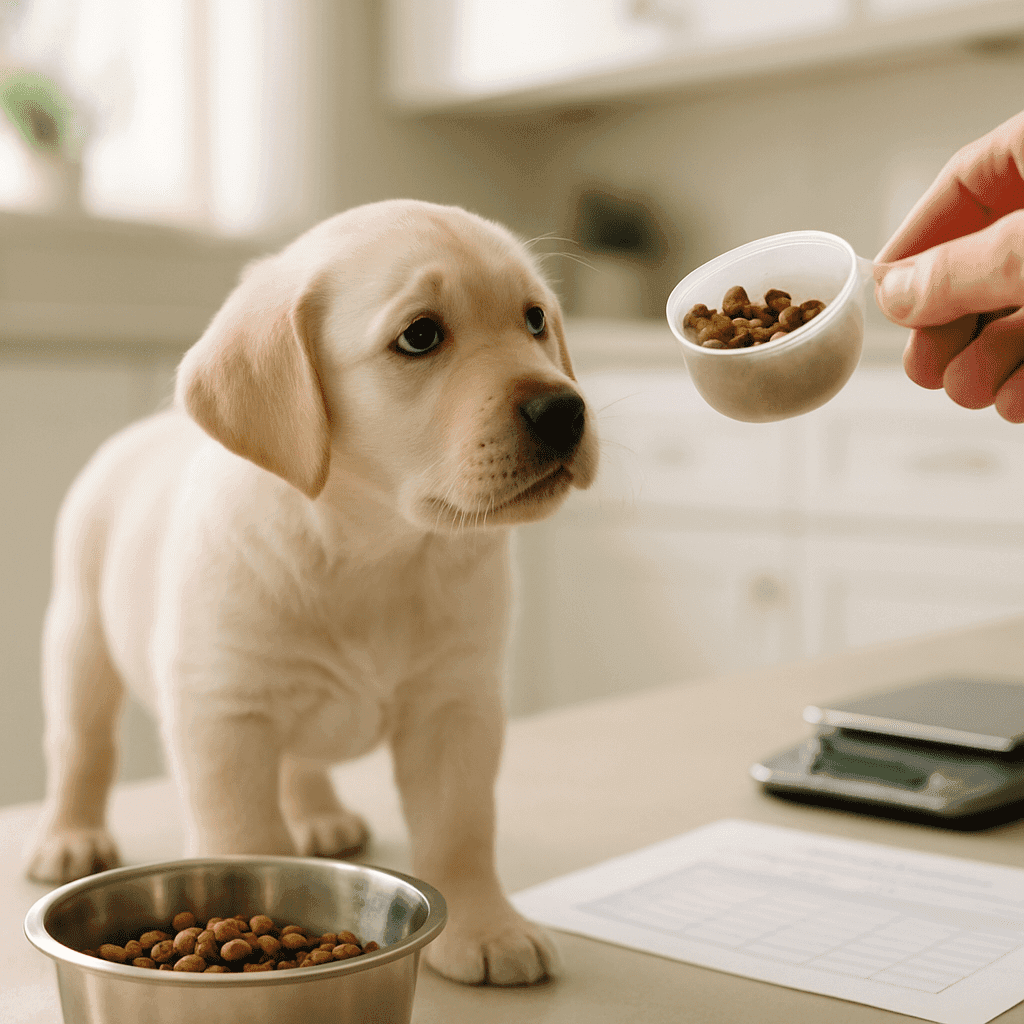
Puppy Feeding Schedule By Age: The Beginner Puppy Day Builder for Meals, Water & Treats
It’s 6:17 a.m. and you’re standing barefoot in the kitchen, clutching a scoop of kibble, while your eight-week-old puppy cries in the crate. You have no idea if you’re supposed to feed him now or wait until 7:00. You’ve already scrolled through three forums that all say something different. One tells you “twice a day,” another says “every four hours,” and a third insists you must never leave water in the crate.That first-morning confusion is exactly what this article is built for. Let’s kill the noise. By the time you finish reading, you’ll have a clear, age-specific daily rhythm that syncs meals, potty breaks, naps, and water—and a tool to build your own custom schedule, even if you work a nine-to-five.Your Puppy’s Age Changes Everything: Meal Count, Potty Timing & Water Rules
A puppy isn’t a small adult dog. An eight-week-old Yorkie has a stomach roughly the size of a walnut; a six-month-old Lab’s stomach is closer to a tennis ball. Those tiny tanks empty fast—often within two to three hours—and a puppy’s blood sugar can dip if the gap between meals stretches too long. That’s why you can’t simply feed twice a day and leave water out all the time. The whole rhythm of eating, drinking, and potty trips is glued together by age.Across all puppies, the number of meals, how long they can hold it, and when you pick up the water bowl change in three predictable windows:- 8–12 weeks → 4 meals a day, potty within 15 minutes after each meal
- 3–6 months → 3 meals a day, sprouting longer gaps and a small treat budget
- 6–12 months → 2 meals a day, adult-like but still need careful water timing
8–12 Weeks: The 4-Meal Mini-Schedule with Linked Potty Breaks
If you brought home an eight-to-twelve-week-old puppy, your highest priority is predictability. At this age, a puppy’s digestive tract triggers a potty reflex within 10 to 15 minutes of eating—every single time. Miss that window and you’ll be scrubbing the floor again.Here is a sample day built around a 6:30 a.m. wake-up. It’s designed so you can still get out the door by 8:30. Feel free to slide the whole block forward or backward as long as the spacing holds.| Time | Action |
|---|---|
| 6:30 AM | Wake up, quick potty outside |
| 7:00 AM | First meal (¼ of daily portion) |
| 7:10 AM | Potty break — stay outside until the puppy goes |
| 7:30 AM | Play, short training, then calm settle |
| 8:00 AM | Nap in crate or pen |
| 12:00 PM | Second meal + potty immediately after |
| 12:15 PM | Potty break |
| 12:30 PM | Exploration, safe chew, or another short walk |
| 5:00 PM | Third meal + potty |
| 5:15 PM | Potty break |
| 5:30 PM | Play, social time, maybe a quick car ride |
| 7:00 PM | Remove water bowl (hard stop 2.5–3 hours before bedtime) |
| 9:30 PM | Final small meal — only the remaining quarter of daily food |
| 9:40 PM | Final potty walk, wait for one more pee, no water after, straight to bed |
| 10:00 PM | Lights out |
- Split the total daily portion into four equal meals. If the food bag says ½ cup per day, that’s 2 tablespoons per meal. Use a kitchen scale if you want precision—it’s the single fastest way to stop overfeeding.
- Water is free all day except after 7:00 p.m. Never restrict water during waking hours to avoid accidents; that can lead to dehydration and urinary tract issues. But after the pre-bed cutoff, lift the bowl. If the puppy seems truly thirsty after the last potty, let him have a tiny sip, no more.
- Potty within 15 minutes. Set a timer if you have to. This link is biology, not a suggestion.
3–6 Months: Dropping a Meal & Introducing Treat Smarts
Sometime around 12 to 14 weeks, your puppy will start sleeping longer stretches and may not need that 10 p.m. meal to make it through the night. But pulling it cold turkey can trigger hunger vomiting or a sudden 4 a.m. howl. Instead, use a slow transition that takes about a week.7-day plan to move from 4 meals to 3:- Day 1: Push the fourth meal from 9:45 to 10:15 p.m. Keep the portion the same.
- Day 2: Shift to 10:30 p.m.
- Day 3: Move to 10:45 p.m. The gap between dinner and this meal is now four hours.
- Day 4: Offer a tiny half-size snack at 11:00 p.m., and make the dinner a little bigger.
- Day 5: No separate fourth meal. Increase dinner by a quarter of the old fourth meal’s volume.
- Day 6: Three meals at 7 a.m., 12 p.m., and 6 p.m. Watch the morning energy.
- Day 7: The 3-meal rhythm is set.
- One Zuke’s Mini Naturals treat is about 3.5 kcal. That means roughly 14 pieces per day.
- Half of a small bully stick can land around 40–50 kcal.
- A tablespoon of peanut butter stuffed in a Kong adds 90–100 kcal—twice your budget for one snack. Use very sparingly, or switch to a few smears of wet food.
6–12 Months: The 2-Meal Workday Routine & Treat Budgeting
By six months, most puppies can comfortably move to two meals a day—but the real stress for working owners is, “How do I manage this if I’m gone eight hours?” The short answer: you don’t need a midday meal, but you do need water and an enrichment plan.Standard two-meal day (stay-at-home or flex-work):- 7:00 a.m.: Meal 1, potty within 15 minutes
- 6:00 p.m.: Meal 2, potty
- Water bowl full all day; remove 2–3 hours before bed
- 7:00 a.m.: Meal + potty
- 12:00 p.m.: A neighbor or dog walker lets the puppy out for a potty, refills the water bowl, and leaves a frozen Kong with 15 kcal of canned food inside (counts toward the treat budget). No meal.
- 6:00 p.m.: Evening meal + potty
- 7:00 a.m.: Meal + potty
- Leave the water bowl topped up (heavy ceramic so it won’t tip)
- Midday: If you’re worried about water running low, you can use a timed water dispenser or a large non-spill bowl, but never restrict water during the day.
- 5:30 p.m.: Meal + potty immediately upon your return.
- Add a low-calorie chew in the late afternoon if your puppy is gnawing the furniture—think an 8 kcal carrot stick or a frozen wet-food ice cube, not a calorie bomb.
The Water & Treat Tweak: What Nobody Tells You About Timing & Limits
Two beliefs cause more upset stomachs and ruined potty training than anything else: “water restriction is the secret to no accidents” and “training treats don’t count.” Let’s get both into the light.Water timing, not water removal.Your puppy needs free access to fresh water all waking day. A 10-pound puppy drinks roughly 10 ounces of water daily. If you lift the bowl for six hours before bed to avoid accidents, you’re putting that puppy at real risk of dehydration and a cranky, restless night. Instead, use the 2–3-hour pre-bed cutoff. Here’s the rhythm:- Fill the bowl at 6:30 a.m.
- Top it up at midday if needed.
- Remove it at 7:00 p.m. when bedtime is 10:00 p.m.
- After the final potty at 9:45 p.m., you can offer a tiny sip—two or three tongue laps—if the puppy really wants it.
- Training treats (even “low-calorie” ones)
- Dental chews
- Bully sticks, rawhide, cow ears
- Peanut butter, pumpkin, or cheese smeared in a Kong
- Leftover bits of your own sandwich
The ‘What If?’ Section: Skipped Meals, Vomiting & When to Call the Vet
Safety note: If your puppy vomits more than once in a few hours, has bloody diarrhea, seems lethargic and won’t drink, or develops a bloated, painful belly, stop adjusting the schedule and contact your veterinarian or emergency clinic immediately. Never restrict water for longer than 2–3 hours without your vet’s specific advice. All portion suggestions are general starting points—your vet should confirm the right feeding plan for your individual puppy’s health and growth.
When you’re tired and anxious, every hiccup can feel like a disaster. Use this traffic-light system to decide what’s normal and what needs a call.Green (normal—watch and wait)
An actual phrase you can use when calling the vet: “My puppy has skipped two meals, has not kept water down, and seems tired—what should I do?”If the “issue” turns out to be that last night’s big bully stick, you’ll often see a skip-breakfast, happy-by-lunch pattern. That’s green. Just adjust tomorrow’s treat cup.- Puppy skips one meal but plays, drinks, and has normal energy.
- Poops within 15–20 minutes after a meal. This is called the gastrocolic reflex; it’s actually a helpful potty training cue.
- Water intake varies day to day, higher when it’s warm or after exercise.
- Single vomit of undigested food (likely ate too fast).
- Skipping two meals in a row, but still drinking and tail wagging.
- One or two episodes of soft stool, but no blood and still playful.
- Low-grade lethargy: wants to sleep more but can be roused.
- Vomiting more than twice in four hours, or vomit containing blood or dark coffee-ground material.
- Diarrhea lasting more than 24 hours, or containing blood or mucus.
- Skipping two meals AND lethargic, cold to touch, or unable to hold down water.
- Bloated, hard belly, dry retching, pacing—possible bloat, especially in large-breed puppies. Do not wait. Drive to the vet immediately.
Your Personal Puppy Day Builder: From Chart to Customized Schedule
A static schedule only works if you wake at 6:30 and never have an odd shift. Real life is messier. So here’s how to build your own day right now using our free Puppy Schedule Generator.- Go to the tool and select your puppy’s age range: 8–12 weeks, 3–6 months, or 6–12 months. The generator automatically picks the right number of meals and potty windows for that age.
- Enter your typical wake-up time and the times you leave for work or will be unavailable. The tool maps the meal blocks around your day, not the other way around.
- You’ll see a visual schedule with exact times for meals, potty trips, a water put-away reminder, and a treat calorie section. It’s built for real kitchens—you can screenshot it, print it, or keep it open on your phone.
- If you hit a bump, the built-in troubleshooting tree helps you adjust: skipped meal, late return from work, puppy wakes early. You tweak one variable and the tool reshuffles the rest.
- 5:45 a.m.: Wake, potty
- 6:00 a.m.: Meal 1
- 6:15 a.m.: Potty
- 6:30 a.m.: Quick play, settle
- 7:00 a.m.: Neighbor arrives for mid-morning potty (no meal)
- 12:00 p.m.: Neighbor potty break, water top-up, safe chew left
- 7:15 p.m.: Evening meal immediately upon return
- 7:30 p.m.: Potty
- 10:00 p.m.: Water picked up
- 10:30 p.m.: Final potty, bedtime
Daily Feeding & Water Ready-CheckUse this list each morning to stay ahead of your puppy’s needs and catch any problems early.
- [ ] Weigh puppy weekly if under six months, and adjust daily portion if needed.
- [ ] Prepare measured meals in advance—use a kitchen scale or pre-portioned bags.
- [ ] Feed each meal within 15 minutes of the scheduled time.
- [ ] Take puppy to potty spot within 15 minutes after every meal.
- [ ] Fill water bowl first thing; top up at midday if needed; remove 2–3 hours before bedtime.
- [ ] Pre-measure the day’s treats into a little cup; do not exceed 10% of daily calories.
- [ ] Record any skipped meal, vomiting, or abnormal stool in a quick phone note.
- [ ] Check body condition weekly: you should feel ribs under a slight fat cover, not see them sharply.
Frequently Asked Questions
Can I free-feed my puppy instead of using a schedule?No. Scheduled meals let you predict when your puppy will need to potty and prevent overeating. Free-feeding makes house-training nearly impossible because you lose the reliable post-meal trigger, and many puppies will eat far more than they need. If you’re attracted to the convenience, you can still portion the day’s food each morning and offer it all within defined windows—but never leave an endless bowl down.What if my puppy wakes up hungry in the middle of the night?First, adjust the timing or size of the last evening meal. For very young puppies (eight to ten weeks), a small, milky snack 30 minutes before the final potty may help—such as a tablespoon of puppy formula stirred into warm water. But check with your vet, because you never want to accidentally double-feed or disrupt a healthy blood sugar rhythm. Often, simply moving the last meal to 9:45 instead of 9:00 solves the crying within two nights.How do I know if I’m feeding the right amount?The food bag chart is only a starting point. Instead, use a body condition score: you should easily feel the ribs with your fingers under a thin layer of fat, but not see them starkly. Weigh your puppy weekly on a kitchen scale (for small breeds) or at the vet’s office, and adjust portions up or down in 10% increments based on whether the puppy is gaining too fast or too slowly. Your vet is your best partner in this—especially during growth spurts.Can I give treats during training sessions?Absolutely. Just make sure those treats come out of the daily treat budget, not in addition to meals. Count them into a cup every morning and stop when the cup is empty. Many new owners mentally separate “training treats” from “fun treats,” but every single calorie counts. If you reach the limit and still need to reinforce, switch to a favorite tug toy, a quick party of praise, or a short burst of play.Ready to stop guessing?Generate your puppy feeding schedule now — it’s free, built around your real wake-up time and work day, and will have you calm and organized before the next meal.