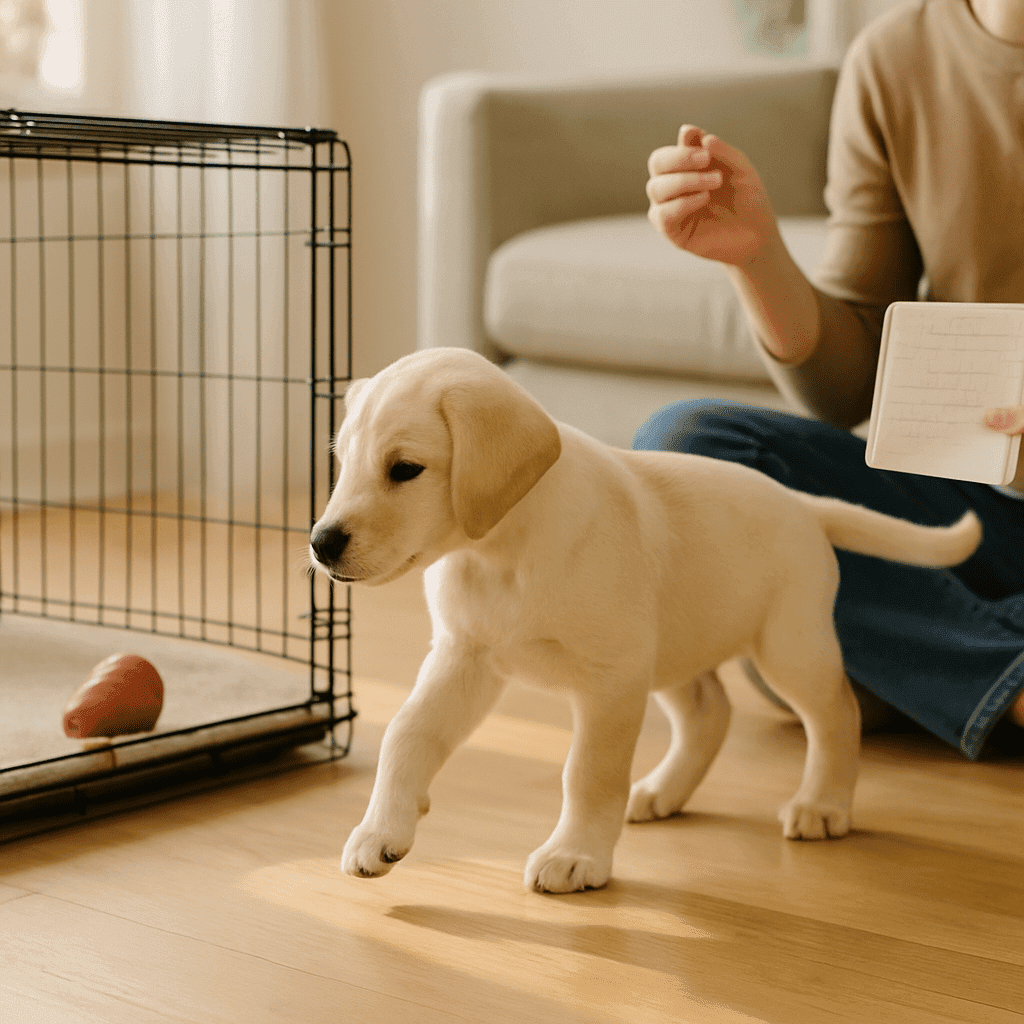
Puppy Hates the Crate? The 3-Day Daytime Reset Plan That Builds Trust
You thought you were doing the right thing. On day two, you had a video call at 2 p.m., so you settled your 9-week-old puppy into the new crate with a chew, closed the door, and walked to the kitchen table. Within thirty seconds, the screaming started—high and desperate, like you'd abandoned her forever. You lasted twenty minutes of gut-wrenching guilt before opening the door. Now, every time you even glance at the crate, she plants her feet and whines. You're terrified you've broken something permanently or that you're the kind of owner who makes their puppy miserable.You haven't broken anything. What you're hearing is a puppy who learned one accidental lesson: crying can open the door. And that gets untangled with a clear, trust-building plan—not by ignoring her, not by letting her cry for hours. This is your three-day daytime reset. It puts back the safety and predictability the crate should have had from the start, and it gives you a rulebook for the crying so you never again freeze between two guilty choices. By the end, you'll have a puppy who can settle beside you during the day without panic, and you'll know exactly what to do the next time she whimpers.
Why Your Puppy Hates the Crate Right Now (It's Not What You Think)
Most new owners blame the puppy—or themselves—for instant crate resistance. But hatred doesn't appear out of nowhere. When an 8‑week‑old puppy arrives in your home, she's still hardwired to seek warm bodies and never sleep alone. Isolation triggers genuine distress. If the very first crate experiences involved a closed door, a silent room, or too much solo time, her brain tagged the crate as a scary, lonely place. If, on top of that, the door opened while she was screaming, she learned that screaming works. That's not stubbornness; that's a survival instinct called negative reinforcement—the removal of something aversive (confinement) in response to a behavior (crying) made that behavior more likely next time. No one did it on purpose.What you're fixing isn't a bad puppy. It's a sequence that never gave her a chance to gather positive predictions about the crate. This is important because the reset plan only works if you stop viewing crate time as a willpower test and start seeing it as a series of tiny "yes" moments. If your puppy has already had a wave of bad experiences, starting over from scratch is entirely possible—because you're changing the rules and the timing, not trying to power through the existing fear.One quick distinction before we begin: mild crate reluctance or protest is not the same as separation anxiety. A puppy who whines intermittently, accepts a Kong, and settles within a few minutes is in the normal zone. If she is thrashing against the bars, drooling heavily, panting, or biting the wire without a pause from the first second the door closes—and that pattern persists across multiple attempts—she may need a veterinary behaviorist's evaluation, not just this three-day plan. We'll revisit that threshold clearly later. For now, know that your daytime reset is built for puppies who are uneasy, not for those in panic.Safety note: Always consider your puppy's overall health and consult with a veterinary professional if you suspect severe anxiety or if natural methods don't yield calmness. For more on humane training, refer to the AVSAB humane dog training position statement.
Before You Start: The 3‑Minute Daytime Crate Setup Check
Before you do a single treat toss, set up the environment so the crate doesn't accidentally work against you. Many well-meaning owners put the crate in a laundry room, fill it with a fluffy bed, and then wonder why the puppy won't settle. Here's your five‑point cheat sheet that takes less than three minutes to run through every morning of the reset.The 5-Point Pre-Reset Daytime Cheat Sheet- Crate placed in a lived-in room where you'll be working or relaxing, not isolated – Three to five feet from where you'll sit. The puppy needs to see and hear normal movement; hiding the crate only increases the shock when you walk away later.
- Washable mat or thin vet bed – nothing that can be chewed into dangerous pieces – No big fluffy cushions, no loose blankets that unravel. A simple, fitted crate mat or a towel you're willing to sacrifice works as long as you check for shredding.
- One super-safe, crate-exclusive chew placed at the very back of the crate – A frozen Kong stuffed with canned food or peanut butter (xylitol-free), or a bully stick in a safety holder. This item only appears inside the crate, never elsewhere. That creates a unique "only here" treat.
- Puppy has recently emptied bladder and bowel (within the last 15 minutes) – You never want to wonder whether a cry is potty or protest. Eliminate the guess.
- Owner mindset: you are not on a countdown, you have 5 minutes of calm energy – If you're rushed, stressed, or about to dash to a meeting, skip the closed-door session and stick to open-door treats. The puppy reads your tension.
Day 1: The Open-Door Reboot—Making the Crate a 'Yes' Place
If the door has been a signal for panic, today we erase that signal completely. The door stays wide open. Your only job is to turn the crate into a magical treat machine so the puppy's brain starts predicting good things when she sees it.How the sessions workAim for 8 to 10 "crate parties" spread across her waking hours. Each party lasts only a minute or two. You'll walk casually near the crate, toss two or three high-value treats deep enough that she has to step all the way in to get them, and then sit back down on the sofa. That's it. No luring, no coaxing, no eye contact. The treats simply appear inside. She can walk in, eat, walk out, repeat. Every entry is her choice.Treat placement and meal trickToss the treat to the far end—not right at the door—so she becomes comfortable with her whole body inside. Use small, smelly pieces: roast chicken, freeze-dried liver, bits of hot dog. If she's reluctant, start with a single piece right at the threshold and gradually move it deeper across parties. You can also feed her entire meal with the bowl just inside the crate door (open!), and inch it further in as she relaxes. The bowl never moves while she's in there—you adjust it between sessions.What you'll see when it's workingBy the end of Day 1, many puppies will begin glancing toward the crate when they hear the treat jar. Some will trot in and out nonchalantly. An 8‑week‑old might need more repetitions but shorter bursts; a 12‑week‑old may happily wander in for a minute of sniffing. Even if she only pops in and out, that's progress. The goal is not duration—it's a changing emotional response.The big mistake to avoidDo not, under any circumstances, close the door "just for a second" on Day 1. That single move can wipe out hours of trust in an instant. If you catch yourself wanting to test it, remind yourself: this is loading the bank account before you make a withdrawal. You haven't made a deposit if you slam the door.Troubleshooting if she won't go inIf she stares at the crate from three feet away, start with treats outside the crate—three feet away, then two feet, then right at the threshold. No pressure. If she still won't budge, try an even higher value treat and place a few on the floor leading up to the entrance like a tiny treasure trail. Keep the atmosphere bored and relaxed; your job is to be the distracted treat dispenser, not the encouraging cheerleader.Normal progress by the end of Day 1: Puppy enters voluntarily, sniffs, takes treats, and leaves calmly. If you don't see this yet: increase the treat value and add a few more parties; remove any pressure to stay inside. You can repeat Day 1 for an extra day before moving on.Day 2: Short Closed Sessions & The Crying Response Rulebook
This is the day most owners dread, because it introduces the closed door. But you'll only close it for tiny, manageable stretches while you're sitting right there, and you'll have a clear decision tree for every single whine. No more guessing.Before you close the doorMake sure the puppy has pottied recently. Place the frozen Kong at the back of the crate. Sit beside the crate, calm and quiet. Wait until she's inside and calmly sniffing her Kong, then close the door without fanfare—and immediately drop one more treat through the bars. Set a timer for 1–2 minutes (2–3 minutes for a confident 12‑week‑old who aced Day 1).The Crying Response RulebookStick this to the fridge. It turns the impossible "should I go or stay?" loop into three clear categories:
How long to keep the door closedStart with a single 1‑minute closed session (8‑week‑old puppy) or up to 3 minutes (12‑week‑old). If the puppy stays calm—even if there's a little intermittent whining that stops—release her after the timer by opening the door during a pause in vocalizing, never while she's actively crying. Give calm, quiet praise. Then end the session. Repeat two or three times across the day, always ending on a success. Never go beyond 3–5 minutes on Day 2.A real-life cry exampleYour puppy whines softly for a few seconds, stops, chews the Kong, whines again 20 seconds later, then lies down. At the 2‑minute mark, she's quiet. You open the door, say "good," and let her wander out. That's a perfect session.Panic exampleThe second the door clicks, she shrieks, throws her body against the bars, and doesn't pause. You open the door immediately, step back, and toss three treats on the floor. If it happens again on a later try, you stay at Day 1 for an additional full day.Age-specific boundaries- Intermittent protest – Whining with pauses of 10 seconds or more, occasional soft barks. Your response: wait silently. Do not speak, do not touch the door, do not make eye contact. This is normal vocal feedback, not panic. Many puppies will settle within a minute.
- Continuous moderate crying without escalation – Whining pulls together into one sound with very few pauses, lasting 2–3 minutes. Your response: silent potty check. Clip on the leash, take her outside without words, no play, 3 minutes max. If she eliminates, reward with a treat and return to a shorter crate session. If not, back in the crate and reassess. This teaches her that persistent crying leads to a boring bathroom trip, not freedom.
- Panic – Frantic screaming, thrashing against the bars, biting the wire, large pupils, panting heavily. Your response: if you see panic, open the crate immediately. Unhitch the latch, step back, let her exit, and scatter treats on the floor away from the crate. No scolding, no forced return. You then spend the rest of the day (and perhaps the next day) returning to Day 1 open-door activities only.
- 8‑week‑old closed session maximum: 3 minutes first time.
- 12‑week‑old closed session maximum: 5 minutes first time (only after a stellar Day 1).
- Continuous protest threshold before a potty check: 3–5 minutes for a young pup.
- Total session, including any crying, never exceeds 10 minutes.
Day 3: Building Trust with Longer Daytime Settles
Yesterday's best session was probably under 5 minutes. Today you expand it in bite-sized chunks, always letting the puppy's calm behavior set the pace—not the clock.How to stretch the timeStart with the same duration that worked yesterday (e.g., 3 minutes quiet). After each successful closed session, add 2 minutes. So your morning session might be 3 minutes, then 5, then 7, and by evening you're aiming for a 10‑ to 15‑minute calm block. Never jump from 3 minutes to 10—that's how you trigger regression.Add a tiny bit of distanceWhile staying in the same room, shift your position 2 feet further from the crate each session. Move from right beside the crate to the armchair three feet away, then to the sofa across the room. Do not leave the room entirely, no matter how well it's going. That step comes later, after the reset is solid.Signs of real progress (checklist)
What a Day 3 win looks likeYour puppy whined for 90 seconds, then settled onto the pad with her Kong. Twelve minutes later, she's still calmly licking and chewing. That is a huge win. Scribble it on the tracker (see next section) so you can see the pattern tomorrow.Age-adjusted goalAn 8‑week‑old may max out at 10 minutes of quiet by evening. A 12‑week‑old might hit 15–20 minutes if all goes smoothly. Anything in that range is plenty for this stage. The goal isn't to immediately crate her for an hour; it's to prove to her—and to you—that calm, closed-door time is possible.What to do if she regressesIf every time you pass 5 minutes she starts up again, drop back to 3‑minute sessions for two rounds, then gently try 5 minutes again. Puppies aren't linear; they just need a softer incline. Also check if you're moving too much or if the room has become stimulating (TV, kids running). Keep the atmosphere boring and predictable.Do not test absence on Day 3. No leaving the room, no stepping around the corner. Trust first, then gradual distance, then absence—each on its own timeline.Normal progress by Day 3 evening: Your puppy can chew or rest in the crate for 10–15 minutes while you remain nearby, with protests that are brief and easily resolved. If you don't see this yet: extend Day 2‑style micro-sessions for one or two more days. Some puppies need five days of this rhythm, and that's completely fine.- Puppy enters the crate without hesitation when she sees the treat.
- She takes the Kong after the door closes instead of freezing.
- She lies down within 2 minutes.
- Whining, if it happens, fades within 60 seconds and doesn't escalate.
- She chooses to stay in the crate with the door open, even for a few seconds.
Your Crate Reset Tracker: Log Today to See Progress Tomorrow
When you're stressed, small wins disappear from memory. You might remember only the 45 seconds of crying and forget that yesterday's settle lasted 4 minutes, while today's lasted 6. The tracker fixes that. It's not a downloadable PDF—it's something you can copy into a notebook, a notes app, or a piece of paper stuck to the fridge. Write one row after every closed-door session, and within three days you'll see your puppy's cry time shrinking in black and white.Copy this table layout into your own notes:| Day/Session # | Duration (min) | Cry Pattern (circle one) | Potty Check (Y/N) | Treat Consumed (Y/N) | Notes |
|---|---|---|---|---|---|
| Day 2 / S3 | 2 | Intermittent | N | Y | Settled faster than the morning |
- Duration: how long the door was actually closed (not counting potty break time).
- Cry pattern: None, Intermittent (pauses), Continuous (no pauses, moderate), or Panic.
- Potty check: did you take her outside mid-session?
- Treat consumed: did she eat the crate-only chew?
- Notes: "lay down immediately," "whined 20 sec then settled," "new frozen Kong contents."