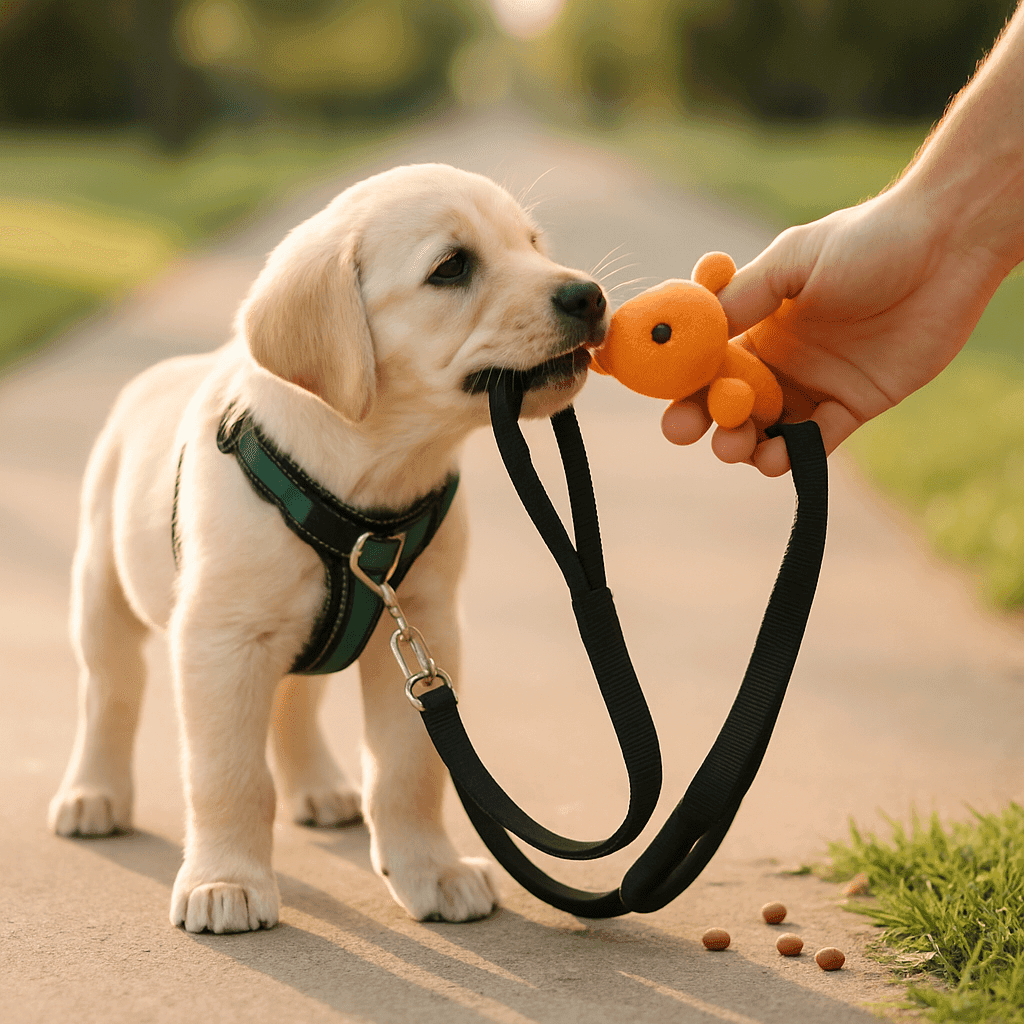
Puppy Keeps Biting the Leash on Walks: A Step-by-Step Redirect Plan for First-Time Owners
You’re three minutes into a walk. Your puppy suddenly stops, spins, and clamps down on the leash like it’s a tug rope. You freeze. Do you pull back? Say “no”? Wait it out? The whole thing feels out of control. This is not your failure — leash biting is one of the most common puppy-on-walk behaviors. You can fix it without yanking, yelling, or bribing. By the end of this guide, you’ll have a silent, step-by-step redirect script you can use tonight to turn chaotic walks into calm, connected outings.Fast Answer: The moment your puppy bites the leash, freeze, soften your grip, and offer a trade object (a plush or rubber toy you carry). If she releases, praise quietly and immediately scatter a few treats on the ground with a calm “find it!” to reset her brain. If she doesn’t drop, apply gentle, steady leash pressure downward — not a yank — until she lets go, then treat scatter. Do not pull, yell, or stare. Repeat up to three times per walk if needed, but never turn it into a tug game.
What to do first tonight: Before your next walk, put a soft squeaky toy in one pocket and fill a treat pouch with tiny, high-value treats (like cheese or freeze-dried liver). That simple preparation removes the panic of “what now?” when your puppy latches on.Why Your Puppy Thinks the Leash Is a Chew Toy
Most first-time owners interpret a puppy grabbing the leash as defiance or aggression — but it’s almost never either. Puppies explore the world with their mouths, and a dangling, moving piece of nylon is incredibly fun. Understanding the actual trigger behind the behavior is the key to responding in a way that extinguishes it instead of fueling it.Here are the most common reasons a puppy bites the leash, based on thousands of real-walk moments:- Teething relief (3–6 months): Sore gums make soft, resistant material feel good. If your puppy is between 12 and 24 weeks old and adult teeth are erupting, leash biting often spikes. A 4-month-old Labrador may start biting the leash about three minutes into every slow walk because the gentle pressure soothes the gums.
- Overexcitement (the “zoomies” spill): When a puppy’s arousal suddenly jumps — hearing another dog bark or seeing a runner — excess energy often gets redirected onto the closest moving object: the leash.
- Frustration from being held back: Puppies naturally want to sniff, run, and investigate. If the leash abruptly stops them from reaching a smell or a person, frustration mounts.
- Play invitation: Some puppies treat the leash as a tug toy. That bouncy, swingy line looks like a play partner. If you pull back, you’ve just joined the game.
- Boredom on sniff-free walks: Walking in a straight line at a constant pace without allowing sniffing or mental breaks can create a bored puppy who invents her own entertainment.
The Calm Redirect Protocol: Your Step-by-Step Walk Script
When the bite happens, your goal is not to “win” or to prove a point. It’s to interrupt the chewing loop without adding excitement, fear, or pain, then restart the walk on a calmer note. Use this 5‑step script every time.Pre‑walk setup: Fill your treat pouch with a handful of pea‑sized, moist, high‑value treats. Put a designated “trade toy” — something your puppy already loves to chew — in your pocket. A squeaky plush or a hollow rubber toy works better than a hard bone because it mimics the soft mouthfeel of the leash.The script (use the exact order and timing):- Freeze & soften your grip (5 seconds). The instant teeth touch the leash, stop moving. Let your hand go softly limp — do not pull back. Stare at a spot on the ground just ahead, not at your puppy, and breathe.
- Offer the trade object with a calm cue. Without any excitement, bring the toy to your puppy’s mouth. Say “trade” or “get your toy” in a quiet, steady voice.
- Mark and praise the release softly. The moment she drops the leash, say “yes” in a low calm tone and give gentle verbal praise.
- If she ignores the toy, apply gentle leash pressure down. Use the lightest pressure toward the ground — no yanking. Wait for 2–3 seconds.
- Resume with a “Find it!” treat scatter. Immediately toss 3–5 tiny treats onto the grass in front of her and say “find it!”
When She Bites Harder: The Escalation Ladder for Stubborn Leash Biters
Sometimes the puppy doesn’t just mouth — she shakes her head, growls softly, or bites down with real pressure. Instead of panicking and yanking, use a three‑tier decision ladder that keeps everyone safe and stops the behavior without punishment.Tier 1 – One more redirect with a high‑value trade. If the first script attempt didn’t work, try once more but upgrade the trade object. Use a higher‑value toy or a piece of real meat (hold it in your closed fist, offer it only if she releases).Tier 2 – Stationary settle (60‑second pause). If the puppy continues to bite or escalates, stop walking completely. Stand still for 60 seconds. Scatter a palmful of treats on the ground at your feet. Breathe. After the settle, try moving again. If she bites again within a few steps, move to Tier 3.Tier 3 – Neutral walk‑end and calm home return. If the biting persists, use a second handle on the harness and walk home without fanfare. No scolding, no extra play. The next walk starts fresh.The Kid‑Safe Walk Rule Sheet (If Children Hold the Leash or Walk Beside)
A jumping, leash‑biting puppy can knock a child over or cause the child to drop the leash, creating a dangerous situation. These four family rules turn potential chaos into a safe, practiced routine.- No child under 8 holds the leash alone. Even confident kids need an adult backup hand on a second leash or the handle loop for instant control.
- The “statue game” is the only response. Teach your child this away from the dog first. The moment the puppy bites, the child freezes like a statue — arms limp, eyes on a spot ahead, no noise. No pulling, no shouting, no tug‑of‑war.
- Practice indoors with a stuffed toy puppy. Spend five minutes role‑playing the freeze‑trade sequence so the child feels ready.
- Emergency drop rule. If necessary, the child immediately drops the leash and steps back quietly. Rehearse this so dropping doesn’t feel scary.
3 Walk Gear Fixes That Quiet the Biting Instinct Faster
Equipment doesn’t train your dog, but three simple swaps make the redirect script easier and instantly reduce biting opportunities.1. Dual‑handle or traffic leash
A leash with a second handle near the collar gives you immediate close control. When your puppy starts to spin, you can shorten the distance and freeze before the bite lands.2. Front‑clip, no‑pull harness
A harness with the attachment point on the chest turns the puppy toward you when tension appears rather than letting her brace and bite. It gives you a second of extra time to cue a trade.3. Chew‑proof or coated leash
A biothane or coated webbing leash offers less texture and less “chew appeal” than standard nylon. It also cleans off in seconds after a wet mouth.Signs You’re on the Right Track (Even If It Doesn’t Feel Perfect)
Leash biting won’t disappear overnight. Here’s what progress looks like:- Level 1 – Faster release: The puppy drops the leash in 3–5 seconds after you freeze, instead of a 20‑second wrestling match.
- Level 2 – Fewer incidents per walk: A walk that had six bites yesterday drops to three today, then to one tomorrow.
- Level 3 – Pattern interruption: The puppy lunges for the leash, then glances at your pocket (the toy) without actually biting. That’s the beginning of a lasting change.
- Level 4 – Bite-free stretches: You complete a 15‑minute walk with zero bites, even when a trigger passes by.
Normal vs. Concerning Leash Biting: When to Get Help
Normal behaviors:- Short bites during excitement spikes (first 2–3 minutes of walk, after seeing another dog).
- Releasing when stopped or offered a toy.
- Biting only at the start of walks, then settling.
- Non‑stop biting that prevents any forward movement for more than 5 minutes out of 10.
- Biting with rigid body posture, hard stare, and continuous growling (not play growling).
- Ingesting pieces of the leash so that swallowing bits is a safety risk.
Owner Mistakes That Make Leash Biting Worse (With a Real Story)
It’s easy to accidentally reward the very behavior you’re trying to stop — especially when you’re tired, cold, or embarrassed. Avoid these common slips.Mistake 1: Jerking the leash back. Pulling away turns it into a tug game. The puppy thinks, “Fun! They’re playing!” and bites harder.Mistake 2: Shouting “drop it!” loudly. Loud corrections spike adrenaline. A stressed puppy grabs again or redirects onto your sleeve.Mistake 3: Failing to upgrade the trade object. If the toy you bring is low value, you lose the redirection moment. Carry two options: a plush and a rubber one.Mistake 4: Keeping a treat as a lure. Showing a treat before the drop teaches your puppy to bite for a snack. Treats only come after the drop and release.Mistake 5: Ending the walk in anger. Marching home stiff and silent might make you feel better, but the puppy learns walks end badly — not that bites caused it.Jen’s story: Jen’s Cocker Spaniel, Baxter, began leash biting at five months. Every walk felt like a tug war. Yanking led to more bites, and Jen started dreading evening walks. She switched to the freeze‑trade script and carried a tiny plush rabbit toy. On Day 1, Baxter released the leash after 10 seconds of frozen stillness. By Day 4, he was running toward the toy pocket when he felt the urge to mouth. Walks became calm again. “I didn’t believe it would work,” Jen said, “but after four days I had a different dog on the other end of the leash.”Tonight’s Walk: Your First Scripted Walk in 10 Minutes
Here’s exactly what tonight’s walk can look like:Pre‑walk (2 minutes): Slip the trade toy and treats in your pocket. Practice “statue game” for 30 seconds with your child. Clip on the dual‑handle leash and harness. Start walking at a sniff‑friendly pace.Minute 2 – the first bite: Your puppy grabs the leash. You freeze, soften your grip, and offer the toy. She drops it after 4 seconds. You say “yes,” then scatter treats. You stand quietly for 10 seconds. Then continue walking like nothing happened.Minute 8 – the more intense bite: A neighbor’s dog barks behind a fence. Your puppy spins, bites hard, and shakes. Freezing didn’t work the first time. You use the Tier 2 pause: stand still for 60 seconds, scatter a palmful of treats, then try to move. The puppy stays calmer and you walk the rest of the block bite‑free.Minute 12 – a five‑minute bite‑free window: That’s a win — even if you only got 5 minutes. Celebrate small progress.Tonight’s Walk Checklist
- Treat pouch with high-value treats (cheese, freeze-dried liver, soft commercial training treats cut small)
- Trade toy ready (squeaky plush or hollow rubber toy)
- Dual‑handle traffic leash (second handle near the collar)
- Front‑clip harness fitted securely
- “Statue game” review with any child who might hold the leash
- Plan for a short walk, 10–15 minutes max