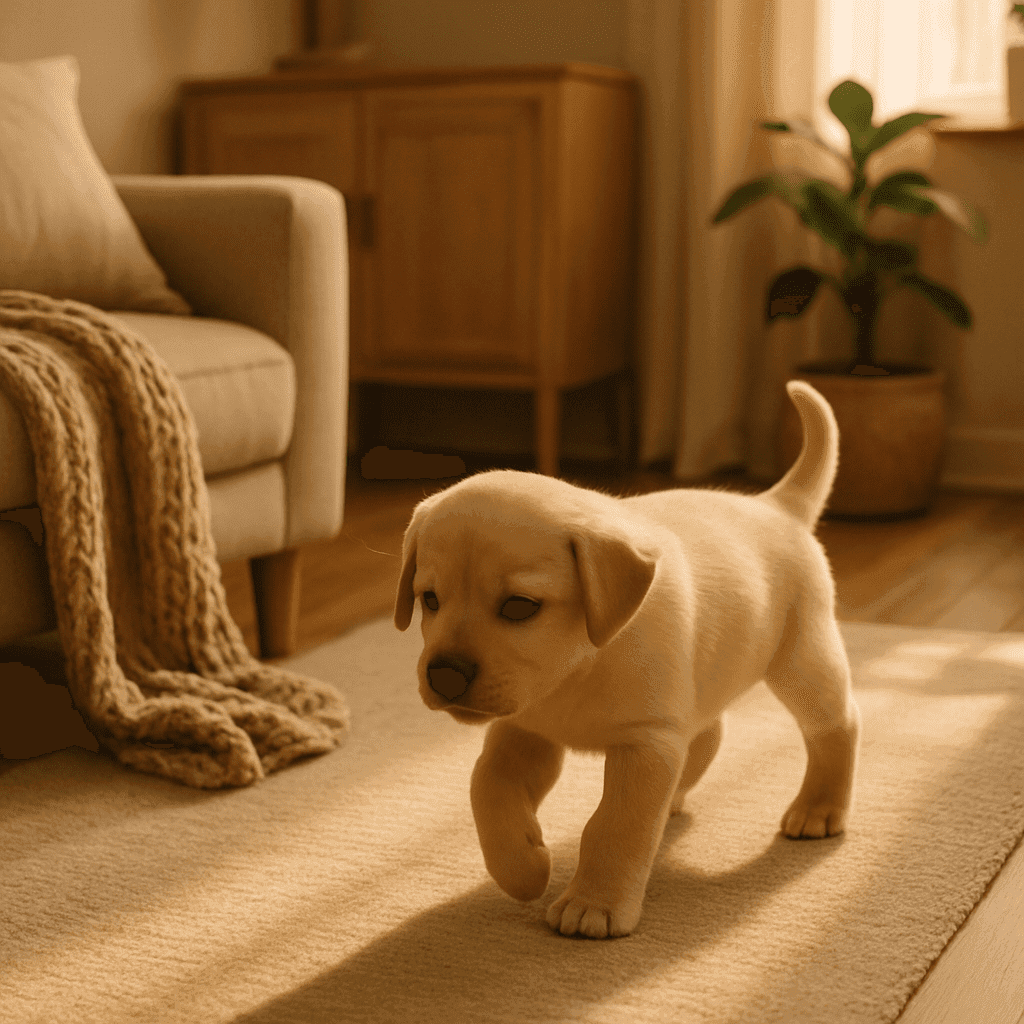
Puppy Scared on the First Day Home? A Calm 5-Step Plan to Build Trust
Welcome your new puppy! Understand why they might be scared and follow our detailed steps to build comfort and trust.
What’s happening: Why many puppies are scared on day one
Your puppy spent every moment before today surrounded by littermates, familiar smells, and the only home they’ve ever known. In a single car ride, that world disappeared. Now the carpet feels different, your voice is new, and there’s no warm pile of siblings to snuggle into. That’s a lot for a young brain to process.
Freezing, hiding, trembling, lip-licking, yawning, or refusing to eat — these aren’t signs that you’re failing. They’re normal survival responses to an unfamiliar environment. Your puppy isn’t broken or unusually anxious; they’re doing what young animals do when everything is suddenly unknown. The modern fear-free approach, drawn from veterinary behavior science, treats this first day as a foundation-building opportunity, not a problem to fix with force.
Fast Answer
If your puppy is scared on their first day home, don’t worry. Allow your puppy to explore at their own pace, avoid forcing interaction, and speak softly to create a calming environment. Follow our 5-step plan to build trust and comfort gradually.
Immediate 0–2 hour plan: Calm first moves (exact scripts + actions)
The first two hours matter because the puppy’s stress hormones are high. Your job is to lower the pressure without adding excitement. Follow this timeline:
- 0–30 minutes — Room prep
Choose one small, puppy-proofed room. Close doors, draw curtains, and turn off loud devices. Place a soft bed, a water bowl nearby, and a puppy pad by the door. If you’re using a crate, leave the door open with a blanket inside. - 30–60 minutes — First presence session
Bring the puppy into the room and sit immediately at your baseline distance: roughly 6 feet (2 meters). Sit sideways on a low stool or the floor, so your body isn’t looming. Avoid direct eye contact. Speak in a low, gentle voice. Try a quiet “Hey there, you’re safe. Take your time.” Then stop talking for a minute. Toss one tiny, high-value treat so it lands halfway between you. Repeat every 1–2 minutes. - 60–90 minutes — Second session
Leave the room for 10–15 minutes, then return to the same spot. Try tossing the treat a little closer to your position — but still at least 3 feet away. If the puppy still looks frozen, toss the treat further out. Every 3–7 minutes of this passive interaction counts as one session. Do up to four cycles across the two-hour window. If the puppy urinates or defecates from fear, quietly clean it with an enzyme cleaner later. Stress accidents are common, and your reaction teaches the puppy whether you’re safe.
The 5‑Step Confidence Ladder (what each step looks like and when to advance)
This ladder turns vague “give space” advice into a measurable system. Each step has a distance, a duration, and specific progress signals. You’ll move through the steps across the first day — not necessarily in one straight line — and you’ll go backward if you see stress signs.
| Step | Name | Distance | What You Do | Session Length | Advance When You See At Least 3 of These |
|---|---|---|---|---|---|
| 1 | Notice & Space | 6 ft / 2 m | Sit quietly, side-on. Toss treats. Speak softly. | 3–7 minutes per cycle | Puppy looks toward you, sniffs ground or air, eats a tossed treat within 60 seconds. |
| 2 | Sitting Nearby | 4 ft | Sit on floor. Continue tossing treats. Add soft, neutral talking. | 5–10 minutes | Puppy voluntarily moves toward you within 2 ft, tail neutral or slightly up. |
| 3 | Ground-Level Greeting | 2–3 ft | Sit on floor. Toss treats close to your side. Let puppy approach your hand resting palm-down. | 3–5 minutes | Puppy sniffs your hand, eats treat from floor near hand, does not freeze. |
| 4 | Brief Calm Contact | touch distance | Offer a closed fist for a sniff. Gently touch if puppy leans in. | 30–60 seconds of contact | Puppy leans into touch, tail soft. |
| 5 | Short Cuddles/Handling | close | Allow puppy on your lap or beside you. Gentle, slow strokes along back. | 1–2 minutes | Puppy remains relaxed, may close eyes. |
When to advance: You need at least 3 of the positive signals in that column, observed in two separate sessions.
Stop signs — when to retreat: If the puppy freezes, shows whale eye, tucks tail tight, or tries to bolt, stop that step. Back up to the previous comfortable step and wait at least 10–15 minutes before trying again.
Trigger Map: Common first‑day fears and how to adapt the ladder
Some puppies have a specific boogeyman. Adapt the ladder to the trigger, not the other way around.
- Footsteps and sudden noises
If the puppy startles at every footstep, move your sessions to the quietest room and add a soft white-noise machine. Start at Step 1 with 6 ft distance. Once the puppy is comfortable with you, invite one family member to walk past the room while you toss treats. - Crate fear
Place the crate in the room with the door open and a blanket inside. Sit at 6 ft (Step 1) and toss treats in the general direction of the crate entrance. As the puppy progresses to Step 2 (4 ft), aim treats closer to the door frame. Never push or lure the puppy into the crate on day one. - Hands and being picked up
Avoid picking up the puppy except in emergencies. Use a soft towel to support a puppy who needs moving.
What not to do: Holding a trembling puppy tightly often increases fear. Similarly, placing a puppy inside a closed crate to “get used to it” breaks trust.
Quick wins, what to avoid, and the stop signs (safe thresholds)
Quick wins you can use in any moment:
- Sit still and breathe slowly — your puppy reads your body tension.
- Toss a few treats every couple of minutes.
- Put a safe chew toy a foot from the puppy’s corner.
- Turn on soft, classical music.
What to avoid on day one:
- Direct eye contact longer than a glance.
- Reaching over the puppy’s head.
- Sudden standing or grabbing.
Stop signs:
If you see signs like freezing, whale eye, or attempts to flee, retreat one full ladder step and wait 10–15 minutes before resuming.
Normal vs. not normal: what to expect on the first day
Normal: Hiding, trembling, refusing food for 6–12 hours, stress-related accidents.
Concerning: Repeated vomiting or diarrhea, not drinking water for 12+ hours, extreme lethargy. If you see these signs, contact your vet immediately.
Two short case walkthroughs: footsteps fear + crate fear
Case 1: Footsteps fear
Sarah brought home a 10-week-old Golden Retriever who froze every time someone walked past. Sarah set up at Step 1 (6 ft) at 5:00 PM. By the end of the day, the puppy began exploring the hallway with confidence.
Case 2: Crate fear
James’s rescue mix avoided the crate. He placed it open and sat 6 ft away (Step 1). By bedtime, the puppy voluntarily explored inside the crate.
Mistake mini-story: Sarah once tried to lift her puppy when he approached at Step 3, thinking he was “ready for a cuddle.” The puppy froze, and she had to reset to Step 1.
When to call the vet or a trainer — and what to tell them
Most fearful-first-day puppies don’t need intervention, but know the red lines.
Call your vet today if:
- The puppy vomits or has diarrhea more than once.
- Refuses water for 12 hours.
Call a certified fear-free trainer if:
- The puppy shows zero improvement after 24–48 hours.
When calling, provide the puppy’s age, vaccine status, when the fear behavior started, and what you’ve tried.
Practical Checklist
- [ ] Create a quiet, single-room safe space (remove visitors, low light)
- [ ] Set baseline distance: sit ~6 ft / 2 m from puppy; keep voice low
- [ ] Start 3–7 minute passive sessions; toss treats every 1–2 minutes
- [ ] Track signals: looking, approaching, eating tossed treats, relaxed posture
- [ ] Advance only after 3 positive signals across 2 sessions; retreat one step on stop-signs
- [ ] If no improvement after 24 hours or any medical signs, contact vet or fear-free trainer
Schedule for a Full Day
| Time of Day | Activity |
| Morning | Brief potty break, set up safe room, initial presence session. |
| Late Morning | Presence sessions, observe puppy cues, offer water and light snack. |
| Lunch/Noon | Calm meal around midday, short walk indoors to stretch and sniff. |
| Afternoon | Longer presence session, training game, offer toy or chew. |
| Evening | Light meal, short play, last presence session encouraging gentle exploration. |
| Bedtime | Final potty break, wind-down with soft music, offer safe sleep spot. |
| Overnight | Provide access to water, ensure comfort, listen for unusual sounds; calm vet note if discomfort persists overnight (contact vet for guidance). |
Frequently Asked Questions
How long will my puppy stay scared?
Every puppy is different, but most begin to adjust within a day or two. Continue using the 5-step confidence ladder to build trust.
What if my puppy refuses to eat or drink?
It’s normal for puppies to refuse food for a few hours due to stress. Ensure water is available and contact your vet if the refusal lasts more than 12 hours.
Why shouldn’t I directly approach my scared puppy?
Approaching can increase fear and stress. Let the puppy approach you at their own pace to build confidence and trust safely.
When should I be concerned about my puppy’s behavior?
Watch for signs like repeated distress vomiting, diarrhea, extreme lethargy, or not drinking for extended periods. If these occur, consult your vet.
Next Steps
Take advantage of our tools to create a calming and nurturing environment for your puppy's first day at home. Follow the step-by-step guidance to confidently support your puppy. Generate your puppy schedule
Sources and safety references
AKC: Puppy’s First Day Guidance
PetMD: Puppy First Day Behavior
VCA: Bringing Home a New Puppy