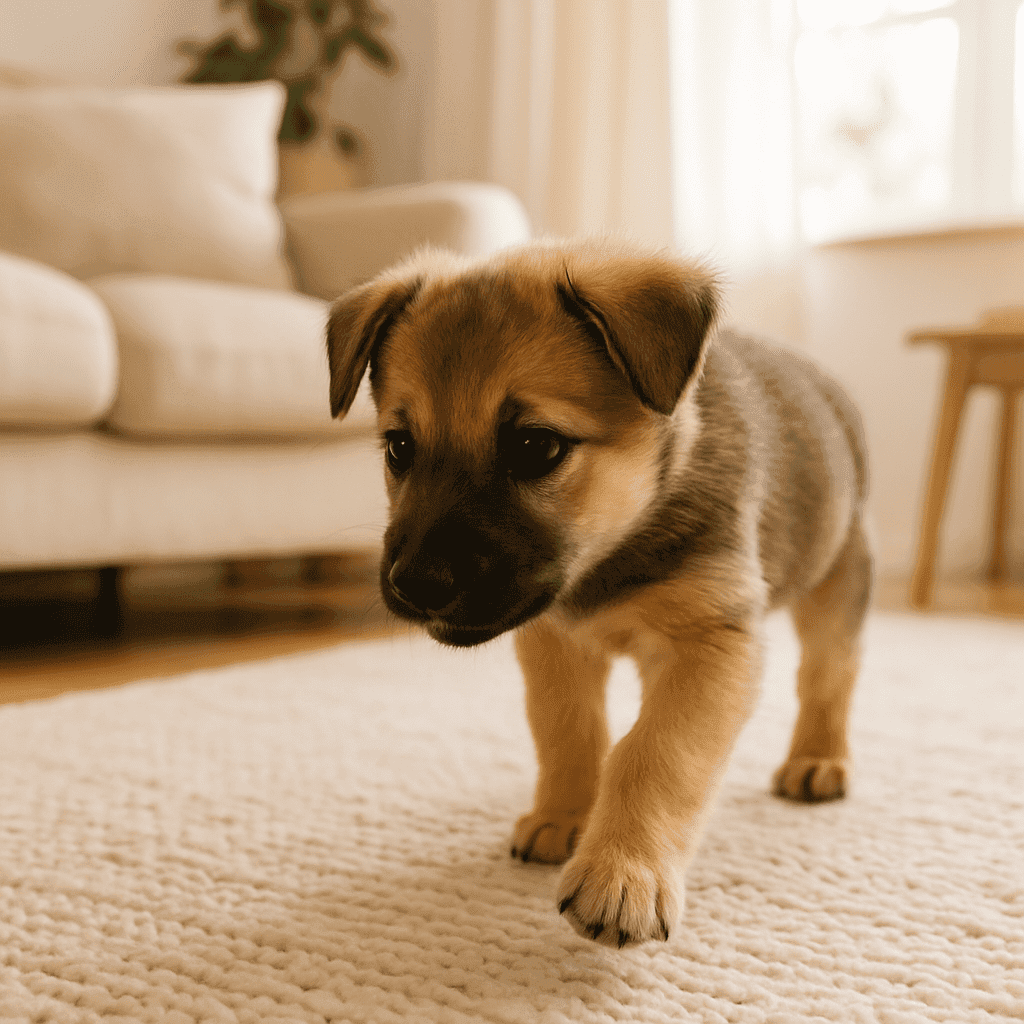
Puppy Scared To Go Outside: First Steps To Build Confidence Safely
What To Do First: The Threshold Reset (Before You Step Outside)
Right now, the most helpful thing you can do is stop trying to force an outdoor trip. It’s okay if your puppy needs a temporary indoor potty spot for a day or two—use a washable pad or a piece of real grass pad by the door (more on handling that in our puppy potty training schedule guide).
Instead, you’re going to start a game that rewires your puppy’s brain from “door = scary” to “door = treats.” Find a high-value treat your puppy goes crazy for—freeze-dried liver, tiny bits of cooked chicken, or soft training treats. Sit on the floor inside, about 5 feet from the door, and open the door wide (if the weather and safety allow).
Take a treat and toss it gently a few feet toward the door—not all the way outside, just near the threshold. If your puppy sniffs, moves forward, and eats it, great. Quietly say “good” and toss another one a little closer to the door. If your puppy won’t budge, toss the treat farther away from the door, back toward you, so the puppy can get it without any pressure. The key: no luring, no calling, no coaxing. Let your puppy decide.
Do 3 to 5 treat tosses, then close the door and end the session—even if your puppy seems relaxed. Always stop before any sign of fear creeps in. Repeat this game two or three times during the day. Within a few sessions, most puppies start moving toward the open door willingly because they’ve learned that good things happen there.
Example
You sit cross-legged, door open, a breeze coming in. You toss a tiny bit of freeze-dried liver about 2 feet from the door. Your puppy hesitates, stretches forward, snatches the treat, and retreats. You calmly toss another. By the third treat, the puppy’s tail is up and they’re looking toward the door. That’s a win.
What Not to Do
Never carry your scared puppy outside and place them on the ground. This can teach helplessness—the puppy feels trapped, not brave. It often makes fear worse because the puppy didn’t choose to go out.
If This Doesn’t Work
If your puppy won’t take even a high-value treat 5 feet from the closed door, something else might be going on—pain, nausea, or severe anxiety. Close the door, give your puppy a break, and book a vet check. Sometimes a subtle health issue can make a puppy refuse everything. [EXTERNAL SOURCE: veterinary behaviorist guidelines – health checks before desensitization].
Your 72-Hour Confidence Plan: Day-by-Day Steps to Safe Outside Time
| Day | What to Do | Treat Strategy | Ready to Move On? |
|---|---|---|---|
| Day 1 | Indoor threshold games, no outside pressure. Use indoor potty pad if needed. | Toss 5-8 high-value treats 2-5 feet from open door. | Puppy happily takes treats near the door for two sessions in a row without freezing. |
| Day 2 | You step outside onto the porch; place a treat trail from the door threshold to the middle of the porch. | Line of 8-10 tiny treats, no calling, no eye contact. | Puppy follows the trail onto the porch and eats treats there without cowering or bolting back inside. |
| Day 3 | Extend the treat trail 2-3 feet off the porch into the grass. Scatter a few treats on the grass. | Scatter treats widely; stand quietly, back partially turned. | Puppy steps all four paws onto grass, sniffs, and eats at least one treat without panicking. |
Details by Day
Day 1: Do three short sessions (morning, afternoon, evening) lasting only 2-5 minutes each. The goal is simply to create positive associations with the open door. If your puppy wanders onto the porch on their own, toss an extra treat but don’t pressure them to stay. If they don’t, no problem. End each session while your puppy is still comfortable and the door is still open, so the memory is “good things near the door.”
Day 2: Now you go first. Step outside onto the porch, leaving the door open. Place a line of tiny treats from just inside the door to about three feet out onto the porch. Then walk a few feet farther out, stand calmly with your back partially turned (no staring), and wait. Let your puppy follow the trail at their own pace. If they nibble all the way to the porch and then look at you, drop another treat near you. If they stop halfway, don’t react. Just wait 10 seconds, then quietly go inside and close the door—end the session on a partial success. Repeat later. This teaches that outside isn’t a trap.
Day 3: Before starting, attach a light long line (10-15 feet) to a front-clip harness so you have a safety line without any tension. Repeat the treat trail, this time extending it off the porch onto the grass. Scatter a small handful of treats over a 1-foot area. Stand still, maybe pretend to look at your phone, so your puppy doesn’t feel watched. The moment they put four paws on grass and eat, that’s huge progress. Do this only once or twice; keep it under 2 minutes. Then go back inside and have a calm play session.
After Day 3: If your puppy is confidently eating on the grass, you can slowly increase the distance, add a verbal cue like “outside time!”, and eventually begin very short, pressure-free leash walks. But always allow your puppy to retreat to the porch if they get spooked. Progress isn’t linear, and that’s okay.
Common Mistake
Rushing through the days because your puppy seems “fine.” A single loud truck or barking dog can undo progress if the foundation isn’t solid. Go at the puppy’s speed, not your calendar.
Daytime Fears vs. Nighttime Fears: What Changes and How to Handle Both
If your puppy is hesitant during the day but utterly refuses to step outside after dark, you’re dealing with two different scenarios. Nighttime fears have extra triggers—reduced visibility, unfamiliar shadows, and sounds that seem louder when everything else is quiet. Puppies’ night vision isn’t fully developed, and the dark naturally makes them more cautious.
Nighttime-specific Solutions:
- Light it up: Install a motion-sensor porch light or wear a headlamp so the potty spot is softly illuminated. Avoid a harsh floodlight—gentle, consistent light works best.
- Always go together: Never send a puppy out alone after dark. Your calm presence right next to them is the ultimate safety signal.
- Reserve a night-only treat: Choose a super high-value food (warm, shredded chicken or freeze-dried liver) that only appears for nighttime potty trips. The exclusivity builds a powerful, positive connection with the dark.
- Use a porch potty pad as a bridge: Place a real grass pad like Fresh Patch on the porch, just outside the door. It removes the fear of walking into a dark yard. This isn’t a failure; it’s a smart, temporary tool that keeps potty training on track while you build daylight confidence.
If you must potty outside at night, keep the trip extremely short—1-2 minutes. Walk to the same small spot, use the night treat immediately after the puppy goes, then head inside without any exploration. That predictability reduces anxiety.
Mistake to Avoid
Standing in the dark yard and waiting your puppy out. If they’re too scared to pee, bring them inside, use the porch pad, and try again in 15 minutes. Forcing can create a night phobia that sticks.
Troubleshooting
If night fear persists despite these adjustments, ask your vet to check for eye discomfort or vision problems. Puppies can have night blindness that only a vet can detect. [EXTERNAL SOURCE: university veterinary school behavior service – vision issues in puppies].
Help! My Puppy Won’t Leave the Porch (Here’s What Works)
So your puppy has made it to the porch, but the edge of that concrete might as well be a cliff. This is a common stuck point. The porch is a “safe island”; the grass is unknown territory. The solution is to build a bridge object—something familiar that breaks the sensory gap.
The Bridge-object Method
- Find a mat, towel, or small outdoor rug that already smells like your home. Place it on the ground directly off the porch, flush against the edge.
- From the porch, toss a few treats onto the mat. Let your puppy stretch to grab them without fully leaving the porch. Repeat until your puppy looks eager to reach.
- Over several sessions, gradually move the mat 1-2 feet farther from the porch. Each day, toss treats onto the mat, then a couple past it on the grass, always allowing your puppy to retreat to the porch at any moment.
- Use a long line attached to a front-clip harness so your puppy has freedom but you can intervene if something truly scary happens (no tension unless necessary).
Example
You place a bath mat off the edge of your deck, sprinkle three treats on it, and sit back on the porch steps. Your puppy puts front paws on the mat, eats, then scampers back. After two days of this, they’re walking onto the mat without hesitation. Great. Now move the mat a foot farther and add one treat on the grass. Within a week, the whole yard becomes an extension of that safe mat.
What to Avoid
Luring the puppy off the porch with a treat and then blocking their retreat or ending the session immediately. They’ll learn that stepping off means the fun ends, and they’ll refuse next time. Always allow a return to the porch as a safe base.
If the Mat Doesn’t Appeal
Try a piece of artificial turf, a wooden board, or even a flattened cardboard box—something with a new but non-grass texture your puppy has already explored inside. Sometimes the grass itself feels weird on their paws; a hard surface can bridge that.
Normal Puppy Fear or a Bigger Problem? When to Call the Vet
It’s easy to spiral into worry, so here’s a clear way to tell normal wariness from something that needs veterinary attention.
| Sign | Category | What to Do |
|---|---|---|
| Puppy freezes near the open door but takes treats within a minute | Normal | Continue threshold games; day-by-day plan is right. |
| Puppy startles at a loud noise, then recovers and explores later | Normal | End session briefly, then resume; no long-term worry. |
| Puppy prefers porch but will follow you onto grass with mild hesitation | Normal, cautious | Use bridge method; don’t rush. |
| Previously confident puppy suddenly refuses to go outside for no clear reason | Watchful waiting | Check for physical discomfort (paw injury, grass allergy, bee sting). Reset to threshold games; if no improvement in 2 days, call vet. |
| Puppy refuses even high-value treats 10 feet from closed door after 3 days | Needs vet check | May indicate pain, nausea, or severe anxiety. |
| Panic shaking, drooling, hiding, or escape attempts when door opens | Red flag, vet now | Stop all outside training. Seek immediate vet or veterinary behaviorist consult. [EXTERNAL SOURCE: veterinary behaviorist guidelines – severe anxiety referral]. |
| Puppy yelps, limps, or refuses to put weight on paw on grass | Red flag, vet now | Likely physical injury or foreign body in paw. |
| Puppy consistently acts fearful only at night, bumping into things | Red flag, vet check | Potential vision problem; get a full eye exam. |
Important: If your puppy shows any red flags, see your veterinarian before continuing behavioral training. Behavioral protocols won’t work if a medical issue is driving the fear.
It’s also helpful to know that puppies go through normal developmental fear periods—brief windows where they’re more easily startled. Read about puppy fear periods to understand why your normally brave pup might suddenly spook.
5 Common Mistakes That Make Puppy Fear Worse (and What to Do Instead)
Even loving owners can accidentally deepen a puppy’s fear. Here’s what to avoid, why it backfires, and what to do instead.
| Mistake | Why It Backfires | Better Approach |
|---|---|---|
| Carrying the puppy outside and setting them down | The puppy feels trapped and helpless; fear pairs with “outside is a trap.” | Use threshold choice games; let the puppy move at their own pace. If you must carry them (e.g., to a vet), carry them in a soft crate or blanket, not as a punishment. |
| Forcing extended exposure (“flooding”) | Increases panic and can create a lasting phobia. | Short, voluntary sessions (1-5 minutes) that end while the puppy is still comfortable. |
| Reassuring with a high-pitched, nervous voice (“it’s okay, it’s okay”) | The tone signals that there is something to worry about; it may reinforce the fearful state. | Stay calm and quiet, scatter treats on the ground, and let sniffing do the soothing. Sniffing lowers a dog’s heart rate. |
| Punishing indoor accidents when the puppy is too scared to go out | Adds stress to an already anxious situation, damages trust, and doesn’t solve the fear. | Set up a temporary indoor potty station (with a real grass pad or washable pad) and clean all accidents with an enzyme cleaner to remove odor. |
| Using a retractable leash or keeping the leash taut | Tension on the leash transmits to the puppy and can trigger panic. | Use a front-clip harness and a long line (10-15 ft) with zero tension, or no leash at all during early confidence building in fenced areas. |
If you’ve already made any of these mistakes, don’t beat yourself up. Just reset to the threshold reset in “What To Do First” and build from there. Puppies are incredibly resilient when the approach shifts to positive, choice-based learning.
Troubleshooting: When Progress Stalls or Fear Suddenly Gets Worse
Even the best plans hit bumps. Here’s how to troubleshoot common setbacks.
Plateau After 4-5 Days
Your puppy will take treats on the porch but won’t step into the yard.
- Possible cause: The grass texture is unfamiliar, or the space feels too open.
- Fix: Upgrade your treat value to something extraordinary—warm, smelly meat. Add a pheromone diffuser (like Adaptil) near the door a few days before trying again. Place a familiar blanket on the grass to create a “safe spot.” Reduce distance: if they’ll step onto the grass with one paw, reward that heavily. Go at a snail’s pace.
Sudden Regression After a Scare (garbage truck, barking dog, firework)
- Possible cause: A single scary event triggered a fear memory.
- Fix: Immediately drop back to Day 1 threshold games for 48 hours. Don’t even try the porch. Rebuild the positive association with the door until your puppy is eagerly eating treats there again. Then resume Day 2 and 3, but shorten sessions. Reset the “treat trail” with very high-value food.
Puppy Only Feels Safe in One Corner of the Yard
- Possible cause: The rest of the yard has unknown or scary stimuli (neighbor’s dog, wind chimes, a shed).
- Fix: Work outward from that safe corner. Stand in the safe corner with your puppy, toss treats a few feet in the direction you want to explore, then walk back to the corner together. Gradually increase the radius day by day. Never drag them out of the safe zone.
Night Fear Not Improving
- Possible cause: Could be vision-related or a chronic phobia.
- Fix: Get a vet eye exam. Meanwhile, rely on the porch potty pad as a long-term solution. You can gradually move the grass pad farther from the door at night over weeks, but there’s no rush.
Panic Attacks (hyperventilating, frantic escape, total refusal to move)
- What to do: Stop immediately. Bring your puppy back inside, make them comfortable, and do not attempt any outdoor training for at least 24 hours. Contact a veterinary behaviorist. These reactions can indicate an underlying anxiety disorder that needs professional intervention. [EXTERNAL SOURCE: veterinary behaviorist guidelines – severe fear referral].
Quick-reference Table
| Problem | Likely Cause | Fix | Get Help If |
|---|---|---|---|
| Stuck on porch for a week | Mat or treat strategy not appealing | Try different bridge surface; increase treat extravagance | No, keep adjusting |
| Suddenly won’t go out after being fine | Startle or pain | Vet check; reset to Day 1 | If you find limp/wound, or no clear trigger and refusal persists 2 days |
| Nighttime only fear persists with lights and treats | Vision issue or deep phobia | Vet eye exam; porch pad | Yes, see vet for eye check |
| Panic episodes | Anxiety disorder | Stop training; consult vet behaviorist | Immediately |
Your Puppy Outdoor Confidence Checklist & Daily Tracker
Here’s a simple checklist you can use as a daily guide. No need to be perfect—this is a tool, not a test.
Day 1
☐ Morning: Open door, sit inside, toss 5 treats 2 ft from door. Did puppy eat? (Yes/No)
☐ Afternoon: Repeat with higher-value treat. Did puppy approach faster?
☐ Evening: Short session, end after 3 tosses if puppy is relaxed.
Day 2
☐ Morning: Step onto porch; place treat trail from door to porch center. Did puppy follow?
☐ Afternoon: Repeat trail; if puppy stepped out, shorten trail to 3 treats. Did puppy touch porch?
☐ Evening: Quick session with extra-tasty treat just inside door (no porch pressure).
Day 3
☐ Morning: Extend trail 2 ft off porch onto grass. Did puppy step onto grass?
☐ Afternoon: Scatter treats on grass, stand still. Did puppy sniff and eat?
☐ Evening: Nighttime protocol: light on, night-only treat ready, porch pad available if needed.
Nightly Routine
☐ Porch light or headlamp on
☐ High-value night treat in pocket
☐ Potty pad on porch if your puppy is too scared
☐ Stay calm and brief; back inside within 2 minutes
Fear Journal Entry (optional but powerful)
Date: ________ Time: ________
What we tried: ________________________________
What the puppy did: ____________________________
Treat used: __________________________________
Next step: ___________________________________
As your puppy gains confidence, a predictable daily schedule for potty breaks, meals, and calm time helps lock in the progress. Grab our free tool to create a custom routine tailored to your puppy’s age: Generate your puppy schedule.