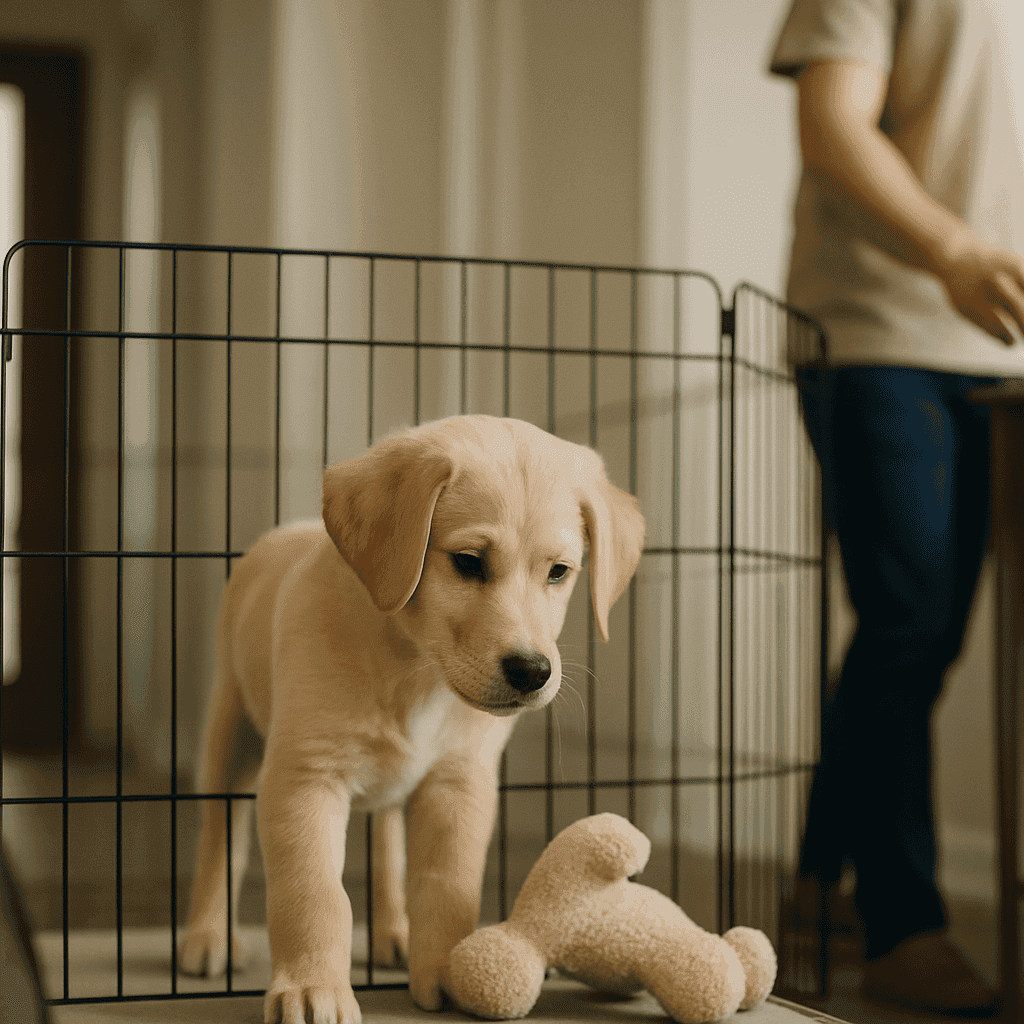
You are standing at the door with your keys in one hand and your bag slipping off your shoulder. The puppy is crying on the other side of the crate or playpen, and your work deadline is waiting. You feel guilty, worried about neighbor complaints, and scared that leaving means you are a bad pet parent. It helps to know this right away: a puppy crying when left alone for work can be a normal adjustment behavior in the first weeks, but it is not something to ignore without a plan.
This guide gives you a step-by-step workday plan, not a list of reasons to feel guilty. You will learn what normal protest looks like, what to do before your next shift, how to track progress, and when crying crosses into a red flag that needs professional help.
Quick Answer: Is It Normal for a Puppy to Cry When Left Alone for Work?
Yes, in many puppies, brief crying when left alone for work is a normal adjustment response. The volume can be loud and dramatic even when the puppy is not in true panic. The important difference is whether the puppy can settle.
A normal workday protest may look like this: your puppy whines, barks, or howls for a few minutes after you leave, then chews a safe toy, settles on the bedding, or naps until the next potty break. The crying may fluctuate, but the puppy can still eat, shift positions, and recover.
A more concerning response looks different: the puppy howls without pausing, pants heavily, refuses a favorite food toy, scratches frantically at the exit, or soaks the bedding with drool. If you see those panic signals, do not extend the alone time. Use the normal-vs-not-normal section below and call your veterinarian if the distress is severe or includes self-injury.
Do not judge the puppy as fine based only on volume. A very loud puppy can still be in a normal learning curve, while a quieter puppy can be frozen and stressed. The best tool is observation: a camera plus the daily scorecard in the Home Alone Independence Plan further down this page.
What To Do First Before Your Next Workday
If you have to go to work tomorrow or in a few hours, do these five things in order. They create a safer, calmer setup before you leave.
- Set up a safe confinement area. Use a crate or playpen with washable bedding, access to water, and a puppy-safe solo chew or food puzzle. The area should feel predictable, not like a punishment.
- Do a potty break first. A full bladder makes alone time much harder. Give the puppy a real opportunity to pee and poop before you begin the departure routine.
- Add a short calm settle activity. A 5-minute sniffing walk, a quiet training session, or a slow food puzzle can help lower arousal. Do not exhaust the puppy with a huge play session right before leaving; overtired puppies often cry and demand more, not less.
- Leave quietly. No high-energy goodbye, no drawn-out apology, no emotional reunion when you return. A calm exit and return teach the puppy that departures are ordinary.
- Watch on camera. Use a pet camera to observe, not to reply to every sound. The camera gives you data for the scorecard instead of guesses.
A realistic pre-leave sequence might be: potty, 5-minute calm sniffing or loose-leash walk, stuffed puppy-safe food toy placed in the crate, grab keys, leave quietly. If you cannot come home at lunch, arrange a dog walker, neighbor, or family member for a short potty and settle visit. Very young puppies cannot hold their bladder through a full workday, so support breaks are part of safety, not spoiling.
If the puppy will not enter the crate or ignores the food toy, go back to a simpler setup. Feed meals inside the crate or playpen while you are home first, with the door open, before asking the puppy to stay there alone.
First Week Back at Work: A Step-by-Step Home Alone Independence Plan
You do not need the puppy to handle a full workday on day one. The goal is to build short, calm absences and observe the settle pattern before extending time.
Start with inside-the-home out-of-sight moments of 30–60 seconds. Step behind a door, return during a brief pause in crying, and do not make the return exciting. Then build outward: leave the room, step outside the front door for 1–5 minutes, and come back quietly. Use the scorecard each time to record when crying started, when it stopped, and what the puppy’s body looked like.
As a rough guide, the first week back at work can look like this:
| Day | Practice Focus | Workday Plan | Advance Only If |
|---|---|---|---|
| Day 1 | 1-minute, 3-minute, and 5-minute practice exits | Shorter supported workday block or midday visit | Puppy settles in under 10 minutes after brief protest |
| Day 2 | Repeat 2–5 minute exits | Same supported workday | No panic signs, no elimination in the pen |
| Day 3 | Add 10–15 minute errand in a quiet car or outside | Supported workday with potty break | Settles after the errand even if there was some crying at first |
| Day 4 | Consolidate 5–15 minute exits | Supported workday | No regression after lunch or afternoon nap |
| Day 5 | Evaluate progress with scorecard | Increase one short block only if the pattern improved | Crying is shorter or more intermittent, not more intense |
| Day 6–7 | Short practice plus real workday routine | Maintain same setup and schedule | Puppy can rest, chew, or nap after the first few minutes |
Do not advance too quickly just because one day went well. Puppies can have a great Tuesday and a hard Thursday. Also avoid changing too many variables at once, such as moving the crate, skipping the midday break, and changing the chew all on the same day. If a 5-minute practice session causes nonstop barking, reduce to 1–2 minutes and pair the exit with a longer-lasting food toy.
If you need help matching meals, naps, and potty breaks to your workday, you can build your puppy routine as a secondary planner, but keep the workday alone-time practice as the main focus.
Normal vs Not Normal: Puppy Protest, Boredom, Fear, or Separation Anxiety?
Crying is a symptom, not a diagnosis. The same noise can come from different internal states. Use the table below as a decision guide.
Safety note: If you see continuous panic signs, self-injury, breathing trouble, or you suspect your puppy is in physical distress, stop the alone-time plan and contact your veterinarian immediately. This guide is not a diagnosis, and no article can replace veterinary advice.
| Category | What You May See | Next Action |
|---|---|---|
| Normal protest | Brief whining or barking, then chewing, resting, or napping; improves over days | Continue the gradual plan and track the settle pattern |
| Boredom or demand behavior | Intermittent crying with pauses, attention-seeking, possible destructive chewing without panic | Add a longer-lasting puppy-safe chew, increase sniffing and calm enrichment, reinforce settled behavior when you are home |
| Fear or stress | Crouching, pacing, tucked body, panting, crying tied to specific triggers or loud sounds | Reduce the difficulty, shorten absences, and create a calmer environment; do not flood the puppy |
| Possible separation anxiety | Continuous distress, howling without pause, escape attempts at the exit or crate sides, self-injury, drooling, elimination despite a recent potty break, refusal to eat, no settle pattern | Stop increasing alone time and contact a veterinarian or qualified separation-anxiety professional |
Many puppies show a mix of these signs. One day may look like boredom, and the next may look like fear. That is why the scorecard is more useful than a single crying episode. Do not label every bark as separation anxiety, and do not ignore a puppy that cannot recover after several minutes. If you suspect separation anxiety, ask a certified trainer or veterinary behavior professional if you are unsure how to proceed.
Common Mistakes That Make Workday Crying Worse
Most owners make these mistakes because they want to help, not because they are doing something wrong. Fixing them often changes the pattern quickly.
- High-energy goodbyes and reunions. A loud apology or excited return raises arousal. The puppy learns that departure and arrival are huge emotional events. Replace this with quiet exits and calm returns.
- Inconsistent routines. Calm exits all weekend followed by rushed Monday exits make the world unpredictable. Use the same five-step pre-leave sequence even when you are running late.
- Using the crate as punishment or only when you leave. If the crate only appears when you disappear, alone time feels unsafe. Feed meals inside the crate with the door open while you are home.
- Leaving a young puppy too long without a potty break. A full bladder or bowel pressure can turn mild discomfort into distress. Plan a realistic midday potty or support visit.
- Using anti-bark collars, yelling, or punishment. These tools suppress communication and can make fear worse. They do not teach the puppy how to feel safe alone.
- Rushing back inside during every cry. If you re-enter unpredictably every time the puppy whines, you may accidentally teach that crying makes you return. Use a camera and a short planned absence to wait for a brief pause unless you see panic signs or a safety issue.
If you have already made one of these mistakes, treat it as data. Drop back to a shorter, easier alone-time setup for several days and rebuild the routine.
Troubleshooting: When the Crying Doesn’t Improve
Real life does not follow a perfect first week. Here is what to do when the plan stalls.
| Problem | Likely Cause | First Adjustment | Professional Help Trigger |
|---|---|---|---|
| Puppy refuses the crate or cries at the door | The crate is not positively conditioned yet | Feed meals inside, keep the door open, practice short closed-door sessions while home | Refusal to enter even with food after several days, or panic inside the crate |
| Neighbor complains about barking | Crying may be louder or longer than expected | Check the camera timestamp, move the enclosure away from shared walls, add white noise, and communicate your plan | Crying goes beyond your planned limit or includes distress signs |
| Regression during teething or schedule changes | Discomfort, changed routine, or missed practice | Offer a cold safe chew, lower the alone-time duration temporarily, and rebuild progress | Pain signs, refusal to eat, lethargy, or fever |
| Dog won’t sleep alone anymore after a sudden schedule change | Night routine changed, physical discomfort, or stress | Rule out a medical issue, reduce night-sleep pressure, and refocus on workday alone-time training rather than adding night pressure | Sudden nighttime distress, pacing, panting, or inability to rest for multiple nights |
| Panic signs or no improvement after 5–7 days | Possible separation anxiety, pain, or a deeper concern | Stop increasing alone time, collect your scorecard notes, and contact a veterinarian or qualified professional | Any self-injury, escape destruction, continuous vocalizing, or elimination despite potty support |
If a neighbor tells you the puppy barked for 45 minutes, do not react with shame. Check the camera timestamp and use the scorecard to see whether the crying started at departure, after a potty need, or after a loud noise. That information tells you whether the fix is a schedule change, a setup change, or a professional consult.
Home Alone Independence Plan: Your Printable Checklist and Daily Scorecard
No separate PDF download is needed. You can copy this plan into your phone notes, write it on a sticky note, or print this page. Use it before each workday.
Morning prep checklist
- Set up crate or playpen with washable bedding, water access, and a puppy-safe solo chew or food puzzle.
- Do a potty break and a short calm settle activity before the departure routine.
- Place the camera so you can see the puppy, door, and confinement area without using two-way audio to reply to every sound.
- Practice one or two very short calm exits and returns before the first full workday if possible.
- Leave quietly: no high-energy goodbye, no emotional reunion, and note the exact departure time.
- Plan a midday potty or support visit appropriate for the puppy’s age and bladder capacity.
- If crying is panic-like, continuous, or includes self-injury, skip the day’s extension and move to the professional-help path.
Daily scorecard fields
| Field | What to Record |
|---|---|
| Date | Day of the week and whether it was a workday |
| Duration left | Practice absence or workday block length |
| Crying start time | First whine, bark, or howl after exit |
| Crying stop time | When the puppy became quiet for at least one minute |
| Settling time | When the puppy chewed, rested, or napped |
| Body language | Loose body, curled on bed, pacing, tucked tail, panting, drooling |
| Accidents | Urine, stool, or none |
| Chews used | Which toy or food puzzle the puppy had |
| Notes | Neighbor complaint, loud noise, visitor, schedule change, or illness |
A scorecard example might look like this: Day 1, left 5 minutes, crying started immediately, crying stopped after 12 minutes, puppy settled after 18 minutes and chewed; Day 2, left 5 minutes, crying stopped after 6 minutes, puppy rested; Day 4, crying increased after a schedule change and a missed midday visit. That pattern tells you to reduce difficulty and rebuild the routine rather than panic.
Do not turn the scorecard into a rigid pass/fail test. One bad day does not erase progress. Use it to spot whether crying is shorter but intense, longer but intermittent, or linked to a specific trigger.
Frequently Asked Questions
Is it normal for a puppy to cry when left alone for work?
Yes, brief protest can be normal in the first weeks. The key is whether the puppy can settle, eat, or rest after the initial crying. If the crying is continuous and the puppy cannot recover, treat it as concerning and scale down.
How long should I let my puppy cry before going back inside?
There is no one hard number for every puppy. Use a camera and a scorecard. For short practice absences, wait for a brief pause in crying before returning. If the puppy shows panic signs or cannot settle after the short planned interval, reduce the next absence instead of holding out longer.
How do I stop my puppy crying when I leave for work?
Use the before-work reset, short progressive exits, safe confinement, quiet departures, and a daily scorecard. Most puppies improve when the exit becomes low-arousal and the alone time is short enough for the puppy to recover.
How long does it take for a puppy to get used to being alone?
Timeline varies. Many puppies make noticeable progress over one to three weeks with a gradual plan, but some need more support or professional help. A puppy who is not ready for a full workday is not a failure; it is a signal to adjust the plan.
When will my puppy stop crying at night and sleep alone?
Night sleep can improve with similar calm routines, but workday alone-time issues and night sleep are related yet separate. If a puppy won’t sleep alone at night, or a dog won’t sleep alone anymore after a change, review crate setup, pain, night routine, and whether a medical issue is present. Refocus on the workday alone-time plan without adding extra night pressure.
How do I know if my puppy has separation anxiety instead of normal adjustment?
Look for observable panic: continuous distress, destruction or escape efforts, self-injury, drooling, elimination despite a recent potty break, refusal to eat, and no settling pattern. If you suspect separation anxiety, stop increasing alone time and contact a qualified professional.
Should I use a crate, playpen, camera, or leave a radio on?
Use a crate or playpen for safety if the puppy is positively conditioned to it. Use a camera for data. White noise or background sound can be supportive, but it is not a standalone fix. Avoid tools that punish, shock, spray, or cause fear.
When should I call a vet or professional trainer?
Avoid relying on a universal number or timeline; record the pattern and contact a veterinarian when the change is persistent, worsening, or accompanied by other concerning signs.
Take This Plan Into Your Next Workday
You do not need to solve everything by tomorrow morning. Use the copyable checklist above, keep the camera on, and record what your puppy actually does. If the pattern improves, continue. If the puppy shows panic signs or cannot settle after a short planned absence, stop and get help. When you are not sure whether a behavior is a training issue or something more urgent, Use the Puppy Panic Button to check the red flags before you panic.