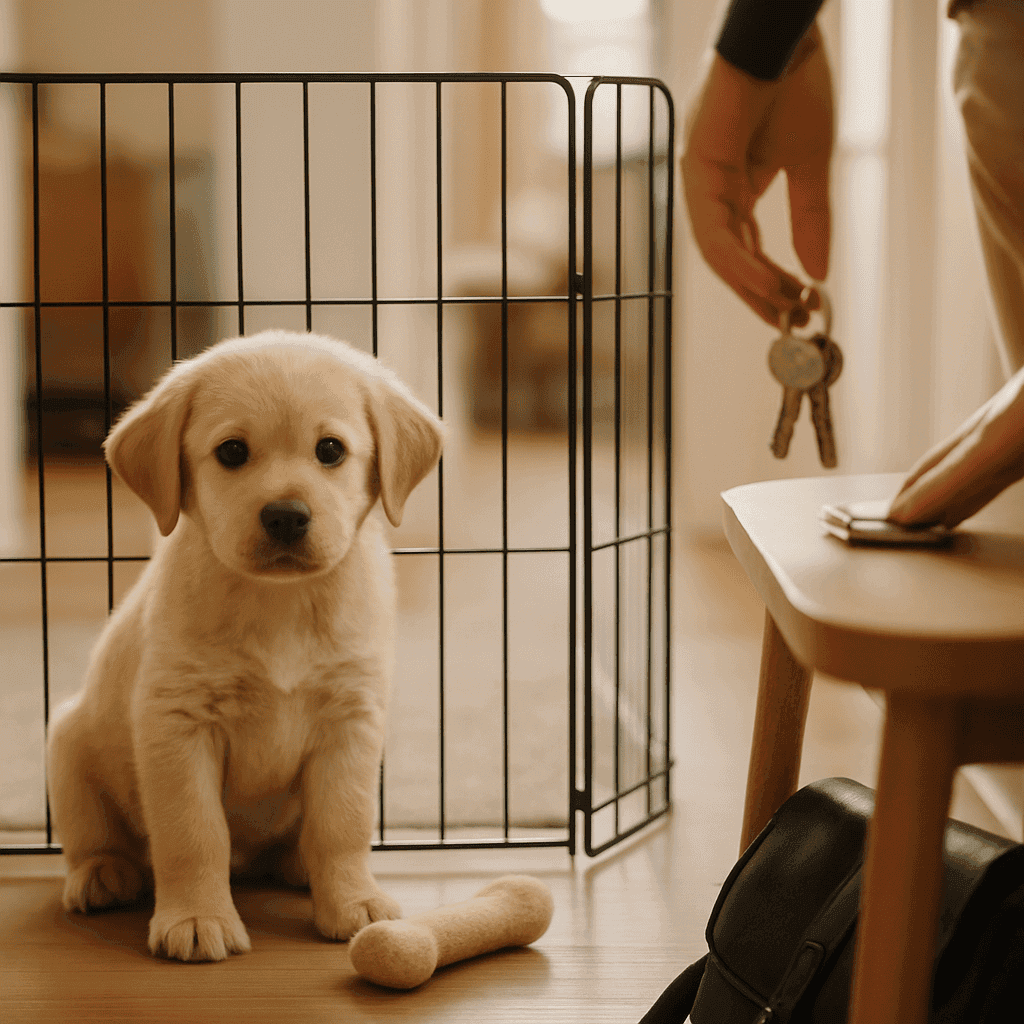
If you are reading this from work with your puppy’s cry playing through a camera app, take one breath. You are not a bad owner, and this is not automatically separation anxiety. But the crying is real, and it deserves a real plan. This guide is a workday survival manual. It will help you distinguish normal protest from panic, build a leaving routine you can run this morning, and decide when to stop training and call a vet or qualified behavior professional.
Fast Answer: What To Do First When Your Puppy Cries When Left Alone During the Day
When your puppy cries after you leave, do not immediately rush back and do not force yourself to ignore everything. Go through four checks in order.
- Check safety on camera. Is the puppy in a safe crate or puppy-proofed area? Look for collar hazards, something that could fall, or a puppy wedged against a door. If you see an immediate injury risk, act on that first.
- Rule out potty pressure. If the puppy is circling, sniffing hard, squatting, or was left past a realistic potty window, crying is communication. For a young puppy, arrange a mid-day visit or a helper rather than hoping they hold it.
- Watch the settle pattern. Many puppies whine for 5 to 15 minutes after departure, then sniff the frozen treat, lick it, pace once, and lie down. That peak-and-settle shape is normal protest. You can let that run while you watch.
- Check duration and distress signs. If crying is continuous, escalating, or paired with panting, drooling, frantic scratching, biting the crate bars hard, or repeated escape attempts, do not ignore it. That puppy needs a plan change, not a longer wait.
A 10-week-old puppy who whines for eight minutes and then settles with a stuffed Kong is on a normal settling curve. A 12-week-old puppy filmed panting heavily and biting the crate door for 20 minutes needs a different setup, shorter absences, or professional help.
Mistake to avoid: rushing back during the first minute of normal protest can accidentally teach that louder protest makes you reappear. Instead, watch the pattern before intervening, unless safety is at stake.
Crying Type Decoder: Protest, Boredom, Potty Pressure, Fear, or Panic
Crying is not one signal. If you misclassify it, you will choose the wrong response. Here are the most common daytime types.
Protest or frustration usually starts right after departure. The whining may rise quickly, peak in the first few minutes, then fall. The puppy can still accept a chew, sit, or lie down. The response is to keep the departure calm and give a high-value settle item, then wait a few minutes rather than returning at the loudest moment.
Boredom or energy crying often starts later, after a period of quiet. The puppy may pace, bark in short volleys, or stand at the pen edge. This is usually a sign that the pre-departure walk or play was too short. Increase calm movement before alone time, not necessarily more time with the puppy after work.
Potty-related crying is different: it often arrives after a longer quiet block and includes pacing, sniffing, circling, or squatting. If you can see a pattern where crying starts at the same time each day and ends with an accident, potty timing is likely the hidden cause. Here, the response is to add a potty break or adjust meal and water timing. If accidents keep appearing at the same camera timestamp, the Puppy Potty Pattern Tracker can help you spot the rhythm instead of guessing.
Fear or startle crying can follow a loud noise, a delivery, or a sudden sound outside. White noise, a covered crate, or moving the daytime area to a quieter part of the home can help many puppies.
Panic or real distress is the red flag. It is prolonged, escalates rather than fades, and may include panting, drooling, screaming, escape attempts, or self-injury. This is not normal protest. You shorten absences, change the environment, and seek qualified support.
This observation cannot identify the cause at home. Record the wider pattern and ask a veterinarian to interpret it if the concern persists or the puppy seems unwell.
Below is a quick camera-informed summary. Use it only after you know the puppy is safe.
| Crying type | Common camera signs | Better response |
|---|---|---|
| Protest | Starts soon after exit, fades within 5–15 minutes | Wait a few minutes; give calm chew |
| Boredom | Starts after quiet period, pacing, demand bark | Increase pre-departure movement and puzzle time |
| Potty pressure | Pacing, sniffing, squatting, accident risk | Add mid-day break; adjust water/meal timing |
| Fear/startle | Sudden onset after noise, hiding, flinching | White noise, cover pen, move daytime spot |
| Panic/distress | Escalating, panting, drooling, escape attempts | Stop long absences; call your vet |
| Pain/medical | Crying with you home, appetite change, limping | Contact your veterinarian |
Remember: if the category is unclear, treat it as possible distress, shorten absences, and collect a few camera notes before making a big change.
Before You Leave: A Pre-Departure Routine You Can Follow This Morning
The goal is not to sneak out perfectly. The goal is to make departure boring and predictable.
20 to 30 minutes before leaving: take the puppy out for a calm potty trip. Do not start a rough play session after this. You want the bladder empty and the puppy’s nervous system settling down, not revving up.
10 to 15 minutes before leaving: put the puppy in the safe crate or exercise pen with a long-lasting safe chew or frozen food puzzle. This is not a loose treat that disappears in 30 seconds. A stuffed Kong, a lick mat, or a safe puzzle toy should take 10 to 15 minutes of quiet work.
5 minutes before leaving: set the camera position so you can see the whole safe area and hear the sound clearly. Check room temperature and make sure there is nothing the puppy can knock over.
At departure: leave without a long emotional goodbye. You can use a simple low-key phrase like “I’ll be back,” but do not repeat it, hover, or re-enter. Your tone matters more than the words.
After leaving: watch the camera for three to five minutes. Look for whether the puppy starts to settle or escalates. That early camera window tells you whether this morning’s setup is working.
Mistake to avoid: crating a hungry, full-bladdered, or overstimulated puppy and then expecting calm. If the routine feels rushed, wake up 20 minutes earlier instead of skipping the potty step.
If the puppy will not settle even during a five-minute practice session on a weekend, practice the routine when you are not actually rushing to work. That way departure does not only mean a long absence.
Step-by-Step Plan: Age-by-Age Alone-Time Limits and a Week-by-Week Progression
Most daytime crying is schedule crying. A puppy who is asked to hold urine too long or go from zero alone time to a full workday will cry because the situation is unfair.
As a rough guide, age and bladder control set the limits. These are not punishments; they are physical realities for many puppies.
| Puppy age | Realistic alone-time window | Realistic potty break window |
|---|---|---|
| 8–10 weeks | Very short sessions; build from minutes to 1 hour | Every 1–2 hours |
| 10–12 weeks | Up to 1–2 hours for many puppies | Every 2 hours |
| 3–4 months | 2–3 hours may work for some puppies | Every 2–3 hours |
| 4–5 months | 3–4 hours may work, but not for all | Every 3–4 hours |
| 6 months and older | Build toward 4–5 hours slowly | Do not jump to a full workday without support |
A 9-week-old left from 9am to 5pm with no midday break will not simply learn to hold it. The schedule must change. A 14-week-old may handle two to three hours with a lunch break for potty and a short settle activity.
For the first month, do not start with the full absence. Build in reps:
- Days 1–3: practice 5- to 10-minute departures while you walk around the block or sit in the car.
- Days 4–7: move to 15- to 20-minute absences only if the puppy shows a peak-and-settle pattern.
- Week 2: work toward 30 to 60 minutes with a potty break before and a calm settle item.
- Week 3–4: extend to longer blocks only if camera footage shows calm gaps and no panic signs.
If the schedule still exceeds the age limit, stop trying to fix crying with more crate time. Change the schedule or add a helper first. When the numbers feel abstract, the Puppy Routine Builder can help you turn them into a daily rhythm that matches your puppy’s age and your work hours.
What To Do During Your Lunch Break or Mid-Day Check-In
A good lunch break is not a party. It is a reset.
Start with potty. The first priority is empty bladder or bowels. Keep the greeting low-key, as hard as that may be.
If there is an accident, clean it calmly. Do not scold. Puppies do not connect punishment after the fact with the accident itself.
Then offer 5 to 10 minutes of calm movement. A short sniff walk or gentle food-puzzle training can be enough. Avoid high-speed fetch, rough wrestling, or anything that sends the puppy into zoomies right before you leave again.
Return the puppy to the safe setup with a fresh safe chew or puzzle. Leave quietly. If you cannot get home, arrange a calm neighbor or dog walker to provide potty and settle help, not just a drive-by.
A good structure: five minutes potty, ten minutes sniff walk, five minutes quiet settle with a frozen food toy. A bad structure: twenty minutes of chase and rough play, then an excited goodbye.
If the puppy becomes harder to leave after lunch, make the visit calmer and shorter rather than longer and more exciting.
Normal vs Not Normal: Protest Crying vs a Puppy Who Needs More Help
Some crying is normal. Some is a serious signal. The difference is usually in the pattern, not the volume alone.
Normal signs:
- Whining for 5 to 15 minutes after departure, then chewing, sitting, or sleeping.
- Brief protest barking without panting, drooling, or escape attempts.
- Reluctance to settle at first that improves over several training sessions.
Concerning signs:
- Continuous screaming or barking for 30 to 45 minutes without any calm gaps.
- Heavy panting, drooling, frantic scratching, biting the crate, or attempts to escape.
- Vomiting, diarrhea, refusal to eat, or any injury from distress behavior.
A 12-week-old who whines for ten minutes and then sleeps until the lunch break is normal. A 5-month-old who screams, drools, and bites the crate bars hard enough to injure the mouth is not someone you ignore.
Safety note: This article is not a veterinary diagnosis. Puppy crying can be caused by pain, illness, or a medical issue such as a urinary tract infection, digestive upset, or an injury. If the crying is new, also happens when you are home, or comes with vomiting, diarrhea, low appetite, limping, or lethargy, stop the training plan and contact your veterinarian. For intense escape attempts or self-injury risk, also ask a qualified force-free trainer or veterinary behavior professional for help. Do not use punishment, bark collars, or flooding methods.
If you are not sure whether you are seeing normal protest or panic, collect three camera notes: when the crying starts, what the puppy’s body does, and when it stops. That evidence is more useful than a scared guess.
Common Mistakes That Accidentally Make Daytime Crying Worse
Most owners do not make crying worse on purpose. They do it because they are anxious and trying to fix the sound quickly. Here are the most common traps.
| Stop doing this | Do this instead |
|---|---|
| Returning at the loudest moment unless there is a safety risk | Wait for a brief quiet gap, then return calmly if you must |
| Shouting, banging the crate, or using a spray bottle | Lower stimulation; use white noise and a calm environment |
| Leaving a puppy in a crate longer than age or bladder limit | Add a mid-day potty break or helper |
| Making the first alone time a full workday | Start with 5- to 10-minute practice sessions |
| Big emotional goodbyes and long reunions | Keep departures and arrivals low-key |
| Skipping a potty break because the puppy seemed quiet | Watch for potty signals and adjust the schedule |
Do not shout or bang the crate to stop barking. That adds fear to an already hard situation. Do not take a puppy that has never been alone and leave it for four hours on the first day.
If you have made one of these mistakes, do not try to fix everything at once. Pick one change first: fix scheduling, potty timing, or departure routine. Then watch the camera for a few sessions.
Troubleshooting: What To Change When the First Plan Doesn’t Work
If you follow the basics for four or five sessions and the puppy still cries or gets worse, do not repeat the exact same plan and hope for a new result.
Go through this order:
- Recheck schedule and potty timing. Is the alone-time window age-appropriate? Is a mid-day break actually happening?
- Change the environment. If the crate seems to increase panic, try a safe puppy-proofed room or playpen instead. Some puppies panic against a closed crate door.
- Increase departure value. Use a better frozen chew, a stuffed food puzzle, or a higher-value settle item. If the puppy calms in 10 minutes with a frozen Kong but not without it, the fix is a better pre-departure activity, not more punishment.
- Track the camera pattern. Write down start time, peak time, settle time, body language, and any potty behavior. If the puppy panics even during five-minute absences despite a calm routine, that is a sign to seek professional support.
- Rule out medical causes. If the puppy cries when you are home, refuses food, or shows vomiting, diarrhea, or injury, call your vet before doing more alone-time training.
- Involve a qualified force-free trainer or veterinary behavior professional if you see escape attempts, self-injury, or escalation that does not improve when absences are shortened.
Do not change everything at once. That makes it impossible to know what helped. And do not conclude the puppy is a lost cause. Most daytime crying improves with schedule changes, practice, and the right environment.
Copy This: Home-Alone Success Checklist – Before Work, During the Day, and After You Return
Since you may be reading this before tomorrow morning, copy this list into your notes or print it. It is designed to be used in real time.
- Check the puppy’s age and schedule. If under 4 months, arrange a mid-day potty visit or helper.
- Prepare a safe crate or puppy-proofed area. Remove collar hazards and unsafe objects.
- Potty the puppy 15 to 20 minutes before departure.
- Provide water appropriately for the puppy’s age and setup.
- Set up a camera with a clear view and sound.
- Give a safe long-lasting chew or food puzzle after the puppy is in the safe area.
- Leave calmly without a high-emotion goodbye.
- Watch the camera for the first 5 minutes to see whether the puppy settles or escalates.
- Do not return during the loudest moment unless there is a safety risk.
- Log the crying pattern: start time, peak time, settle time, body language, and potty behavior.
Quick Answers to Common Daytime Alone-Time Questions
Should I ignore my puppy crying when I leave for work?
Only ignore short protest crying after checking the camera and ruling out potty need or panic. Never ignore distress signs like panting, drooling, or escape attempts. The key is not all-or-nothing ignoring; it is camera-informed judgment.
How long can a puppy be left alone at 8, 10, or 12 weeks?
As a rough guide, 8- to 10-week-old puppies need very short sessions and potty breaks every 1 to 2 hours. At 10 to 12 weeks, many puppies can handle 1 to 2 hours without a break, but bladder limits override exact minutes. Arrange mid-day help.
How do I know if my puppy is crying because they need the toilet?
Look for sudden increased pacing, circling, sniffing, or squatting on camera, especially after a longer quiet period. If the crying happens around the same time each day and leads to an accident, potty pressure is likely.
What is the difference between normal protest crying and separation anxiety?
Normal protest tends to fade within 5 to 15 minutes and the puppy can eat, rest, or settle. Real distress is prolonged, escalates, and includes panic or escape behavior. Avoid diagnosing separation anxiety too early; many puppies simply have not been taught to be alone.
What should I do if my puppy won’t sleep alone during the day?
Build short daytime alone rests with potty, low-key departures, white noise, and a safe chew. Do not force them into long isolation and hope they learn. Practice when you are still home, moving into another room for a few minutes.
Can I leave a puppy alone while I work full time?
Not a young puppy without mid-day help. Use a visitor, dog walker, staggered schedule, or puppy-safe plan until the puppy can handle longer stretches. A full workday with no break is not fair to an 8- to 12-week-old puppy.
When should I worry about puppy crying enough to call a vet?
This observation cannot identify the cause at home. Record the wider pattern and ask a veterinarian to interpret it if the concern persists or the puppy seems unwell.
If You Are Still Not Sure What You’re Seeing
When the crying turns into something that looks like pain, illness, collapse, breathing trouble, or a scary symptom you cannot explain, do not guess. Use the Puppy Panic Button to walk through the red flags and decide whether to call your veterinarian now. It is a safety helper, not a substitute for veterinary care.