You just brought your new puppy home. The crate is set up, the potty schedule is running through your head, and then you reach down to touch a tiny ear or check a paw — and the puppy squirms, mouths your hand, or pulls away. It is easy to think, “Oh no, I’ve already made my puppy afraid of me.” But here is the truth: nipping, wiggling, and even pulling a paw back are normal puppy communication, not a sign that you have failed.
This article gives you a real first-week puppy handling plan. Not a list of vague “touch your puppy every day” tips, but a day-by-day sequence with exact seconds, treat timing, and what to do if your puppy resists or bites. Even a 30-second happy handling session can build lifelong trust, so you do not need to be perfect. You just need a safe order and a way to read your puppy.
Quick Answer: Handling Your Puppy in the First Week
Here is what to do right now, without overthinking it:
- Keep sessions short: 30–120 seconds per body area, 2–3 times a day. For most puppies, that means less than 5 minutes total of deliberate handling daily in week one.
- Follow this order: calm body touch → collar introduction → ear touch → paw touch.
- Always stop before stress. If the puppy yawns, licks lips, looks away, or tries to move away, pause or end the session.
- The goal is positive association, not grooming mastery. You are not trimming nails or cleaning ears in week one. You are just teaching the puppy that your hands near ears, paws, and collar predict good things.
- Day 1 example: stroke the shoulder twice for 5 seconds, say “yes,” give a tiny treat, end the session.
- If the puppy nibbles your hand, stay calm, switch to a chew toy, and try again later. That is normal curiosity.
Longer sessions do not equal faster progress. Overhandling can sensitize a puppy so touch feels like an event to survive, not a routine to trust. If your puppy already had a bad experience, even a single positive 3-second touch starts repair.
How to Start: The Foundation of Calm Touch and Trust
Calm touch is not just petting. It is intentional, consent-based touch that gives the puppy a chance to show you if they are comfortable. Use a flat hand, move slowly, start on the shoulder or chest, and watch for the puppy to lean in, sniff, or stay relaxed. If the puppy walks away, that is information, not failure.
Set up a quiet room. No children running, no TV, no other pets. Have high-value treats cut into pea-sized pieces — soft treats work better than crunchy because the puppy can eat them quickly and stay focused. You can use a clicker or just a calm marker word like “yes.”
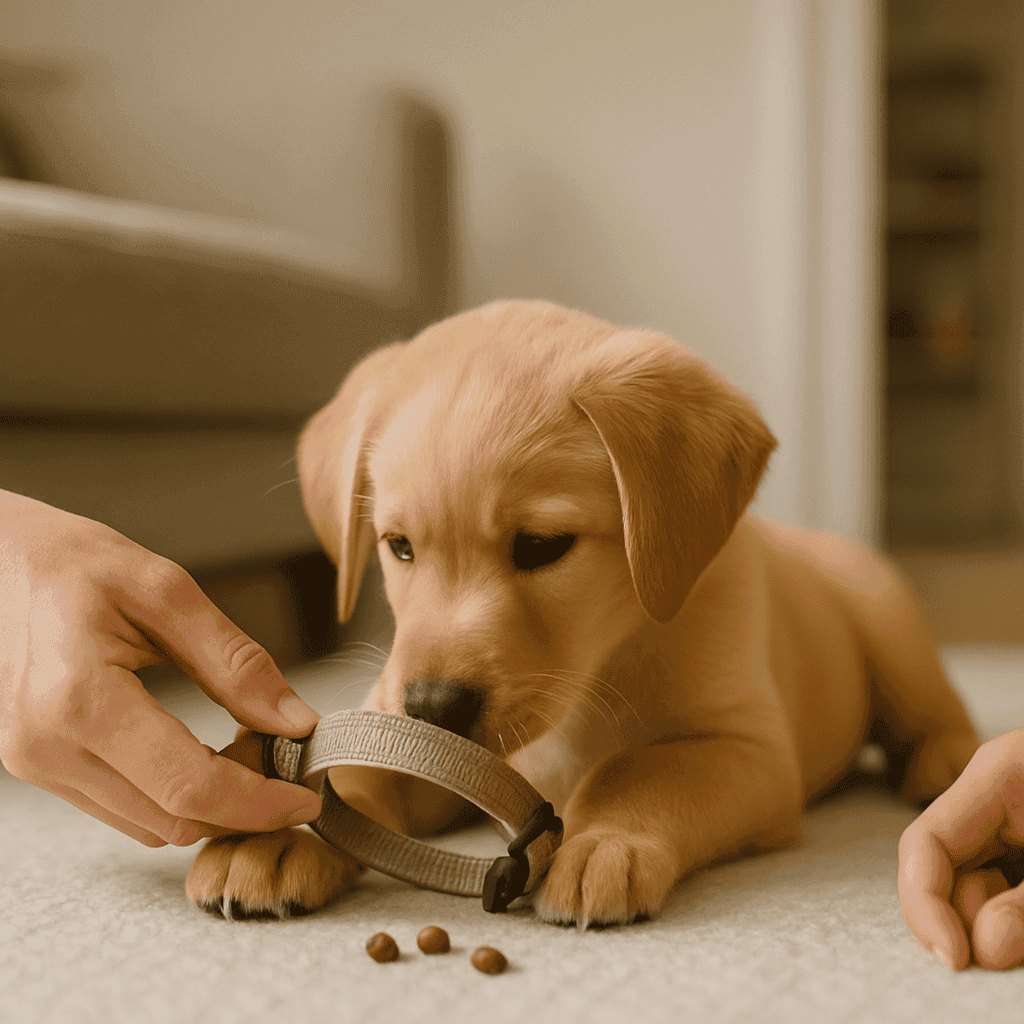
Before you touch ears, paws, or collar, introduce the collar as a separate, non-scary game. Let the puppy sniff the collar on the floor. Hold it in your hand and feed a treat next to it. Touch the collar to the puppy’s neck without fastening it and reward. Do not rush into buckling it the first time. That sequence might take two or three days.
The order that works for most puppies is: calm body touch → collar present → collar on/off → ear lifts → paw lifts. Ears and paws are often more sensitive because puppies are not used to having them manipulated. Build the trust first.
Example of a 5-second calm touch drill:
- Say “touch” in a soft voice.
- Stroke the puppy’s shoulder twice with a flat hand, slow and light.
- Say “yes” and give one tiny treat.
- Repeat 3 times.
- End the session while the puppy is still relaxed.
If the puppy shies when you reach for the collar, do not follow with the collar. Back up to just showing the collar and treating. No neck contact. The goal is to change the puppy’s emotional response, not to “get it over with.”
One common mistake in this stage is doing too many new things in one session — collar on, ear lift, paw lift all at once. Separate novel sensations by at least a few hours, or a day. To make handling easier, schedule these micro-sessions after crate naps or potty breaks when the puppy is calm. You can build your puppy routine so handling fits naturally into the day.
Safety note: If your puppy yelps, screams, snaps, hides, or refuses treats during handling, stop and check for an injury or medical issue. Repeated yelping, ear odor, head shaking, paw licking, swelling, or limping should be evaluated by a veterinarian. You can also use the Puppy Panic Button if you are not sure whether a symptom needs urgent vet attention. Do not force handling if you suspect pain.
The 7-Day Step-by-Step Handling Plan (Ears, Paws, Collar)
This plan assumes an 8–10 week old puppy, but you can adjust for older puppies by moving slower or faster depending on their reactions. The times are a rough guide. If your puppy is relaxed, you can increase by a second or two. If they are tense, stay at the current step or go back one.
| Day | Body Part / Skill | Action | Duration / Reps | Reward & End Cue |
|---|---|---|---|---|
| 1 | Calm body touch | Flat hand on shoulder/chest, slow stroke | 5 sec per rep, 3 reps, 2 sessions | “yes” + treat each rep; end while relaxed |
| 2 | Collar introduction | Let puppy sniff collar, touch to neck without fastening | 5 reps, 2 sessions | “yes” + treat each time collar stays calm |
| 3 | Collar on/off | Fasten loosely for 1–2 seconds, treat, remove | 3 reps, 2 sessions | treat while fastened; end before pup freezes |
| 4 | Ear touch | Gently lift one ear flap, hold 2 sec, release | 2 reps each ear, 2 sessions | “yes” + treat after each release |
| 5 | Paw touch | With puppy lying down, touch top of paw, flat hand, no grip | 3 sec per paw, 2 reps each, 2 sessions | “yes” + treat after each paw |
| 6 | Combine | Collar on, ear lift, paw touch in sequence | 2 circuits, 2 sessions | treat after each piece; keep total under 2 min |
| 7 | Mini routine | Full sequence: collar touch, lift one ear, lift one paw | 1–2 circuits, total under 2 min | end with a happy settle or chew |
Day-by-day details:
Day 1 – Calm body touch only. Keep the door closed and the room quiet. If the puppy climbs into your lap, that’s fine, but don’t trap them. Do 5-second strokes on the shoulder or chest. If the puppy mouths, freeze, remove your hand slowly, and give a chew toy. The point is to teach, “hands near me are safe,” not “I must sit still forever.”
Day 2 – Collar introduction. Hold the collar in your open palm. Let the puppy sniff. Click or say “yes” and treat for any calm interaction. Touch the collar to the side of the neck for one second without fastening it. If the puppy backs away, just place the collar on the floor and scatter treats around it. You are building curiosity first, not compliance.
Day 3 – Collar on/off. Fasten the collar loosely enough to fit two fingers underneath. Keep it on for 1–2 seconds while the puppy is eating a treat, then remove it. Do not leave the collar on for the whole day yet if the puppy seems worried. Repeat until the puppy does not notice. If the puppy scratches at the collar, that is a clue to shorten the next rep, not a reason to push longer.
Day 4 – Ear touch. Gently lift one ear flap — not the whole head — and hold for 2 seconds. Use a soft, flat hand. Do not squeeze or rub. If the puppy shakes their head after, that is normal. If they scream, stop and check for redness, discharge, or odor. Keep the session tiny enough that the puppy can succeed twice in a row.
Day 5 – Paw touch. With the puppy lying down or sitting, place your flat hand on top of one paw for 3 seconds. Do not grab or lift the paw yet. If the puppy pulls away, let them. Try again later with a treat hidden in your closed fist so the puppy voluntarily noses your hand. That gives you a way to reward calm without wrestling the paw into place.
Day 6 – Combine. Put the collar on first, then lift one ear for 2 seconds, treat, then touch one paw for 3 seconds, treat. Keep the whole circuit under 2 minutes. If the puppy looks away or yawns, take a break. If the puppy is doing well, you can repeat the circuit once more later in the day rather than stretching one session too long.
Day 7 – Mini routine. Run through the full sequence once or twice. The goal is a calm puppy who accepts touch as a normal part of the day. If the puppy is wiggly, do one circuit and stop. You can continue this routine daily, adding a second or two as the puppy relaxes.
A human version of this plan looks like a normal morning: the puppy wakes up from a nap, goes potty, gets a tiny treat, and spends 90 seconds learning that shoulder touch, collar touch, or a paw touch is no big deal. Then the puppy gets a chew and a nap. That is enough.
Normal vs. Not Normal: Reading Your Puppy’s Reactions
First-time owners often panic when a puppy mouths, squirms, or pulls away. But those are usually normal communication. The key is to watch whether the puppy re-engages after a pause.
Normal reactions:
- Gentle mouthing during paw touch, then re-engaging with the treat.
- Pulling paw away once, then allowing touch after a break and a sniff.
- Yawning, lip-licking, or looking away during an ear lift, but no struggling. These are low-level stress signals that often resolve if you back off slightly.
- Freezing for a second when the collar is first buckled, then relaxing with treats.
Concerning reactions:
- Yelping or screaming at a gentle ear lift or paw touch.
- Snapping or lunging when your hand approaches the collar.
- Trying to bolt, hide, or crouching with tail tucked and refusing treats.
- Persistent head shaking, scratching, discharge, or foul odor from ears.
- Swollen paw, broken nail, or limping unrelated to play.
Keep this as an observation rather than a diagnosis: record what changed, watch the wider pattern, and contact a veterinarian if the puppy appears unwell or the concern persists.
Safety note: If your puppy yelps, screams, snaps, hides, or refuses treats during handling, stop and check for an injury or medical issue. Repeated yelping, ear odor, head shaking, paw licking, swelling, or limping should be evaluated by a veterinarian. You can also use the Puppy Panic Button if you are not sure whether a symptom needs urgent vet attention. Do not force handling if you suspect pain.
If you see something that worries you, take a short video of the behavior. It can help your vet or a certified trainer understand what happened. And for new puppy handling, never assume resistance is “dominance.” In an 8-week-old puppy, resistance usually means fear or discomfort.
5 Common Handling Mistakes That Undo Your Progress
1. Handling when the puppy is over-tired or over-excited. Pick calm, post-nap windows. A puppy that is zooming around or exhausted will not learn calm handling. Mistake: trying to practice after playtime. Fix: wait 15 minutes after a nap or potty break.
2. Pushing past the first stress signal with “just one more second.” Stress is cumulative. If you see a yawn, lip-lick, or look-away, end the session on a positive note. Mistake: holding the paw while the puppy pulls away. Fix: release immediately, treat for any calm, and reduce duration next time.
3. Repeating the exact same movement over and over without progression. Ten ear lifts in a row can make a puppy more sensitive. Mistake: doing 10 reps because the first one seemed fine. Fix: stick to the plan’s 2–3 reps per body part, then switch to a different activity.
4. Forgetting to pair touch with a reward marker immediately. Timing matters. If you touch the paw and wait five seconds to treat, the puppy may not connect the touch with the reward. Mistake: fumbling for treats after the fact. Fix: have treats in an open pouch or your pocket so you can mark and reward within one second.
5. Using handling after scolding or as a restraint exercise. If you are frustrated, the puppy will feel it. Mistake: grabbing the collar to stop a behavior and calling that “handling practice.” Fix: never pair collar touch with punishment. Separate redirection from handling.
If you have already made one of these mistakes, do not panic. Dial back to an earlier step in the plan and rebuild. The fix is a smaller, happier session, not a longer one.
Troubleshooting: What to Do When Your Puppy Resists or Bites
If your puppy pulls away, mouths, freezes, or screams, do not panic. The best response is to reduce intensity, increase treat value, and reassess for a medical cause.
| Body Part | Reaction | Immediate Action | Next Attempt Adjustment |
|---|---|---|---|
| Ears | Pulls away, shakes head | Stop, offer a treat, check for odor/discharge | Back up to cheek touch for one day; re-try ear lift for 1 second |
| Ears | Screams at gentle lift | Stop immediately, inspect ear, call vet if repeated | Do not re-try until vet clears; then use counter in hand approach |
| Paws | Mouths hand when touched | Freeze, remove hand slowly, give chew toy | Reduce to 1-second flat touch; use hidden treat in closed fist |
| Paws | Pulls paw away once | Let paw go, wait, offer treat | Try again later with less grip, no lifting |
| Collar | Backs away when collar appears | Place collar on floor, scatter treats around it | Next day touch collar to neck without fastening |
| Collar | Freezes or panics when buckled | Remove collar, play treat-chase game | Reintroduce collar with only neck touch for 2 days |
| General | Biting | Remove hands calmly, present a chew toy, end session | Try again in 15 minutes at lower intensity |
For each body part, follow this 3-step escalation path:
- Reduce intensity: shorter touch, lighter pressure, no grip.
- Increase treat value: use something extra smelly like tiny bits of chicken or liver.
- Reassess medical cause: if yelping, odor, swelling, or limping, stop and check with a vet.
Example scenario: Day 5, puppy bites when paw is picked up. Solution: go back to Day 4 style (flat touch only) and use a treat scatter on the floor to reset. Another scenario: collar goes on and puppy freezes. Solution: remove collar, play a happy treat-chase game to reduce fear, and reintroduce collar with only neck touch tomorrow.
If your puppy mouths your hand during paw work, do not yank away. A sudden pull can scare the puppy or teach them that hands are unpredictable. Instead, freeze, calmly remove your hand, and make the next rep easier. That small adjustment matters more than “winning” the session.
Puppy Handling FAQs: Your Top Questions Answered
How much should I handle my puppy in the first week?
Keep deliberate handling to 2–3 short sessions of 2 minutes each day, spread out. That is a maximum of about 5 minutes total per day. Quality beats quantity; micro-sessions build trust without overwhelming the puppy.
This observation cannot identify the cause at home. Record the wider pattern and ask a veterinarian to interpret it if the concern persists or the puppy seems unwell.
How long should each handling session be?
30–120 seconds per body area, increasing gradually over the week. For example, ear touch on Day 4 might be 2 reps of 2 seconds per ear in two separate sessions. Keep total handling under 2 minutes per session in week one.
Keep this as an observation rather than a diagnosis: record what changed, watch the wider pattern, and contact a veterinarian if the puppy appears unwell or the concern persists.
Should I do ears, paws, or collar first?
Start with calm body touch, then collar introduction, then ear touch, then paw touch. This order moves from least novel and least sensitive to more novel and more sensitive. Ears and paws come last because they are often more sensitive and require more trust.
How do I combine handling with collar introduction and calm touch?
Calm touch is the warm-up. Collar introduction is a daily game. Only after several days do you merge them into a routine. On Day 6 you can combine collar on, ear lift, and paw touch in one circuit, but each piece should already feel familiar alone.
Can I use these handling exercises for grooming later?
Yes. Once your puppy accepts calm touch, you can slowly add grooming tools one at a time. Start with the brush or clipper just sitting nearby, then touch it briefly to the body, then pair it with treats. If you want the next step, see Puppy Grooming: Nail Trimming Without Stress.
What if I missed the first week and haven’t started yet?
Start now. The same plan still works. You may move more slowly, but the process is identical: calm body touch first, then collar, then ears, then paws. The puppy does not know what day it is; they only learn from the pattern you create today.
Should strangers do these exercises too?
Not in the first week unless the puppy is very relaxed. Start with you or the primary caregiver. Once the puppy is comfortable, you can gently expand to other calm adults as part of broader socialization. That helps the puppy accept future vet exams, grooming, and handling by family members.
Your Next Step: Copy This First Week Handling Checklist
You do not need to remember all of this in your head. Copy the checklist below into your notes or a notes app. You can tick boxes as you go. There is no download required — just use this as your fridge guide.
- ☐ Day 1: Calm touch on shoulders/chest — 5-second reps × 3, 2 sessions.
- ☐ Day 2: Introduce collar — sniff, touch neck, no fastening; 5 reps, 2 sessions.
- ☐ Day 3: Collar on/off — fasten loosely, treat, remove; 3 reps, 2 sessions.
- ☐ Day 4: Ear touch — lift flap 2 sec, treat, each ear; 2 reps each ear, 2 sessions.
- ☐ Day 5: Paw touch — flat hand on top of paw 3 sec, treat; each paw, 2 sessions.
- ☐ Day 6: Combine — collar on, ear lift, paw touch in sequence; 2 circuits, 2 sessions.
- Avoid relying on a universal number or timeline; record the pattern and contact a veterinarian when the change is persistent, worsening, or accompanied by other concerning signs.
- ☐ Reminder: Always end on a positive; if puppy shows stress, back down a step.
If at any point you are not sure whether your puppy’s reaction is normal or needs a vet, use the Puppy Panic Button. It is a safety helper that walks you through red flags so you can stop guessing. Keep it nearby during your first handling sessions.
If you want to keep the puppy’s overall day calm and predictable while you practice these exercises, you can also build your puppy routine around naps, potty breaks, and short handling windows. That makes success much easier in the first week.
If you are also setting up the rest of your home for a new puppy, you may find it helpful to look at Puppy Crate Training: First Week Setup so handling practice happens when your puppy is rested, not overwhelmed.