8-Week-Old Puppy Won't Settle in Crate After Coming Home: A 3-Night Reset Plan for First-Time Owners
It's 1:47 a.m. You're on the floor beside a covered crate, phone brightness turned all the way down, typing "how long should I let my 8 week old puppy cry" for the third time tonight. The puppy inside is wailing—and you're not sure if you're about to ruin him forever or if you're already doing everything wrong. You're running on adrenaline, guilt, and maybe a granola bar you ate at 9 p.m.That exact moment is why this 3-night reset plan exists. No cry-it-out, no punishment, no "just ignore him and he'll figure it out." Just a clear, night-by-night protocol that tells you what each sound means, exactly when to go to the crate, and how to move your puppy from panic to sleep without losing your mind.By the time you finish reading, you'll have a concrete plan for tonight—a 20-minute pre-crate routine, a simple 3-sound decision system, and a step-by-step progression that respects your puppy's age and emotional needs. Let's get started.Before You Crate: The 20-Minute Settling Routine That Prevents Midnight Chaos
Most midnight screaming isn't "naughtiness." It's an 8-week-old puppy crashing into a crate after a rushed, chaotic bedtime with a full bladder and a racing heart. A predictable, calming pre-crate sequence signals safety and drains the last bits of adrenaline before the lights go out.Here's your minute-by-minute timeline. Set a timer on your phone if it helps.Minute 0 (20 minutes before bed): Take your puppy outside for a final potty break. Leash on, no play, no exploring—just "do your business." Reward quietly with a soft "good" and a tiny treat when they go. No rambunctious celebration; this is the start of calm, not a party.Minute 5: Back inside, dim the lights. Offer a small drink of water if they're interested, then remove the water bowl 15 minutes before crate time (so around now). A puppy's bladder at this age can't hold much, so limiting liquid right before bed reduces the chances of a 3 a.m. accident.Minutes 5–10: Calm settling begins. Gentle, long strokes down the back, quiet praise. No squeaky toys, no tug, no chasing. If you have a Snuggle Puppy—a plush toy with a heartbeat that mimics a littermate—activate the heartbeat now and place it inside the crate. The steady thump often cuts panic cries in half because it replaces the silence of being alone. A breathable crate cover can also help; it creates a den-like darkness while still letting air through, so the puppy isn't distracted by your every move.Minutes 10–18: Continue the calm. You can offer a low-value chew (like a non-flavored nylon bone) only if you're supervising, but avoid exciting items. The goal is to lower the puppy's arousal, not spike it.Minute 18: Guide your puppy into the crate. If they've had positive crate introductions during the day, this should feel familiar. If not, that's okay—you'll build that trust over the next few nights. Place a worn t-shirt that smells like you inside; your scent is a powerful security blanket.Minutes 18–20: Sit quietly beside the crate for two minutes. Don't stare directly at the puppy; just be present. Turn on a small white-noise machine or a fan on low—this masks startling outside sounds and becomes a sleep cue. Cover the crate with a light blanket, leaving one side open for airflow and so the puppy can see you if they're right beside the bed. Use a consistent phrase like "goodnight, settle" in a low, calm voice.Minute 20: Lights out. Do not linger. Walk away, get into your spot, and begin the night. This consistent sequence tells your puppy's brain: bedtime is safe and predictable, not a chaotic drop-off.What if the puppy is still hyper during settling? Then the exercise happened too late. Move any energetic play or zoomie sessions earlier in the evening, at least 45 minutes before this routine begins. The 20-minute window is strictly for winding down.Decoding the Sounds: The 3 Cry Types That Tell You What to Do
The biggest source of 2 a.m. guilt is not knowing whether to go or stay put. So before you spend one more minute staring at the ceiling, learn the three cry types. They turn anxious guesswork into a simple decision tree.Type 1 – Whimper / Grumbles / Self-Soothe
Sound: Short, intermittent, fading in and out. It sounds like a puppy mumbling to themselves, maybe circling and then flopping down.
What's happening: Normal settling. The puppy is learning to self-soothe.
Action: Do not enter the room or open the crate. Wait up to 5 minutes; most of these sounds stop on their own. If you rush in, the puppy learns that whimper = company.Type 2 – Protest Bark / Whine (Demanding Attention)
Sound: Louder, more rhythmic, may intensify if ignored. It's a "hey, I'm not thrilled about this" bark.
What's happening: Mild discomfort or testing boundaries, not panic.
Action: Wait 2–3 minutes. If the barking continues, offer a calm, low "shush" or "settle" from your spot—without getting up, without opening the crate. Many puppies will quiet down once they hear your voice. If the barking escalates into Type 3 within those minutes, move to the next step.Type 3 – High-Pitched, Continuous, Panicked Cry / Yelp
Sound: Sharp, unrelenting, almost screaming. The puppy may be pawing frantically at the crate door, drooling, or panting heavily. This is not normal fussing.
What's happening: Real distress—fear, pain, or a true state of panic.
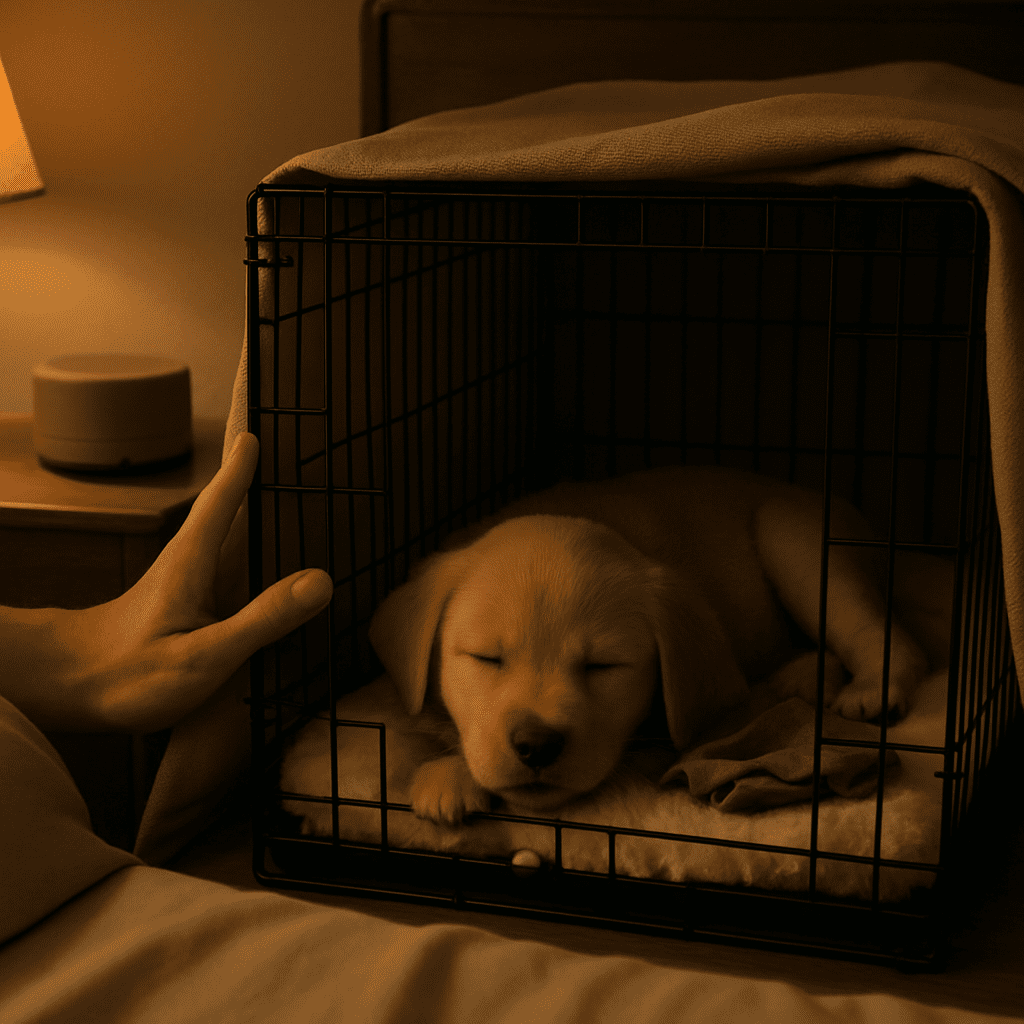
Action: Go to the crate immediately. Keep your voice calm and low. First, check for safety: is a paw stuck in the wire? Did the blanket slip and obstruct breathing? If everything is physically fine, implement the "touch and reassure" protocol: place your hand flat against the crate door so the puppy can sniff and feel your warmth. Say the quiet phrase "you're okay." Do not take the puppy out unless you spot clear potty dance signs (circling, sniffing the floor mid-cry). If no potty, stay until the crying starts to settle—hand still against the crate—then slowly remove your hand over 30 seconds. This teaches the puppy that being right there doesn't always mean out.
Normal vs. Concerning Crying:- Normal: Intermittent whimpering that fades after 5–10 minutes, a few protest barks that stop when you shush, crying around a typical potty time (like 2 a.m.) that ends after a boring potty trip.
- Concerning: High-pitched screaming that doesn't decrease in intensity after 15 minutes of the correct comfort protocol; crying with drooling, panting, or frantic pawing without settling pauses; non-stop crying for over 30 minutes with no potty need; or crying paired with daytime vomiting, diarrhea, or refusal to eat.
Night 1: Bedside Setup – The Safety Layer
Your 8-week-old puppy just left their mom and littermates. Throwing them into a crate across the room and expecting silence is a recipe for terror. Night 1 is about proximity, not independence. You are the security substitute.Crate location: Position the crate directly beside your side of the bed. If possible, elevate it on a sturdy stool or a low table so it's at hand level; if not, the floor works fine. The puppy must be able to see, hear, and smell you. A fabric-sided crate or a wire crate with a cover that leaves the front open works.The "hand through the door" method: If your puppy cries—Type 2 or 3—lower your hand near the crate door wire. Let them sniff your fingers. Don't open the door. Don't coo and sing; you're not entertaining, you're reassuring. Use a soft cue like "you're okay" just once. As soon as the crying quiets (even for a moment), slowly withdraw your hand over about 30 seconds. If the crying resumes the instant your hand disappears, bring it back and wait a little longer. You are teaching that you'll respond to genuine distress, not that crying brings playtime.Night 1 potty protocol: Most 8-week-olds need at least one potty break overnight, usually 2–3 hours after lights out. If the puppy wakes and a hand drop doesn't settle them within a couple of minutes—and you see circling, sniffing, or squatting motions—do a dead-boring potty trip. Leash on, carry them if needed, go straight to the potty spot, no eye contact, no treats beyond a quiet "good," and right back into the crate. No lights except a dim flashlight. The entire trip: under 3 minutes. This separates bathroom from social hour.Morning: The moment the puppy is up, go straight to an outdoor potty break. Then you can do a small, calm celebration—but no frantic release that teaches the crate is a punishment box.Troubleshooting: If lowering your hand actually makes the barking worse, withdraw the hand and simply sit silently beside the crate for a few minutes. Your presence without touch is often enough to stop the spiral. Do not bring the puppy into your bed "just this once"—that sets up a much harder reset later.Need a full plan for daytime feeding, potty breaks, and those first 72 hours? Use our New Puppy First 72 Hours Plan to nail the overall rhythm while you tackle nighttime crating.
Night 2: 6 Feet Apart – The Trust Test
Night 1 built trust. Now you'll begin to build independence—slowly. Moving the crate just 6 feet away keeps security but shifts toward a more normal sleeping arrangement.Crate position: Move the crate to the foot of your bed, or against the wall about 6 feet from your pillow. The puppy should still be able to see you, but they're no longer reachable by an outstretched hand. The line of sight may be partially blocked by a dresser—that's fine. The sound of your breathing and the white noise remain cues.Response adjustments: Your hand can't reach the door easily anymore. Instead:- For Type 2 protest barks, use a soft, low "settle" from your bed. One or two words, no rising inflection.
- For Type 3 panic, walk to the crate, place your hand on top of the cover (not the door) for a few seconds, and give the quiet phrase. Then retreat to bed. Do not stay longer than 30 seconds. This tells the puppy you saw them, you're still here, but bedtime is for sleeping.
Night 3: Across the Room – The Independence Push
If Night 2 went reasonably well—settling time under 15 minutes, no panic cries, only one predictable potty break—you're ready to graduate. The crate moves to its longer-term spot: across the bedroom, or just outside the door with a baby monitor on.Crate location: Across the room, against the opposite wall. Keep it within hearing range; don't exile it to the basement. The puppy should still be able to hear your movements and the white noise. If you choose to place the crate in an adjacent room, use a monitor so you can still distinguish protest from panic.Response protocol: Now you fully trust the decision tree.- Type 1 whimpers: no action.
- Type 2 barks: a soft "goodnight, settle" from across the room. No getting up.
- Type 3 panic: go to the crate, hand on the door, brief reassurance, potty check if needed, then back to bed.
When Night 3 Doesn't Go to Plan: The Extension Protocol & When to Call the Vet
Not every puppy fits a tidy 3-night timeline, and that's completely normal. The real mistake is assuming persistent crying is just stubbornness—or banging your head against the plan without checking for a hidden health issue. Here's your Plan B.Night 4+ extension protocol:- Return the crate to Night 2 distance (or even 4 feet).
- Add a distraction: a frozen Kong with a smear of peanut butter (no xylitol) or a long-lasting chew that's safe for unsupervised use (read the label). The licking motion is naturally soothing.
- Extend the pre-bed settling routine by 10 minutes. Extra calm time can make a big difference.
- Consider an Adaptil or similar calming pheromone diffuser near the crate (not inside it). The synthetic dog-appeasing pheromone mimics the scent of a nursing mother and can take the edge off anxiety.
- Log everything. If after 5–7 nights of consistent protocol there's zero progress—the puppy panics every time you're out of sight, even with these adjustments—stop and seek professional support.
Vet visit criteria – red flags to watch for tonight:
- The puppy vomits more than once, has diarrhea (especially with blood), or refuses even a high-value treat.
- Temperature over 102.5°F (use a rectal thermometer if you know how; otherwise, a vet can check).
- Lethargy during the day—the puppy won't play, walk, or lift their head.
- No bowel movement or urination for more than 12 hours.
- Crying that never decreases in intensity after 40 minutes of the correct comfort protocol.
If you're sitting in the dark unsure whether the crying is a training bump or a medical red flag, use the Puppy Panic Button—a quick symptom triage tool that helps you decide when to call the vet right now.
The 8-Minute Pre-Crate Checklist & Your Crate Sleep Log
Instead of a PDF that you have to download, this section gives you everything you can copy into a notebook or a notes app tonight. No email required, no fumbling for a file—just a system you can use immediately.The 8-Minute Pre-Crate Routine ChecklistRun through these eight steps every single night. They take roughly 8 minutes once you've prepared:
Make Your Own Crate Sleep LogGrab a piece of paper or open a notes app. Create columns:- Final potty break 15–20 minutes before bedtime (leash on, no play, business only).
- Remove water bowl 15 minutes before crate time.
- Place a worn t-shirt (your scent) or a Snuggle Puppy with activated heartbeat inside the crate.
- Turn on a white-noise machine or fan to a steady, low volume.
- Dim all lights; keep the last 10 minutes calm—no fetch, no rough voices.
- Position the crate at the correct distance for tonight (bedside, 6 feet, or across the room).
- Cover the crate with a light blanket, leaving one side open for airflow and a view of you if beside the bed.
- Place a log sheet and a pen next to your spot, ready to note the first sound.
| Time | Cry Type (1,2,3) | What You Did | Result (Settled in __ min, Potty, etc.) |
|---|---|---|---|
| 10:15 PM | Type 2 | Shushed from bed | Quiet after 3 min |
| 2:30 AM | Type 3 (circling) | Boring potty trip | Settled after potty, no crying |
| 3:45 AM | Type 1 | No action | Self-soothe, asleep in 2 min |
Quick Answers to the Most Haunting Middle-of-the-Night Questions
Q: How long should I let my puppy cry before responding?There is no single clock time. Use the 3-sound decision system:
- Whimper/grumbles → wait ~5 minutes; they often self-soothe.
- Protest barks → wait 2–3 minutes, then offer a low verbal shush.
- High-pitched panic → respond immediately.
Q: Should I sleep next to the crate the first night?Yes—place the crate directly beside your bed, at hand level if possible. You are the security substitute, not a crutch. Proximity on Night 1 makes Night 2 and 3 possible. You don't need to sleep on the floor; just be close enough to lower a hand to the crate door.
Q: What if the puppy still won't settle after 3 nights?First, don't panic. Use the extension protocol: roll back to Night 2 distance, add a frozen Kong, extend the calming routine. If after 5–7 nights there's still zero progress—or the crying sounds pained no matter what—call your vet to rule out an infection, then consult a certified force-free trainer for separation anxiety guidance. The plan is flexible, not a final deadline.
The 3-night reset isn't magic, and it won't turn every 8-week-old into a silent sleeper overnight. But it replaces chaos with a clear script, guilt with a decision tree, and those 2 a.m. Google spirals with a log that shows you exactly how far you've come. Tonight, start with the 20-minute routine, listen to the sounds, and trust the progression. And if you ever hit a wall of worry about your puppy's health, don't guess—use the Puppy Panic Button to get a rapid, vet-grounded assessment.Always consult your veterinarian for concerns specific to your puppy's health. No online guide can replace an in-person veterinary examination.