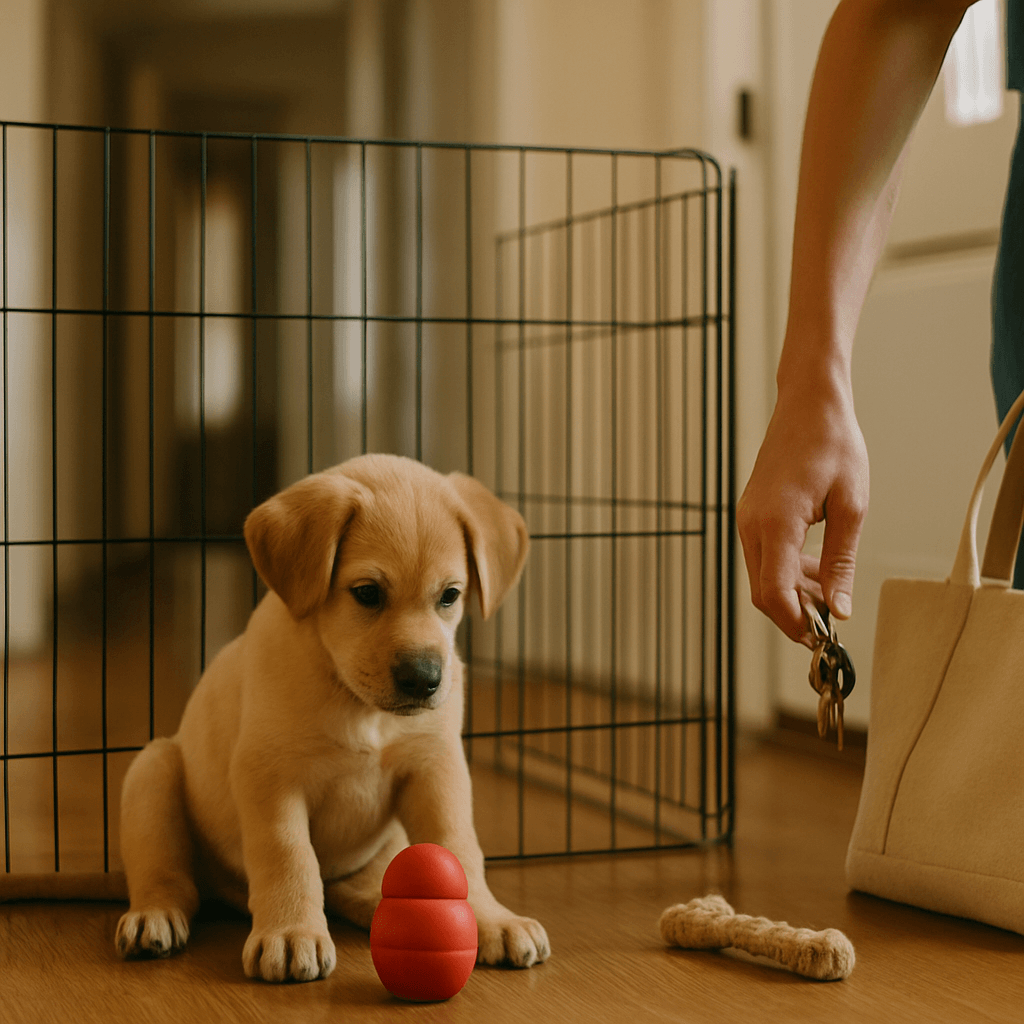
If your stomach tightens every time you grab your keys and your puppy’s little whimpers echo in your head, that is completely normal. Leaving a puppy home alone for the first time can feel weirdly big, even if you only need to go to the mailbox or run one errand. You are not being dramatic. You are trying to do two important things at once: keep your puppy safe and teach them that alone time is normal.
The good news is that this is a trainable skill. You do not need to guess, and you do not need to rush. This guide gives you a calm, practical plan for the first 30 days so you can build independence step by step instead of accidentally creating panic.
Safety note: If your puppy shows intense panic when left alone — screaming, nonstop howling, drooling, trembling, repeated escape attempts, self-harm, or a sudden refusal to eat or drink after a scary session — stop the alone-training plan and contact your veterinarian or a certified separation anxiety trainer. If you are unsure whether what you’re seeing is normal or urgent, use the Puppy Panic Button to help you decide what to do next.
What to Do Before You Ever Leave Your Puppy Alone
Most first attempts fail for the same reason: the puppy was not set up to succeed. They needed the potty, had too much energy, were in a space that felt too big or too empty, or were left with nothing interesting to do. Before you leave, follow this exact order every time.
The golden rule: potty, empty, tired, then alone
Do not reverse this order. Do not skip straight to the crate because you are late. Do not leave after a chaotic game of zoomies. The sequence matters because a puppy that is physically uncomfortable or mentally wound up has a much harder time settling.
- Potty first. Take your puppy outside and wait for a real potty break, not a rushed attempt. Let them sniff. Give them a moment.
- Exercise second. Keep it short and controlled: a sniffy walk, a little fetch, a short tug game, or basic training reps. The goal is calm tiredness, not exhaustion.
- Calm-down minute third. Give a chew or stuffed toy and let your puppy settle while you are nearby. This teaches that the safe space predicts good things.
- Place your puppy in the safe zone. Put them in the crate, pen, or puppy-proofed room with their enrichment item already inside.
- Leave quietly. No emotional speech. No long goodbye. No repeat checking. Just go.
A simple self-talk script helps if you feel guilty: “I have done the prep. My puppy is safe. I am building independence, not abandoning him.”
Crate, playpen, or puppy-proofed room?
The right setup depends on age, house-training progress, and how your puppy behaves when contained.
- Crate: Best for short training sessions and puppies who need help learning bladder control. Use a divider if the crate is too big. Too much space can invite accidents.
- Playpen: Best when you need a bit more room and want to add a safe potty option, water, and a chew. This can work well for slightly older puppies or for longer practice sessions.
- Puppy-proofed room: Usually the least helpful for a very young puppy unless the room is truly safe and you know your puppy can relax there. Big spaces can feel confusing, and some puppies pace or panic in them.
If you need help creating a calmer den-like setup, the New Puppy First 72 Hours Plan is a useful next step.
Safety check before you leave
Do a quick scan before every session:
- Remove collars or anything that could snag.
- Hide electrical cords.
- Pick up small objects that could be swallowed.
- Leave only safe, sturdy chew items.
- Avoid rope toys, thin plastic toys, and plush toys with parts that can be torn off.
- Make sure water is available if your puppy will be alone long enough to need it.
A safe setup can look like this: a crate or pen with a chew-proof bed, a frozen Kong, and a water bowl clipped to the side of the pen. Simple is better.
The first 5-minute test
Before you ever leave the house, test the space while you are still home.
- Put your puppy in the safe space with a stuffed Kong.
- Sit nearby for 5 minutes.
- Step out of sight for 10 seconds.
- Return calmly.
- Repeat once or twice.
If your puppy sniffs, chews, or settles, you are ready to begin. If they spiral into frantic barking or thrashing, stop. Do not push through. Spend the next day or two building positive associations while you are still visible: toss treats into the space, feed a meal there, or let your puppy chew there while you sit nearby.
The goal is not to prove your puppy can handle being alone right away. The goal is to make alone time feel boring and safe.
How Long Can a Puppy Be Left Alone? A Week-by-Week Guide
People often say puppies can hold it for age in months plus one hour. That is a rough bladder rule, but it is not the same thing as being emotionally ready to be alone. A puppy may physically be able to hold urine longer than they can calmly tolerate separation.
Use this table as a training guide, not a rigid law.
| Age | Max Alone Training Time | Potty Break Frequency | Notes |
|---|---|---|---|
| 8–9 weeks | 30–45 minutes | Every 1–1.5 hours | Start very small. Even 5–10 minutes is a valid win. |
| 10–11 weeks | Up to 1 hour | Every 1.5–2 hours | Keep practice sessions short and predictable. |
| 12–13 weeks | 1.5–2 hours | Every 2–2.5 hours | Some puppies are ready sooner, some are not. |
| 14–16 weeks | 2–3 hours | Every 2.5–3 hours | Good time to build more real-world flexibility. |
| 4–6 months | 3–4 hours | Every 3–4 hours | Longer daytime alone time becomes more realistic if training has gone well. |
These are training ceilings, not targets you must hit on day one. If your 12-week-old puppy cannot yet stay calm for 15 minutes, that does not mean anything is wrong. It means you need to stay at the shorter level longer.
A realistic workday example
If you work full-time, do not assume a young puppy can do a full day. They cannot. The answer is structure, help, and a break.
A workable example:
- 7:00 a.m. — potty and short exercise
- 8:00 a.m. — quiet alone session with a stuffed Kong
- 12:00 p.m. — midday break from a neighbor, dog walker, or family member
- 1:00 p.m. — another short alone session with a puzzle feeder
- 4:00 p.m. — you return
That is very different from leaving a puppy for an eight-hour stretch. A bedtime sleep stretch is not the same as daytime alone training. Night sleep and daytime separation are separate skills.
If you need help shaping your day around naps, meals, and potty breaks, the Puppy Routine Builder can help you map a realistic schedule.
Your 30-Day Alone Training Plan: Gradual Separation Without the Panic
This is the heart of the article. The plan is built in phases so you know what to do, when to increase time, and when to slow down.
What you need
- A crate, playpen, or safe room
- A frozen Kong or similar stuffed rubber toy
- A safe chew or puzzle feeder
- A simple notes app or notebook
- A camera if you have one, which is helpful but not required
Phase 1: Build a positive den, Days 1–3
You are not really leaving yet. You are teaching your puppy that the space is safe.
Day 1
- Potty first.
- Give a stuffed Kong.
- Sit beside the space for 5 minutes.
- Step out of sight for 10 seconds.
- Return quietly.
- Repeat once.
- End on a successful moment, even if that success is very small.
Day 2
- Repeat the same setup.
- Increase out-of-sight time to 20 seconds, then 30 seconds.
Day 3
- Try 1 to 2 minutes out of sight.
- If whining rises instead of fading, go back to the previous successful duration.
Do not proceed if: the puppy escalates, scrambles, or cannot redirect to the chew.
Phase 2: Short departures, Days 4–7
Now you leave the room or the house, but only for short stretches.
- Day 4: 10 minutes
- Day 5: 15 minutes
- Day 6: 20 minutes
- Day 7: 30 minutes
Vary the timing slightly so your puppy does not start clock-watching. Sometimes leave for 15 minutes, sometimes 20. Keep the routine calm and boring.
Pass sign: whining is brief, then your puppy engages with the chew or settles.
Do-not-proceed signal: crying beyond 10 minutes, panic pacing, or any accident that suggests your puppy was left too long for their current stage.
Phase 3: Extend the calm, Days 8–14
This is where you move toward 30–60 minutes.
- Use the same safe space.
- Use the same basic departure routine.
- Introduce quiet cues like picking up your keys or putting on your coat and then sitting back down again.
- Alternate short sessions: 30 minutes, then 45 minutes, then 30 again.
That variation matters because it prevents your puppy from expecting the exact same return time every day.
Phase 4: Build the midday gap, Days 15–21
Now you start simulating a real-life schedule.
- Aim for 1 hour in one session.
- Then build to 1.5 hours.
- Then 2 hours if your puppy is staying calm.
Keep the potty schedule in mind. This phase should still include breaks. The point is not to see how long your puppy can tolerate discomfort. The point is to help them practice calm alone time in manageable pieces.
Phase 5: Real-world flexibility, Days 22–30
During this phase, work toward 2–4 hours only if your puppy has been successful in the earlier stages.
- Vary departure times.
- Vary the enrichment item.
- Vary the length within a small range.
- Use camera check-ins if you have them.
If your puppy regresses, go back to the last successful duration for two more days before trying to move up again.
The simple progress tracker
Use this every day:
| Day | Planned Duration | Enrichment Item | Outcome | Notes |
|---|---|---|---|---|
| 1 | 5 min in sight + 10 sec out | Frozen Kong | calm / whine / panic | |
| 2 | 2 min out of sight | Frozen Kong | calm / whine / panic | |
| 3 | 1–2 min out of sight | Frozen Kong | calm / whine / panic | |
| 4 | 10 min | Frozen Kong | calm / whine / panic | |
| 5 | 15 min | Puzzle feeder | calm / whine / panic |
You do not need perfection. You need data.
Is This Normal? Separation Anxiety vs. Adjustment in a New Puppy
A little protest is normal. Panic is not. The difference matters.
| Observation | Normal Adjustment | Anxiety Alert |
|---|---|---|
| Vocalizing | Soft whining or barking for less than 5–10 minutes that fades | Intense howling, screaming, or barking that lasts beyond 15–20 minutes and does not settle |
| Body language | Sniffing, chewing, lying down, relaxed posture | Trembling, drooling, pacing, frantic movement, wide eyes |
| Chewing | Engages with a Kong or chew, then rests | Destroys barriers, chews bars, digs at exits, or tries to escape dangerously |
| Elimination | May have an accident if left too long physically | Pees or poops immediately after departure despite having just pottied, often with visible panic |
| Recovery | Settles again once alone feels familiar | Never truly settles during the session |
If your puppy complains briefly and then settles, that is normal learning. Keep going.
If your puppy escalates into panic, do not use a “cry it out” approach. That is not the same thing as training. Pause the plan and get professional support.
A helpful camera example:
- Normal: 10:00 leave, soft whine until 10:04, then chewing the Kong, asleep by 10:15.
- Concerning: 10:00 leave, immediate loud barking, pawing the crate, salivating, still frantic at 10:45.
If you are unsure, pause the alone training and ask a vet or behavior professional for guidance.
5 Common Mistakes That Make Alone Time Harder, and What to Do Instead
Almost every first-time owner makes at least one of these mistakes. That is not failure. It is normal. The fix is what matters.
| Mistake | Why It Backfires | The Fix | Example |
|---|---|---|---|
| Skipping the pre-flight routine | A puppy with a full bladder or leftover energy is more likely to panic or have an accident | Potty, then exercise, then calm-down chew, then leave | I used to just grab my keys and go. Now I follow the full sequence first. |
| Emotional goodbyes | Big goodbyes make departure feel important and scary | Keep it quiet and brief | I stopped saying three different goodbye phrases and now just leave calmly. |
| Only using the crate when leaving | The crate starts to predict abandonment | Feed meals there and do short in-home practice sessions | I hide a few kibble in the pen while I make coffee. |
| Changing too many things at once | Your puppy cannot tell what actually helped or hurt | Change one variable at a time | If I increase duration, I keep the same toy and same location. |
| Punishing or over-celebrating the return | Punishment damages trust; huge greetings make alone time ending the most exciting part of the day | Return calmly and reward calmness later | I come in, go straight to potty, and keep my voice neutral. |
If you have already made these mistakes, do not spiral. Reset for three days. Go back to the shortest successful version and rebuild calmly.
Troubleshooting: Crying, Accidents, and Destructive Chewing When You’re Gone
A bad session is data, not a disaster.
If your puppy cries
- If it is less than 10 minutes and fades: keep going. Note it and move on.
- If it escalates beyond 15 minutes: your puppy is telling you the session was too hard. Shorten the next one and improve the setup.
- If crying starts at the same minute every time: change the routine slightly so your puppy cannot predict your exact return.
A good next step is usually one of these: shorter duration, better chew, calmer pre-departure routine, or more practice while you are still home.
If your puppy has an accident
First, do not assume bad behavior. Accidents usually mean the timing was too long, the potty routine was off, or there may be a medical issue.
Try this order:
- Check whether the puppy was recently pottied.
- Shorten the next session.
- Reduce the space if the area is too large.
- Clean with an enzymatic cleaner so the smell does not invite another accident.
- If accidents keep happening after a previously good pattern, call your vet.
If your puppy chews or destroys things
Check the toy first. Some toys are not safe to leave with an unsupervised puppy. Use sturdier options like a frozen Kong or a robust puzzle toy, and make sure the size is appropriate.
If your puppy is chewing the crate bars or tray, the space may be wrong for that puppy right now. A playpen or safer room setup may work better.
If you have to go to work tomorrow
Do not panic and do not lock your puppy away for an entire day as a fallback. Instead:
- Ask a neighbor, friend, or dog walker for a midday break.
- Use a safe pen with water and a chew.
- Keep expectations low and protect the potty schedule.
If the situation feels urgent and you are not sure what to do, use the Puppy Panic Button to help you sort the next step.
Puppy Alone Training Checklist: Your Week-by-Week Companion
Print this, save it, or copy it into your phone. This is your daily guide.
Your Daily Puppy Alone Training Checklist
- Pre-flight check: Puppy has pottied, been exercised, and is calm, not hyped up.
- Safe space prepared: crate, pen, or room checked for hazards, with only safe chew items inside.
- Calm pre-departure routine completed: no emotional goodbyes, no dramatic exits.
- Enrichment item loaded: frozen Kong, puzzle toy, or appropriate chew placed inside.
- Departure is quiet and brief; I leave without looking back.
- I set a timer for the planned duration and do not return early out of guilt.
- On return, I stay calm; I do not punish messes or overexcite the greeting.
- I review camera footage or mental notes: did whining stop, and when?
- I document the outcome: success, minor whining, or regression.
- If there was regression, I do not increase time tomorrow; I repeat today’s successful duration.
Weekly reflection prompt
Write one sentence each day:
- Today my puppy was calm for: ___ minutes
- Today’s enrichment item was: ___
- Tomorrow I will try: ___ minutes
That tiny record keeps you from guessing.
Create an Easier Starting Point
How long can my puppy be left alone at 8 weeks, 12 weeks, and 16 weeks?
Use training ceilings, not just bladder rules. At 8–9 weeks, start with 30–45 minutes maximum. At 12–13 weeks, aim for 1.5–2 hours if training has gone well. At 14–16 weeks, 2–3 hours may be realistic. Always pair the timing with a potty schedule and a calm setup.
What is the difference between normal adjustment whining and real separation anxiety?
Normal adjustment usually means brief whining or barking that fades within 5–10 minutes, then the puppy settles. Anxiety looks like loud, escalating panic, drooling, trembling, pacing, escape attempts, or distress that never settles. If you see anxiety signs, stop the plan and get help.
Should I use a crate or a playpen when I leave my puppy alone?
Use a crate for short, supervised training sessions and when you are building bladder control. Use a playpen if your puppy needs more room or a safer setup for a slightly longer absence. The best choice depends on age, chewing habits, and potty progress.
What do I do if my puppy cries the moment I leave?
Do not rush back in. Wait for a brief pause, then return calmly. For the next session, shorten the duration, improve the pre-flight routine, and make the safe space more rewarding with a higher-value chew.
What enrichment and toys are safest for a puppy who is home alone?
Safe choices include frozen Kongs, sturdy rubber puzzle toys, and robust chews sized for your puppy. Avoid rope toys, thin plastic, and anything that can be shredded or swallowed. Always test new toys while you are home first.
Can I leave my puppy alone while I work full-time?
Yes, but not all at once. Young puppies need a plan, gradual training, and often a midday break from a person or pet sitter. No young puppy should be left for a full workday without relief.
When to Ask for Help
If your puppy seems overwhelmed, or if you are overwhelmed, that does not mean you failed. It means the plan needs a better match for your puppy’s comfort level.
Use the Puppy Panic Button if you need a fast way to decide whether what you are seeing is an emergency or a training issue. For severe ongoing distress, talk to your veterinarian or a certified separation anxiety trainer.
If you want the portable version of this plan, the next step is to get the Free 30-Day Puppy Alone Training Plan & Checklist so you can follow the same structure day by day without trying to remember everything yourself.