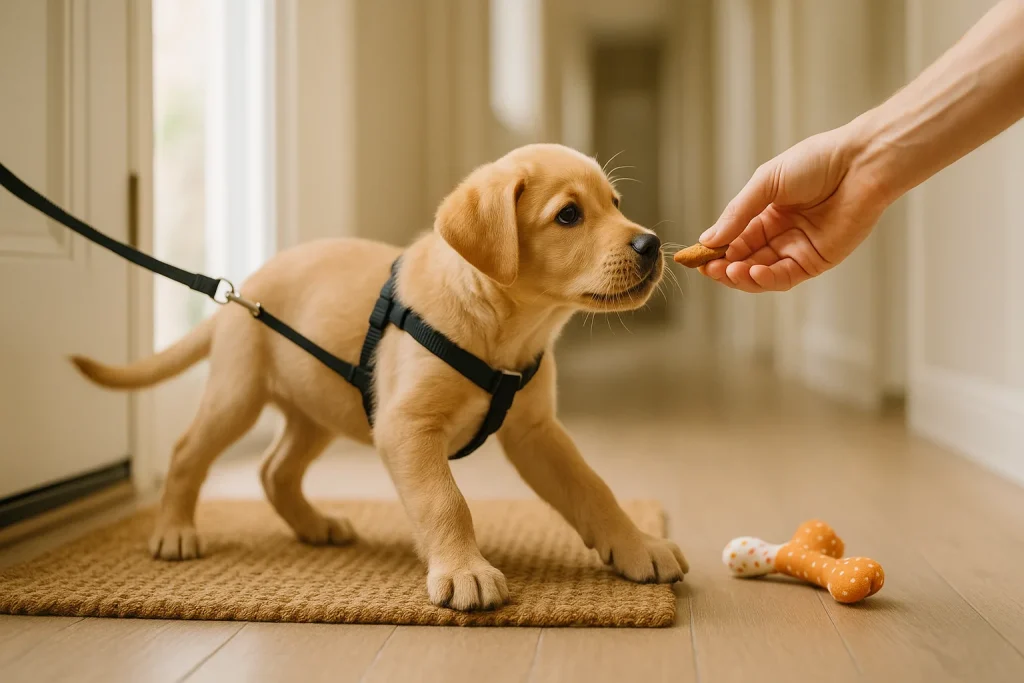
You call your puppy at the park. He glances up, tail wagging, then rockets toward a duck while you stand there holding a treat bag like a fool. You already know the script in your head: be consistent, use positive reinforcement, practice every day. The problem is that real life is not a quiet training room. Real life has visitors at the door, kids running past, smells everywhere, inconsistent moods, missed naps, and days when your puppy acts like he has never heard his own name.
That gap between ideal advice and actual daily chaos is exactly where a lot of first-time puppy owners get discouraged. So let’s make this practical. This article is about puppy training with real dogs — not polished demo dogs, not perfect backyards, and not the fantasy version where every cue works on the first try. The goal is simpler: understand what your puppy is telling you in real situations, then choose the smallest next step that makes success more likely.
What Real Progress Usually Looks Like
Real progress with a puppy is usually uneven. It looks more like three good repetitions, one confused pause, and then a small win in a harder setting than it does like a perfect montage. That does not mean your plan is failing. It usually means your puppy is learning in context.
A helpful way to think about progress is this: success is not “my puppy does it perfectly everywhere.” Success is “my puppy can do a little more, in a little more of the real world, with a little less help.”
For example, if “sit” only works in the kitchen but not when your cousin walks in, that is still information. It may mean your puppy understands the cue, but the environment is too exciting. If recall works in the hallway but not at the park, that may mean the skill exists, but the distraction level is too high. That is normal. Puppies do not learn one behavior in a vacuum and magically apply it everywhere.
Safety note: if your puppy suddenly refuses food, seems unusually flat or shaky, or shows a sudden change in behavior that feels more like a health issue than a training issue, pause the lesson and call your veterinarian. Training can wait.
A good training plan gets clearer over time. A plan that is not working usually shows one of these patterns:
- The puppy cannot do the behavior even in the easiest version of the setup.
- The puppy seems more overwhelmed every time you practice.
- You keep repeating the same step with no visible improvement.
- The puppy only succeeds when the environment is almost empty of distractions.
If you see those signs, do not blame the puppy for being stubborn. Usually the task is just too hard, too fast, or too long.
Common Real-Life Situations and What Each One Changes
Below are everyday puppy scenarios that look simple from the outside but change completely once you add real-world triggers, arousal, and history.
1) Jumping on visitors
Your puppy hears the doorbell, launches into the air, and arrives at the guest with both paws and full enthusiasm. The mistake many owners make here is trying to fix the final moment — the jump — when the real issue is the build-up.
What changes the plan: the doorbell, a new person, and the excitement of greeting are all part of the trigger. That means the first goal is not “perfect manners at the door.” The first goal is to prevent the puppy from rehearsing the jump while teaching a different habit in a much easier setting.
Try this:
- Practice a calm alternative such as going to a mat or offering a hand target.
- Work on it when nobody is at the door.
- Add tiny bits of difficulty later, such as a knock on the wall or a family member entering quietly.
- Keep real guest greetings short and controlled until the puppy can handle them better.
A visitor at the door is a high-arousal moment. If your puppy cannot succeed there yet, that does not mean the cue is broken. It means you need a smaller step first.
2) Pulling on leash
Some puppies step outside and instantly turn into tiny sled dogs. That does not always mean they are being disobedient. Often the outdoors is simply more interesting than the human at the other end of the leash.
What changes the plan: the environment is loaded with smells, movement, and opportunities. In addition, pulling often works. If the puppy gets to move forward by leaning hard, the behavior is accidentally rewarded.
Try this:
- Start indoors where the puppy can notice you.
- Reward any moment of slack in the leash.
- Move to a quiet hallway, then a driveway, then a low-distraction sidewalk.
- Turn around or pause when the leash tightens so pulling does not become the ticket to progress.
If your puppy is extremely strong for his age, management matters too. A front-clip harness can make walks safer and easier while you teach the skill. The point is not to “win the tug.” The point is to make staying with you the path of least resistance.
3) Ignoring recall at the park
At home, your puppy comes beautifully. At the park, he suddenly develops selective hearing. That is incredibly common.
What changes the plan: distance, freedom, and competing rewards. A puddle, another dog, a leaf blowing by, and a squirrel all have a lot of value to a puppy. Your cheerful “come” has to compete with that.
Try this:
- Practice recall in a quiet, fenced, low-distraction area first.
- Use a long line so the puppy cannot repeatedly ignore you and self-reward by running off.
- Call only when you have a realistic chance of success.
- Pay quickly and generously when the puppy turns toward you.
If recall works in the kitchen but not across the park, that is not proof that your puppy “won’t listen.” It usually means the environment is too hard for the current level of training.
4) The puppy stares when you ask for “wait”
Many owners think their puppy is being difficult when the puppy just freezes and stares at them during a new cue. Often the puppy is not refusing. He is confused, uncertain, or waiting for the moment that will earn him success.
What changes the plan: duration and clarity. A long “wait” may be too much, especially if the puppy does not yet know exactly what earns reinforcement.
Try this:
- Begin with a tiny pause — even half a second can count.
- Reward the smallest successful stillness.
- Make your body movement slower and simpler.
- If the puppy breaks position, make the next repetition easier instead of repeating the same hard ask.
A good rule: if the puppy cannot win, your first job is to make the game easier, not louder.
Create an Easier Starting Point
This is the core skill behind realistic puppy training. When a behavior breaks down, do not jump straight to the final version. Shrink the task until the puppy can succeed.
You can usually make training easier in one of four ways:
- Reduce distance from the trigger.
- Shorten the duration.
- Lower the distraction level.
- Improve the reward.
Here is the simplest way to think about it: the puppy should be able to succeed before you ask for more.
If you want a calm greeting, the first success might be “all four paws stay on the floor for one second.” If you want a reliable recall, the first success might be “the puppy turns his head toward you when you say his name.” If you want loose leash walking, the first success might be “the leash stays slack for two steps.”
A practical mini-rule:
- Success signal: one thing you can clearly see, such as the puppy looking at you, staying on the mat, or taking one step beside you.
- Simplify signal: the moment the puppy stops being able to succeed, such as jumping, barking, freezing, mouthing, or losing interest in food.
When you see the simplify signal, do not keep pushing. Reduce the difficulty and try again. Repeating failure usually teaches the wrong thing and frustrates both of you.
Use a Scenario-to-Next-Step Map
When you are in the middle of a messy moment, it helps to use one simple decision map. This is not a second training method. It is just a fast way to choose what to do next.
| What you observe | What it may mean | Smallest next step | If that does not help |
|---|---|---|---|
| Puppy ignores treats during training | The setting may be too exciting, stressful, or physically uncomfortable | Move to a quieter place and use a better reward | Pause the session and reassess the setup |
| Puppy jumps or mouths during greetings | Arousal is too high and the greeting is too hard | Prevent the jump from happening and practice calm greeting skills separately | Make greetings shorter and more controlled |
| Puppy pulls hard the second you step outside | The outdoors is too interesting and pulling has been reinforced | Practice indoors, then in quieter spaces, and reward slack leash moments | Use management and reduce the distance or time of the walk |
| Puppy will not come when called at the park | The distraction level is too high for the current recall skill | Use a long line and practice in easier places first | Return to a simpler environment and rebuild the response |
| Puppy freezes or hides | The puppy may be overwhelmed | Increase distance, lower pressure, and give the puppy time to recover | If it keeps happening, get help from a qualified professional |
If you do not know which branch applies, return to observation. Ask: what changed right before the problem? What is the easiest version of this behavior my puppy can actually succeed at today? That question usually leads you to the right next step.
Why a Good Method May Still Fail in One Context
A method can be good and still fail in a specific situation. That is not unusual. The failure may have nothing to do with whether the method is humane or well-designed. It may simply be the wrong version for the moment.
Here are the most common reasons that happens.
Reinforcement is too weak or too late
A puppy working in a quiet room may respond well to kibble. The same puppy outside may ignore that exact reward because the environment is too distracting. Timing matters too. If the reward arrives too late, the puppy may not connect it to the behavior you wanted.
Try using a better reward and delivering it quickly. The more difficult the setting, the more valuable and immediate the reinforcement should be.
The session is too long
Puppies tire quickly. What looks like “bad behavior” may just be a short attention span or a tired brain.
If you have already done a few good repetitions, stop while the puppy is still doing well. Short sessions are often more effective than long ones that drift into frustration.
The puppy is too distracted, too excited, or too worried
A puppy who is over-aroused, uncertain, or fearful cannot learn the same way a relaxed puppy can. That does not mean the puppy is broken. It means the setup needs to change.
Try increasing distance from the trigger, making the environment quieter, or practicing the same skill when the puppy is calmer.
The puppy has an unmet need
A puppy who needs to potty, is hungry, or has not had enough rest is not in a strong learning state. Before you blame the behavior, quickly check the basics: potty break, water, rest, and whether the puppy is simply done for now.
A 10-minute sniff walk, a chew toy, or a nap may solve more than another round of “sit.”
If changing one variable improves the outcome, you have found the bottleneck. If it does not, simplify again or choose a different variable. That is how real training progresses: one useful adjustment at a time.
When Training Help or a Safety Check Changes the Plan
Some situations are bigger than a general training article.
Behavior help makes sense when:
- Your puppy shows persistent fear across multiple settings.
- The puppy growls, snaps, or bites in a way that seems risky.
- You have simplified the task repeatedly and still cannot make progress.
- The behavior is creating real conflict or worry in the household.
In those cases, look for a qualified positive-reinforcement trainer or behavior professional who can watch the full picture in person.
A health check matters when:
- A puppy suddenly changes from confident to fearful.
- Keep this as an observation rather than a diagnosis: record what changed, watch the wider pattern, and contact a veterinarian if the puppy appears unwell or the concern persists.
- Your puppy seems tired, refuses food, vomits, has diarrhea, or acts very unlike himself.
- The problem started suddenly rather than gradually.
If both behavior and health seem possible, start with the veterinarian first. Pain and illness can look like training trouble, and it is better to rule that out before increasing training demands.
Safety note: if your puppy has breathing trouble, collapses, seems injured, or has another sudden scary symptom, treat it as urgent and get veterinary help right away. If you are panicking and not sure what counts as urgent, use the Puppy Panic Button as a next-step check.
FAQs
My puppy is a rescue and has different behavior — do these examples still apply?
Yes. The same scenario logic still helps, but a rescue puppy may need a slower, simpler version of each step. Start with easier setups, expect less certainty at first, and let the puppy show you what he can handle.
What if my puppy is older than 6 months and still struggles with these basics?
The same approach still works. Focus on what your puppy can do in easy settings, then build toward the harder version. Older puppies can still learn well; they may just have more practice with the old habit.
Why does my puppy only listen when I have treats? Is that a problem?
Not at the beginning. Treats are normal training language for puppies. Over time, you can vary rewards and use praise, toys, sniffing, or access to something the puppy wants. If the puppy stops responding the second the treats disappear, the step was probably too hard too soon.
How do I stop my puppy from jumping on visitors without scaring him?
Do not try to scare the puppy out of jumping. That usually makes greetings worse. Instead, prevent the jump, teach a calm alternative, and keep greetings brief and controlled until the puppy can handle them.
My puppy pulls like a sled dog — what real method works for a strong-willed dog?
Start where the puppy can succeed, usually indoors or in a quiet area. Reward slack leash moments, shorten the walk, and make pulling less useful. The goal is to build a habit, not win a strength contest.
I tried “wait” but my puppy just stares at me. Am I doing it wrong?
Probably not. The ask may just be too big. Make the pause tiny, make your body movement simpler, and reward the smallest version of stillness. Many puppies need very small steps before a formal “wait” starts to make sense.
Final thought
The realistic picture of puppy training is rarely a highlight reel. Some days you will have a breakthrough, and the next day you will wonder where that puppy went. That is normal. What matters most is not whether your puppy is perfect, but whether you can keep adjusting the setup so success is possible.
If you remember only one thing from this article, make it this: when your puppy cannot succeed, do not demand more. Make the step smaller, clearer, calmer, and easier to win. That is how puppy training with real dogs becomes workable in real life.