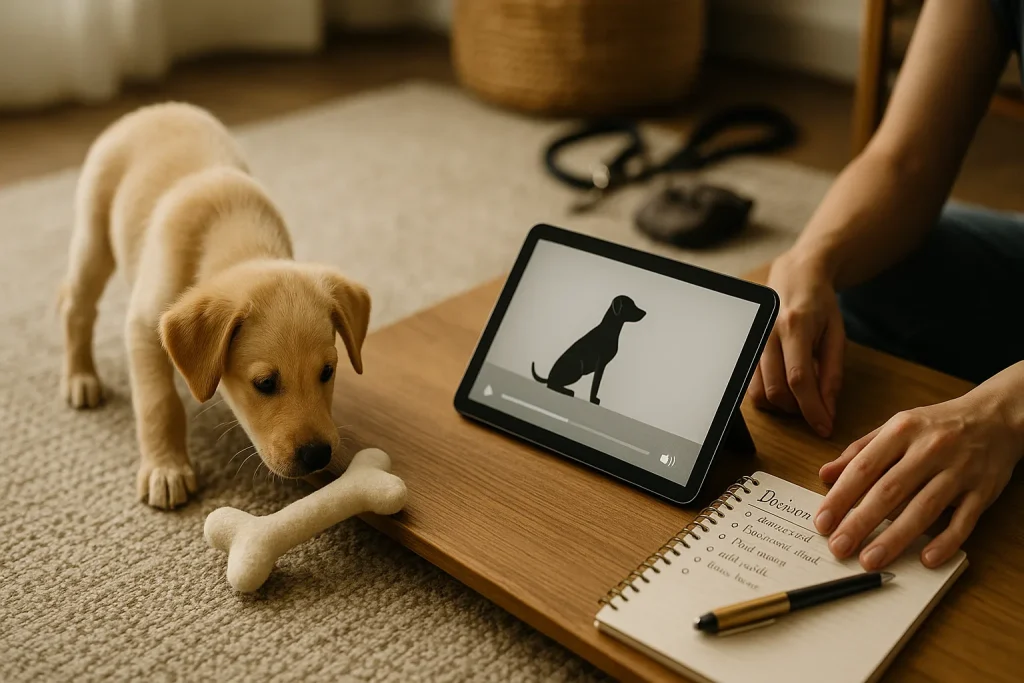
You’ve watched three “perfect puppy” tutorials this week, and every one tells you something different. One swears by a routine that takes 15 minutes, another insists you need hours, and the third warns that if you don’t follow the exact steps, your puppy will grow up untrained.
You try to follow along, but your puppy doesn’t react like the dogs in the videos. She sniffs the floor, wanders off, or just stares at you like you’re speaking a foreign language. You’re left wondering whether you’re doing it all wrong or whether the advice itself is the problem.
The real issue isn’t your lack of skill. It’s that many online tutorials promise a polished final scene without telling you what’s actually required to get there—and without warning you when the method might be unsafe. This article won’t give you another magic recipe. Instead, it will give you a simple filter for deciding whether to trust, adapt, or skip any puppy training tutorial you come across.
What the Advice Is Actually Promising
Before you even try a training exercise, take 30 seconds to write down exactly what the tutorial is claiming. Most methods package their promise as a crisp headline: “Teach a settle in 10 minutes,” “Cure leash pulling in one walk,” or “Perfect crate training in a weekend.” The headline feels confident, and confidence is seductive when you’re tired.
Pull that promise apart, because the outcome the tutorial shows is not the same as the conditions it requires. Ask yourself:
- What behavior is supposed to change? Be specific: does the tutorial promise the puppy will lie quietly on a mat, walk without pulling for the whole block, or stay in the crate without whining for two hours? Vague words like “calm” or “obedient” aren’t testable.
- What timeline is stated or implied? A claim of “in three days” probably assumes several short sessions each day, zero disruptions, and a puppy who already knows a few prerequisite skills.
- What setup, equipment, or prior training does the method assume but not say out loud? Many tutorials silently require a puppy who already works for food in a low-distraction room, an owner who can isolate the dog from distractions for an extended period, or a house with no other pets or children underfoot.
- Who gets the blame if it doesn’t work? Trustworthy guidance puts the responsibility on the method and the teacher. Be skeptical of any tutorial that suggests the puppy is “stubborn,” “dominant,” or “not trying hard enough” if things go sideways.
When the promise is vague—say, “your puppy will be happier”—treat it as a general idea, not a verified plan. A clear promise is one you could explain to a friend and they could watch for. For example, “After five sessions, my puppy will voluntarily walk into the open crate and lie down for 30 seconds” is a testable outcome. “He’ll love his crate” is not.
Does the Method Fit the Puppy and Situation?
Once you see what the tutorial is actually selling, check whether that method fits your puppy in her current environment—not the environment you wish you had.
A confident, four-month-old Labrador who was clicker-trained from eight weeks will respond very differently to a loose-leash walking exercise than an eight-week-old puppy who just left her litter and hasn’t worn a collar yet. Yet many tutorials never mention the age, prior learning, or home setting the method was designed for.
Run a quick comparison:
| What the method assumes | What your situation actually looks like |
|---|---|
| Puppy already knows a “watch me” cue and can focus for 60 seconds | Puppy gets over-excited by the mere rattle of the treat bag |
| Training happens in a quiet room with one handler | You have a toddler, a doorbell, and a partner who doesn’t follow the plan |
| The puppy is food-motivated and not full from a recent meal | The puppy ignores treats because his meal bowl is still half-full |
| The method uses a specific piece of gear (front-clip harness, long line, treat pouch) | You own a simple flat collar and a pocketful of kibble |
| The trainer mentions stress signals and what to do if the puppy yawns, lip-licks, or turns away | The video never shows a struggling puppy; it only shows the polished finish |
If the setup differs on more than one row, the method isn’t ready to copy. That doesn’t make the tutorial bad—it just means you need to adapt it before you start. And if the tutorial never mentions stress signals at all, be very careful. A puppy who is silently anxious isn’t learning; she’s just shutting down, and some tutorials mistake that stillness for obedience.
Red Flags in Misleading Training Tutorials
You don’t need to be a professional to spot advice that is unlikely to help—or that could do harm. Look for these red flags; if you see two or more, stop the video and close the tab.
The method blames the puppy, not the setup. If the instructions include phrases like “don’t let the puppy win,” “show him who’s boss,” or “he’s just being stubborn,” the advice is rooted in dominance thinking, which does not belong in humane puppy training. Effective training adjusts the environment and the criteria to make success possible. It never blames a baby animal for being a baby animal.
No preparation or environment setup is described. A tutorial that jumps straight to the finished behavior—say, loose-leash walking in a busy park—without showing how to build that skill in low-distraction environments is skipping the learning staircase. Puppies need to succeed with an empty hallway before they can handle a sidewalk. If the video doesn’t explain how to set up that first win, you’re being shown a performance, not a teaching plan.
Punishment, flooding, or “just let him figure it out” is suggested. Any technique that involves forcing a puppy to endure something frightening until she stops reacting, using leash jerks, alpha rolls, shock collars, or spray bottles is a red flag. These actions can damage trust and create long-term behavior issues. Look instead for methods that reward the behavior you want and manage the puppy so unwanted behavior is harder to practice.
The tutorial guarantees a result in a fixed number of repetitions. If you hear “in exactly seven reps, your puppy will stop jumping,” walk away. Learning doesn’t happen on a countdown. A good tutorial gives you a rough framework, signs of progress, and what to do when the puppy struggles—not a timer.
There’s no fallback when the puppy can’t succeed. The tutorial should tell you what to try if the puppy shows distress, loses interest, or simply can’t do the described behavior. If the only answer is “keep trying,” the teacher hasn’t equipped you to be a fair trainer.
A useful shortcut: if the advice sounds more like a test of the puppy’s attitude than a plan for changing behavior, it is probably the wrong advice.
Use an Advice-Quality Decision Filter
The difference between turning a tutorial into real progress and driving yourself crazy lies in a simple filter. You can run any piece of advice through this sequence before you even pick up the treat pouch.
Grab a notepad or open a note on your phone and answer these six questions about the tutorial:
- Is the claim clear? Can you describe exactly what the puppy will do and under what conditions? “He’ll be better” fails this test.
- Are the prerequisites listed? Does the trainer explain what the puppy needs to know first, what equipment you need, and how to set up the environment?
- Is the method humane? Does it use reward-based teaching, and does it actively avoid punishment, flooding, or intimidation?
- Are stress signals discussed? Does the trainer teach you how to recognize when the puppy is uncomfortable and what to do next?
- Is there a fallback? If the puppy can’t do the task, does the tutorial give you a simpler step, or at least tell you to take a break and try later?
- What is the evidence? Is the advice coming from a qualified trainer or an organization that uses positive, science-based methods? Or are the credentials vague (“I’ve trained dogs for years”)?
Now match your answers to one of four actions:
- Use as written: If the tutorial gets a clear yes on questions 1–5 and the source is qualified, the method is likely ready to try. Even then, start with a shorter, easier version to see how your puppy responds.
- Adapt and test: If most answers are solid but the setup doesn’t match your home, keep the principle but modify the difficulty.
- Verify before using: If you’re uncertain about the evidence or the fallback is missing, search for the same skill from a few other positive-reinforcement sources. Look for a consistent thread. If you find widely different advice, pause until you can talk to a qualified trainer.
- Reject outright: If the tutorial blames the puppy, suggests punishment or flooding, ignores stress signals, and makes guarantees—don’t test it. Delete the bookmark. The risk of damage is higher than any promised benefit.
This filter doesn’t replace experience; it prevents you from accidentally outsourcing your dog’s welfare to a stranger who won’t be there when your puppy freezes in fear.
How to Adapt Useful Advice to Real Life
Let’s say you’ve found a tutorial that passes the filter: the method is positive, the teacher’s background is solid, and the video includes a “what if my puppy struggles” moment. But your living room looks nothing like the trainer’s studio, and your puppy is in the middle of her evening zoomies. You don’t need to abandon the idea; you need to turn the principle into a smaller, realistic action.
Change one variable at a time. The most common mistake is to lower the criteria for the puppy while keeping the environment the same—or to change everything at once and wonder why she’s confused. Pick one lever:
- Distance: If the tutorial shows loose-leash walking for 50 feet, start with just three steps in your hallway.
- Duration: If the video asks for a two-minute down-stay, practice five seconds at first, then release before she moves. Every success builds the skill.
- Distractions: If the original exercise happens in a quiet yard, try it first with the TV off and nobody else in the room. Add one mild distraction only after your puppy succeeds twice.
- Reinforcement value: Some tutorials rely on high-value treats that the puppy would run through fire for. If your kibble isn’t doing the trick, upgrade temporarily to tiny pieces of plain boiled chicken or cheese. When the behavior is reliable, you can fade the special treats.
Clarify the success signal. Before you start, decide what counts as a pass. For example: “I’ll reward the instant my puppy’s bottom touches the mat, and I’ll release after three seconds.” Write it down so you’re not second-guessing yourself in the moment. If she doesn’t do it within ten seconds, lower the bar: maybe just a paw on the mat gets the reward. That’s not cheating; it’s teaching.
Avoid fixed repetition counts. A tutorial that says “do ten reps” was probably shot with a dog who already had the skill on a good day. Watch your puppy instead. If you get three clean reps and she’s still engaged, do one more and stop. If she misses twice in a row, make it easier or end the session with something she can do. Pushing through failure teaches the wrong thing: that training is frustrating.
The goal is to preserve the useful core—the mechanics, the reward timing, the humane philosophy—while molding it to fit your life. Over time, you’ll get faster at this adaptation. For now, write your modified steps on an index card and follow only those; don’t try to keep the original video playing in your head.
What a Realistic Puppy Training Tutorial Should Look Like
A good tutorial doesn’t just show the finished behavior. It shows the middle. You should see the puppy making mistakes, the trainer adjusting the difficulty, and a simple recovery path when the puppy is confused.
In practice, that means a realistic tutorial usually includes:
- a short explanation of the goal in plain language
- the puppy’s starting point, not just the destination
- the setup needed for a first successful try
- a reward strategy that matches the puppy’s level of interest
- a clear “if this happens, do this next” branch
- a reminder to stop before the puppy becomes overwhelmed
If a tutorial skips all of that and jumps straight to a polished result, it may still be useful as inspiration, but not as a training plan. Think of it like a recipe photo that looks great but leaves out half the ingredients.
A particularly common mismatch is crate training. A polished clip may show a puppy sleeping calmly in a crate, but the actual teaching process is much more gradual. Humane guidance from the American Kennel Club emphasizes gradual setup, positive association, and avoiding the mistake of expecting the puppy to accept confinement without first building comfort with the crate itself. That kind of slow build is what makes the difference between a useful tutorial and a misleading one. AKC crate training guide
When a Professional Check Is the Better Next Step
Even the best online tutorial can’t see what’s happening in your home, and not every training struggle is solvable by a better video. Some situations call for a live professional who can watch you and your puppy interact.
Reach out to a qualified positive-reinforcement trainer when:
- You’ve used the filter and adapted several tutorials, but the behavior isn’t improving—or it’s getting worse—over a couple of weeks.
- Your puppy shows persistent signs of distress during training even when you lower the criteria.
- You feel consistently frustrated, overwhelmed, or worried about your relationship with the puppy; a good trainer can restore clarity.
- The behavior you’re working on involves higher-risk situations, such as resource guarding that has escalated to snaps, or a fear response so intense the puppy cannot eat or play, even at a distance.
A certified trainer can help you build a plan rooted in humane, evidence-based methods. They won’t blame you or the puppy; they’ll adjust the teaching so the puppy can succeed.
When to see a veterinarian first:
If your puppy suddenly refuses a behavior she previously could do, or if any training effort is accompanied by signs of pain—limping, yelping when touched, straining to eliminate, sudden loss of appetite, or unusual lethargy—skip the trainer for now and contact your vet. Pain and medical issues undermine training far more than skill does. You can’t reward your way out of a sore tooth or a painful joint.
This observation cannot identify the cause at home. Record the wider pattern and ask a veterinarian to interpret it if the concern persists or the puppy seems unwell.
Common Problems and Better Adjustments
What if I already followed a bad tutorial?
You can recover. First, stop repeating the risky or unrealistic part of the method. Reset your expectations: if the tutorial promised a result in one session but your puppy learned nothing, that doesn’t mean you failed—it means the plan was flawed. Go back to a simpler version of the skill. For example, if you tried calm greetings and now your puppy jumps even more, take a step back and reward her for keeping four paws on the floor when the doorbell rings while she’s behind a baby gate and the visitor is still outside. Small wins rebuild confidence. If you’re worried the original method caused trust issues, a few sessions with a positive-reinforcement trainer can help you re-establish a safe training relationship.
How do I find good online tutorials?
Start with credentials and clarity. Look for trainers who are certified through organizations such as CCPDT, IAABC, or KPA, or for organizations that emphasize positive, humane methods. Their tutorials often include clear setup, realistic demonstrations, and explicit instructions on what to do when things don’t go perfectly. Avoid channels that rely on quick fixes, drama, or “magic” claims. A trustworthy video will show you how to set up the environment, coach the first few attempts, and scale the exercise up and down. When in doubt, compare two or three positive-reinforcement sources for the same skill; the common thread is usually a safe starting point.
Is it normal if my puppy doesn’t respond like the one in the video?
Yes—completely normal. The dogs in polished tutorials are often already experts at the behavior, filmed after multiple takes, or living in a near-perfect training setup. Your puppy is a beginner in a real-world home. It’s far more useful to compare her to herself yesterday than to a screen. Track tiny improvements: did she look at you one second longer? Did she take a treat more softly? That’s progress.
Why does every online tutorial say something different?
Because tutorials often mix different goals, different puppy ages, and different environments. A method that works well for a quiet, food-motivated puppy in a training room may not work the same way for a distracted puppy in a busy household. Some videos also leave out prerequisites, which makes the advice look simpler than it really is. When two tutorials disagree, compare their setup, stress-signal guidance, and fallback steps before deciding which one fits your puppy.
How much time should training really take each day?
For most young puppies, short sessions are better than one long one. You’ll usually get more from several brief practice moments than from trying to power through until the puppy is tired. The exact amount depends on the skill, your puppy’s age, and how quickly she loses focus, but the key is to stop while she can still succeed. If your puppy starts to wander off, disengage, or get bouncy in a way that makes the task harder, that’s usually your cue to make the session shorter or simpler.
Can I trust popular online trainers?
Popularity alone isn’t a quality signal. A video can be well edited, widely shared, and still be a poor fit for your puppy. Look at the method, not the follower count. Does the trainer explain prerequisites, show real mistakes, and give you a fallback if the puppy struggles? If yes, that’s a better sign than how famous the channel is.